Disclosure: This article contains affiliate links. As an Amazon Associate, AIToys.co.uk earns from qualifying purchases. If you buy through our links, we may earn a small commission at no extra cost to you. It never changes the price you pay, and it never changes our verdict.
LeapFrog Magic Adventures Globe Review UK 2026: The Interactive Globe That Streams the World
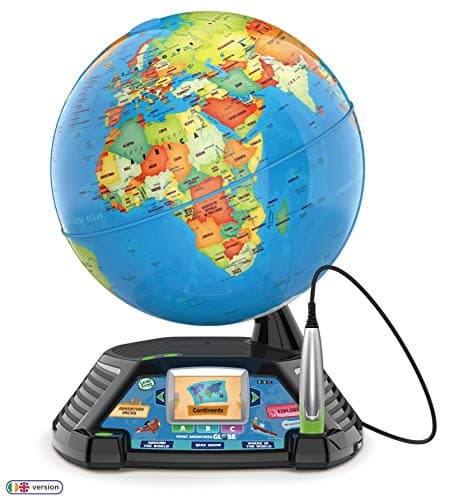
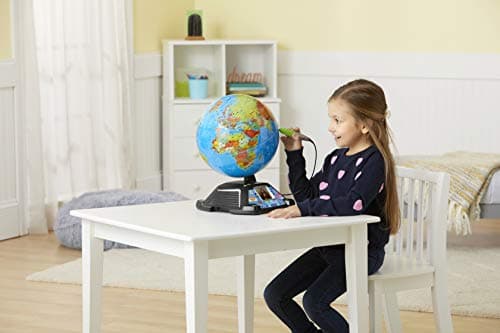
A traditional globe is a lovely thing, but let's be honest about what usually happens to it: a child spins it twice, finds the country shaped like a boot, and never touches it again. The LeapFrog Magic Adventures Globe sets out to fix exactly that problem. It keeps the classic spinning globe your parents had, then drops a small colour screen into the stand and an attached stylus into your child's hand. Tap anywhere on the world and the globe answers back: with facts, animations and, most impressively, more than five hours of short BBC and Discovery video clips. That single idea, turning a passive object into something that responds, runs through this entire review.
This is firmly a smart, interactive learning toy rather than an "artificial intelligence" gadget, and we'll be straight about that throughout: it doesn't talk back conversationally or adapt to your child the way a robot companion might. What it does instead is make the world feel reachable for a five-year-old, and keep being useful right through to homework-stage nine-year-olds. Here is our honest, hands-on take on whether it earns its place on the bookshelf.
👉 Short on time? Check the latest price on AmazonAs an Amazon Associate, AIToys.co.uk earns from qualifying purchases..
Quick Verdict: LeapFrog Magic Adventures Globe
The Magic Adventures Globe earns a confident 4.2 out of 5. It does the hardest thing in educational toys: it makes a child want to learn something they'd otherwise ignore. The BBC video clips are the star. They're short, beautifully shot and genuinely interesting, so children dip in and out for minutes at a time rather than zoning out. The three games give the globe a reason to come back off the shelf, and the build quality is reassuringly solid. The marks come off for the optional adventure packs, which rely on dated PC software that frustrates some parents, and for the AA-battery setup in a world that has mostly moved to rechargeable. For its core job (sparking curiosity about the world for ages 5 to 9) it's one of the best-value smart learning toys you can buy in 2026.
Pros
- Brilliant video content: 5+ hours of short, professional BBC and Discovery clips that children actually choose to watch.
- Tap-anywhere facts: the attached stylus unlocks thousands of spoken facts, so there's always something new.
- Three real games: Around the World, Quiz Show and Where in the World add purpose and replay value.
- Reassuring privacy: no camera, no microphone, no account, no internet connection on the device.
- Grows with the child: suits a curious five-year-old and a project-doing nine-year-old alike.
Cons
- Fiddly add-ons: downloading adventure packs needs PC software that can be temperamental.
- AA batteries: four of them, included, but no rechargeable option supplied.
- Small screen: the 2.7-inch display is for one or two children, not a crowd.
- Limited memory: only one or two expansion packs fit at once.
What You Get in the Box
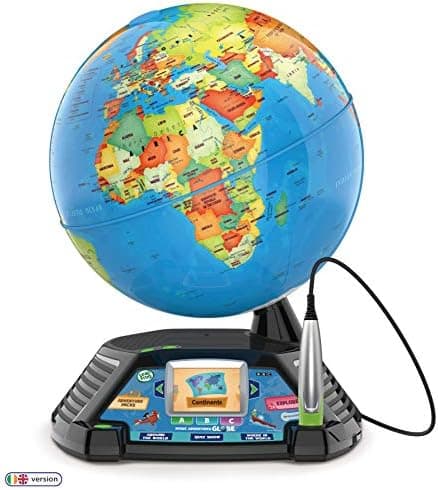
The globe arrives almost ready to play. It stands roughly 35cm (about 14 inches) tall on its base, which is a proper presence on a shelf or desk rather than a token gadget. Set into the front of the stand is a 2.7-inch colour LCD screen, and tethered to the side is a stylus on a short cord: a small but genuinely clever design choice, because the single most-lost accessory on any toy like this is the pen, and here it simply can't wander off.
You'll need four AA batteries to bring it to life. They're included in the box, which is a nice touch for the inevitable "can I play with it now?" moment, though we'll come back to the battery question because it's one of the toy's few real weak spots.
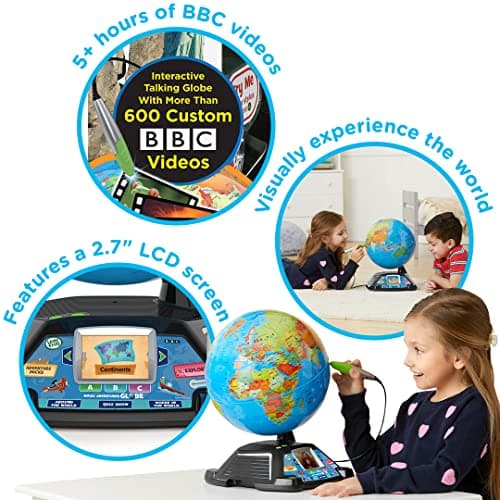
That's the whole proposition out of the box: a sturdy globe, a screen, a pen that can't be lost, and a world's worth of content already loaded. No app is required for the core experience, no pairing, no sign-up. For a generation of parents weary of toys that demand a phone before they'll do anything, that simplicity is part of the appeal.
The Learning Experience: BBC Clips and Thousands of Facts
The heart of the globe is the moment your child taps a country with the stylus. Instead of a single beep or a robotic capital city, the screen springs to life with animations, spoken facts, and short live-action videos produced with the BBC and Discovery. There are more than five hours of these clips in total, and crucially they're short (a minute or two each) so a child absorbs the world in small, vivid bites rather than sitting through a documentary.
This is where the globe genuinely earns its keep. A child taps Kenya and sees elephants on the savannah; taps Japan and watches a bullet train; taps Brazil and meets the rainforest. The content goes well beyond "countries and capitals" into cultures, animals, habitats, landmarks and weather, which is exactly the kind of breadth that turns a geography lesson into an adventure. Parents in our research consistently singled out the videos as the feature that kept their children coming back, and several mentioned children repeating facts at the dinner table days later: the real test of whether anything was learned.
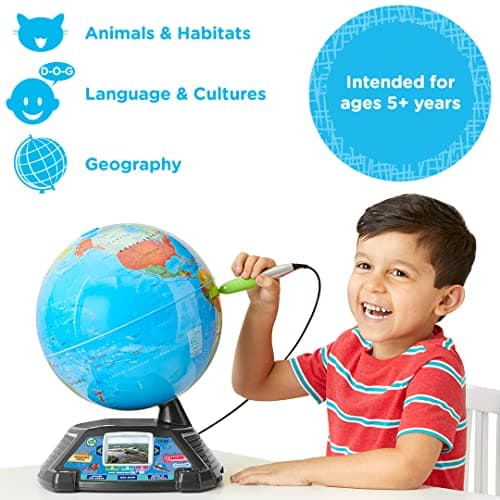
The spoken facts are equally important for younger children who can't yet read fluently. Because everything is read aloud, a five-year-old can explore independently, which keeps the toy in the "child plays on their own" category rather than the "needs a grown-up reading the screen" one. That independence is a big part of why the globe holds attention.
The Three Games
A globe you can only look at gets boring. A globe you can play keeps coming back, and LeapFrog has built in three games that give children a reason to return:
- Around the World is a race where children answer questions and discover new places as they travel, rewarding exploration with progress.
- Quiz Show challenges them to find specific countries and landmarks, and works as a one- or two-player game, so siblings or a parent and child can compete.
- Where in the World casts the child as a detective, solving mysteries by following geographical clues.
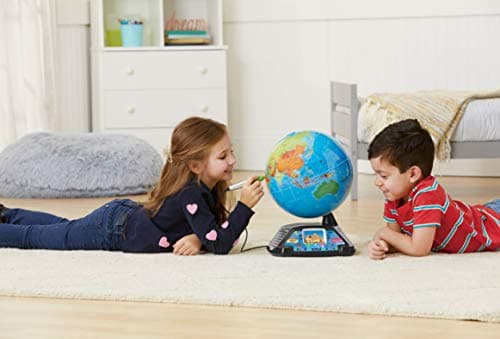
These aren't throwaway mini-games: they reinforce the facts and the video content, turning passive watching into active recall. Quiz Show in particular is the one that gets pulled out on a rainy afternoon, because the two-player mode makes it social. If there's a criticism, it's that the base games can start to feel familiar once a confident older child has played them a few dozen times, which is partly what the adventure packs are meant to address.
Adventure Packs: The Honest Caveat
Here's the part where we have to be candid, because it's the globe's biggest frustration. Beyond the built-in content, LeapFrog sells downloadable adventure (expansion) packs that add new themed content to the globe. The catch is how you install them: you download LeapFrog's companion software onto a Windows or Mac computer, connect the globe, and transfer the pack across. There's no slick phone app for this. It's old-school desktop software, and it shows its age.
A meaningful number of parents report a fiddly experience here. Some struggle to get the software to recognise the globe; a few have reported a globe misbehaving after a pack installation. On top of that, the onboard memory only holds one or two packs at a time, so you can't simply load everything on and forget about it: you have to swap content in and out. Some reviewers also feel the extra games in certain packs are weaker than the base games.
Our honest advice: buy the globe for its excellent built-in content, and treat the adventure packs as an occasional bonus rather than the main event. The core experience needs no computer at all, and it's strong enough to stand on its own. If you do want a pack, set aside a quiet ten minutes at a computer and follow the instructions carefully rather than letting an impatient child watch over your shoulder.
Build, Batteries and Everyday Practicalities
Physically, the globe is reassuringly well made. The sphere is solid, the colours are vibrant, and the base is stable enough to survive the enthusiastic spinning and tapping of a primary-schooler. The attached stylus, as mentioned, is a quiet masterstroke of practical design. This feels like a toy built to live on a shelf for years, not a flimsy gadget destined for landfill by Christmas.
The one genuine practical gripe is power. The globe runs on four AA batteries with no rechargeable pack included, and there's no getting around the fact that an interactive screen-based toy will work through them. If your child uses it regularly, a set of rechargeable AAs and a charger is a sensible companion purchase: better for your wallet and for the planet than a steady stream of disposables. It's a small thing, but in 2026, when so many toys charge over USB-C, the AA tray feels a little dated.
A word on volume, too: like most LeapFrog toys it can be loud out of the box, so check for a volume control and set it sensibly before handing it over: your sanity on a long car-free Sunday will thank you.
Who It's For: Age Suitability
LeapFrog pitches the globe at ages 5, 6 and 7 and up, and that lower bound is about right. A five-year-old can use it independently thanks to the spoken facts and tap-anywhere design. In practice, though, the sweet spot stretches further than the box suggests. Curious children stay engaged comfortably to around nine, and plenty of parents report it earning its place during the school years when geography, world cultures and "where does this country go on the map" homework start to appear. Some even use it alongside home-education or topic work for older children.
If your child is under five, look instead at audio-led toys built for little ones, like the Toniebox 2, which we rate highly for the preschool years. And if you're weighing up a screen-based learning toy against a screen-free one more generally, our guide to the best learning tablets for kids is a useful companion read, as is our roundup of the best AI and smart toys for 6-8 year-olds.
Safety, Screen Time and Privacy
For UK parents weighing up any connected or screen-based toy, three questions matter, and the Magic Adventures Globe answers all three well.
Physical safety. The globe carries the usual UKCA/CE conformity marks, has no loose small parts of concern for the 5+ age group, and the tethered stylus removes a common small-part worry. As always, supervise the very first session and check the battery compartment is screwed shut, as it should be on any toy with button-free AA cells.
Screen time. This is a screen-based toy, so it counts towards your child's daily screen allowance. There's no pretending otherwise. The mitigating factor is the nature of the screen time: content is short-form, educational and self-paced, with no autoplay rabbit-hole, no algorithm nudging "just one more", and no adverts. It's about as benign as screen time gets, but it's still screen time, and it's worth folding into your household's overall balance.
Data privacy. This is genuinely one of the globe's strongest cards. The device has no camera, no microphone, no internet connection and no account. Everything runs locally, and even the adventure packs are transferred from your own computer rather than streamed from the cloud. In an era where connected toys raise real questions about what they record, a toy that simply can't listen to or watch your child is a reassuring choice. If toy privacy is on your mind, our guide on keeping smart toys private and safe covers the wider picture.
What Could Be Better
No toy is perfect, and a fair review names the weaknesses plainly:
- The adventure-pack software is the standout frustration: dated, occasionally temperamental, and a poor fit for a 2026 toy. The core experience doesn't need it, but the upsell deserves a better delivery method.
- AA batteries with no rechargeable option mean ongoing cost and hassle for regular users.
- The small 2.7-inch screen makes this a one- or two-child toy; it's not built for a group huddle.
- Limited onboard memory caps you at one or two expansion packs, so you can't load everything at once.
- Base games can become familiar for confident older children after heavy use.
None of these is a deal-breaker for the globe's main purpose, but together they explain why it lands at a strong 4.2 rather than a flawless five.
How It Compares
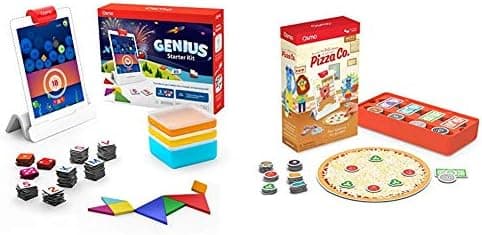
The Magic Adventures Globe occupies an interesting middle ground. It's more active than a passive audio toy and more focused than an open-ended tablet. If your priority is screen-free, audio-led learning, the Yoto Player (3rd generation) is a different but excellent route. No screen at all, child-controlled stories and facts. If you want hands-on, screen-paired STEM and problem-solving rather than geography, the Osmo Coding Starter Kit is well worth a look. And for parents specifically chasing the educational sweet spot for older primary children, our best STEM toys for 8-year-olds roundup lines up the strongest options side by side.
Where the globe wins is specificity: nothing else makes the world itself this tappable, this video-rich and this self-contained. If geography, cultures and animals are what light your child up, it has no real direct rival at this price.
Related reading
Frequently Asked Questions
What age is the LeapFrog Magic Adventures Globe for? It's designed for ages 5, 6 and 7 and up, and realistically stays engaging to around nine. Spoken facts mean even non-readers can explore independently, while the games and video depth keep older primary children interested.
Do you need a phone or app to use it? No. The core experience (videos, facts and the three games) works straight out of the box with no app, account or internet. A computer is only needed if you choose to add optional adventure packs.
Does it need batteries or does it charge? It runs on four AA batteries, which are included. There's no rechargeable pack in the box, so for regular use we'd suggest buying rechargeable AAs and a charger.
Is the screen time educational or just entertainment? It's educational screen time: short BBC and Discovery clips, spoken facts and geography games, with no adverts, no autoplay and no algorithm. It still counts towards a daily screen allowance, but it's among the most wholesome forms of it.
Are the adventure packs worth buying? The built-in content is strong enough on its own. The packs add variety but rely on dated PC software and only one or two fit at a time, so treat them as an occasional extra rather than essential.
Is it safe and private? Yes. It has no camera, no microphone and no internet connection, and carries the standard UKCA/CE marks. Everything runs locally on the device, which makes it a reassuringly private choice.
The Verdict
The LeapFrog Magic Adventures Globe does something deceptively difficult: it makes a child genuinely curious about the world, and then keeps feeding that curiosity with content good enough that they choose it over a cartoon. The BBC video clips are the reason to buy it, the three games are the reason it stays off the shelf and in their hands, and the no-camera, no-microphone, no-account design is the reason parents can relax while it does its work. It's not an AI toy and doesn't pretend to be. It's a smart, well-made, self-contained learning toy that earns its keep from age five right through the primary years.
The frustrations are real but contained: the adventure-pack software is stuck in the past, and the AA batteries feel dated. Neither touches the core experience, which needs no computer and no fuss. For UK parents who want a screen-based toy they can feel good about (educational, ad-free, private and built to last) the Magic Adventures Globe is an easy recommendation and a deserved 4.2 out of 5.
👉 Check the latest price on Amazon (price correct as of 20 June 2026; do check the live listing as prices change).
Reviewed by the AIToys Editorial Team. We research every product using manufacturer specifications, verified UK availability and a wide range of parent and expert feedback, and we always lead with the honest pros and cons so you can decide what's right for your child.