Disclosure: This article contains affiliate links. As an Amazon Associate, AIToys.co.uk earns from qualifying purchases. If you buy through our links, we may earn a small commission at no extra cost to you. It never changes the price you pay, and it never changes our verdict.
Yoto Player (3rd Generation) Review UK 2026: The Screen-Free Audio Player for Ages 3-12
Ask almost any UK parent about screen time and you will get a sigh. We want our children entertained, soothed at bedtime and quietly learning, but not glued to yet another glowing tablet. The Yoto Player (3rd Generation) is built squarely for that worry. It is a chunky, child-proof audio player that works with physical cards: your child slots a card in, a story or song plays; they take it out, it stops. There is no video, no scrolling feed, no adverts and, crucially, no camera or microphone. For ages 3 to 12 and up, it is one of the most thoughtful pieces of children's tech you can buy in 2026, and that screen-free promise is the thread running through this whole review.
Yoto is a London-based company, and the third-generation player builds on a formula that has quietly become a fixture on British bedside tables. Here is our honest, hands-on take on what it does well, where it falls short, and what it really costs once the novelty wears off.
👉 Short on time? Check the latest price on AmazonAs an Amazon Associate, AIToys.co.uk earns from qualifying purchases..
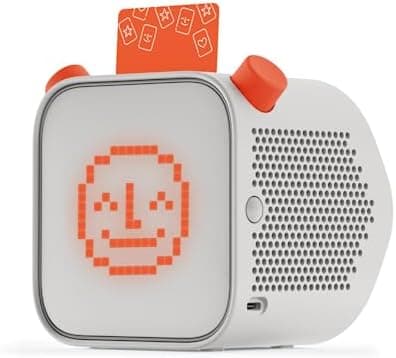
Quick Verdict: Yoto Player (3rd Generation)
The Yoto Player earns a strong 4.6 out of 5. It does the rare thing of pleasing children and parents at once: kids love the independence of choosing and playing their own cards, and parents love that it pulls them away from screens without a fight. As an all-in-one bedtime storyteller, nightlight, OK-to-wake clock and travel companion, it is genuinely excellent and built to survive real family life. The honest caveats are about money rather than design: it is a premium device, and the physical cards (plus the optional Yoto Club subscription) turn it into an ongoing spend rather than a one-off. If you go in expecting that, it is one of the easiest recommendations we can make.
Pros
- Truly screen-free: audio-first play that builds listening and imagination, with no video, feeds or ads.
- Privacy by design: no camera, no microphone and no in-device advertising.
- Child-simple: insert a card, turn a dial: usable independently from age three.
- Five gadgets in one: nightlight, OK-to-wake clock, sleep sounds, thermometer and Bluetooth speaker.
- Grows with the child: a vast paid library plus free daily content and a record-your-own card.
Cons
- Premium price before you add any cards.
- Ongoing cost: cards mount up and Yoto Club is a recurring fee.
- Parent setup needed: a phone and Wi-Fi are required to get going and add content.
- Bedtime distraction: the little display and lights do not suit every sleeper.
Key Features
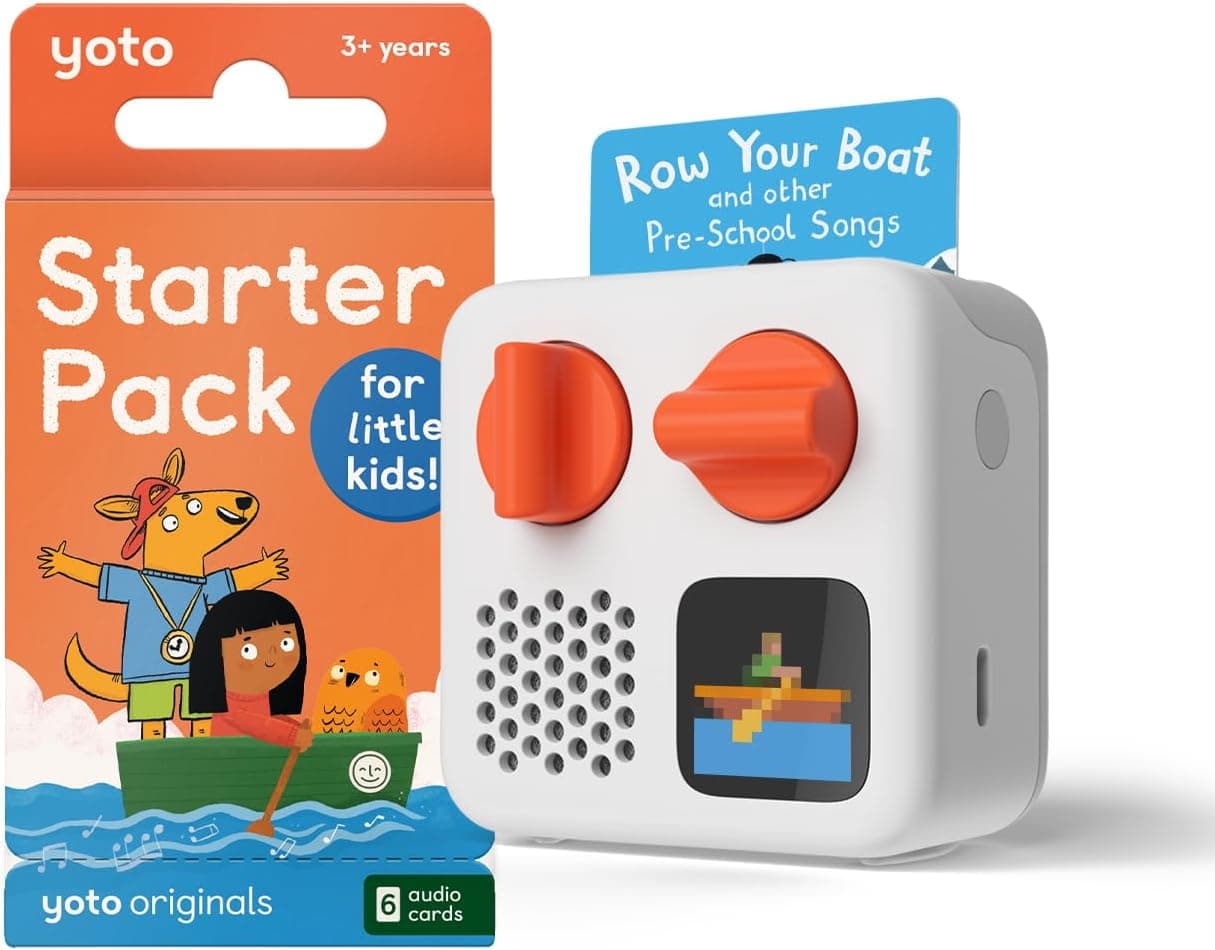
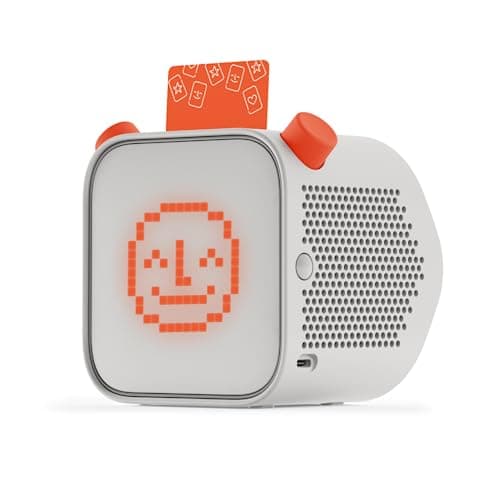
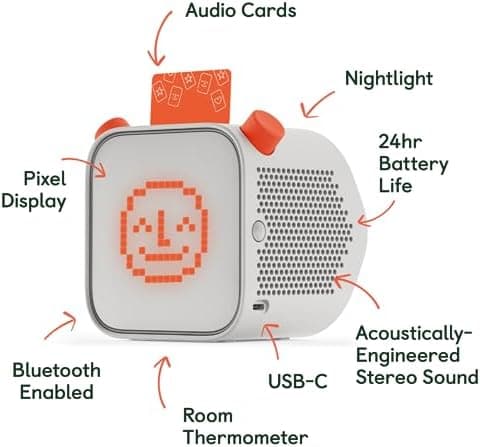
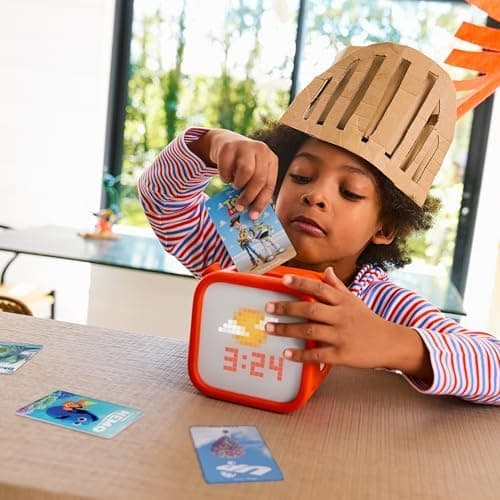
The genius of the Yoto Player is how little there is to learn. The device is a soft-cornered cube with two physical dials on top (one for volume, one for skipping tracks) and a small pixel display on the front. To play something, your child pushes a credit-card-sized Yoto card into the slot. To stop, they pull it out. That is the entire interface, and it is why a pre-reader can drive it with no help at all.
Underneath that simplicity sits a surprisingly capable little machine:
- Card-based, screen-free playback for stories, audiobooks, music, activities and podcasts: insert to play, remove to stop.
- A 16x16 pixel display that shows simple, charming animations and album art to bring the audio to life, without becoming a video screen.
- Up to around 16 hours of playback per charge, with fast USB-C charging and 32GB of internal memory for 600+ hours of offline listening.
- A genuine multi-tasker: nightlight, sleep sounds and soundscapes, an OK-to-wake alarm clock, a room thermometer and a portable speaker, all in one.
- A 3.5mm headphone jack plus Bluetooth audio so it can be used quietly with wired or wireless kids' headphones.
- A free companion app (iOS and Android) for setup, parental controls, day and night modes, and adding or streaming content over Wi-Fi.
- A Make Your Own card included in this bundle, letting you record your own voice or load playlists and family audio onto a physical card.
How It Works in Real Life
Setup is a parent job and takes ten minutes: download the Yoto app, connect the player to your home Wi-Fi, and link any cards to your account. After that, day-to-day use needs no phone at all, and that is the whole point. Once content is downloaded to the 32GB of onboard storage, the player works completely offline, which makes it superb for car journeys, holidays, grandparents' houses and patchy rural broadband.
Children take to it almost instantly. The cards are tactile and collectable, the dials are satisfying to turn, and there is no menu to get lost in. We found the lack of a "what next?" prompt is actually a feature: instead of an algorithm queuing up the next thing, the child has to choose and physically swap a card, which gives them agency and a natural stopping point. It is a refreshing contrast to the bottomless autoplay of most apps.
The display deserves a mention because it sits at the heart of the "is this really screen-free?" question. It is a low-resolution pixel screen showing static or gently animated pictures: think a glowing icon or simple scene, not a cartoon. There is no video and nothing to swipe. We would call it screen-light rather than screen-free in the strictest sense, but it is a world away from a tablet, and it never becomes the thing the child is staring at.
Content: The Cards, the Library and the Costs
This is where you need to go in with eyes open. The player is only as good as the content on it, and most of that content is bought card by card. Yoto's library runs to 1,000+ official cards covering bestselling children's novels, picture-book classics, music, languages, activities and educational series: many of them genuinely excellent, with proper production values. Popular British favourites and big franchises are well represented, so there is plenty for fans of familiar characters.
Cards typically cost a few pounds each, and they add up. A child who falls in love with a series can run through a fair amount of pocket money very quickly. Three things take the edge off that:
- Free content is more generous than you might expect. The player includes Yoto Radio, the free daily Yoto Daily podcast, sleep sounds and a rotating selection of free podcasts: usable with no extra spend.
- The Make Your Own card (included in this bundle) lets you record your own audio or load playlists, so grandparents reading a bedtime story or a homemade playlist costs nothing beyond the card you already own.
- Yoto Club, an optional subscription, sends a couple of cards a month plus member discounts and free shipping. It can be good value for heavy users, but it is another recurring cost to weigh up rather than a must-have.
Our honest take: budget for the player plus a starter handful of cards, and treat Yoto Club as optional. The second-hand market for cards is also lively, and cards can be re-linked between accounts, which softens the long-term cost.
Sound, Battery and Build Quality
For its size, the Yoto Player sounds clear and warm, with enough volume to fill a bedroom and a sensible parental volume limit you can set in the app. It is tuned for speech, and spoken-word content comes through beautifully. Music is perfectly enjoyable but will not trouble a proper speaker. Bass is modest and it is mono, so think "background songs and singalongs" rather than a hi-fi.
Battery life lands at roughly 14 to 16 hours of real-world playback, which comfortably covers several bedtimes or a long day out before it needs the USB-C cable. Standby drain is low, and the fast charge tops it up quickly. Build quality is reassuringly solid: rounded, grippy and clearly designed to be dropped by small hands without drama. It is the kind of object that survives a few years of family chaos.
More Than a Storyteller: Nightlight, Clock and Sleep
A big part of the Yoto's appeal is that it quietly replaces a shelf of single-purpose gadgets. The nightlight is adjustable and warm, the sleep sounds and soundscapes are genuinely calming, and the OK-to-wake clock (which changes colour to signal when it is acceptable to get up) is a small miracle for parents of early risers. There is even a room thermometer for checking the nursery isn't too warm.
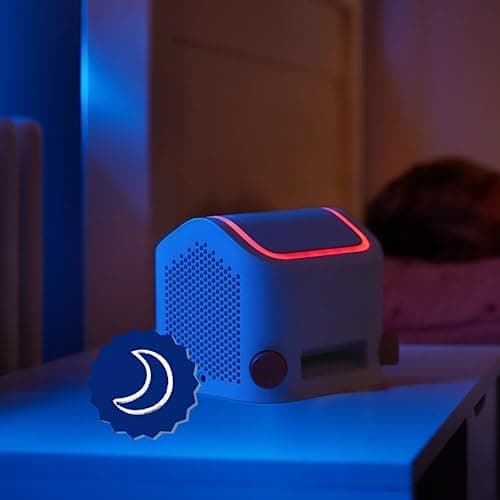
The one caveat: a minority of children find any light or display at bedtime distracting. You can dim and schedule everything through day and night modes, and most families settle into a routine quickly, but if your child is sensitive to light, factor that in.
Privacy and Safety: The Strongest Card in the Deck
For a connected children's device, the Yoto Player's privacy story is genuinely reassuring, and it is the feature we would highlight first to any cautious parent. There is no camera and no microphone anywhere on the device, so it cannot listen to or watch your child. There are no in-device adverts, and the curated library means children are not exposed to the open internet. The companion app needs a parent account and a Wi-Fi connection, and that is where data handling lives, so it is still worth reading Yoto's privacy policy and using a strong account password.
If connected-toy data collection is something you think about, it is worth reading our wider guide on what smart toys do with your child's data, and our overview of whether AI and smart toys are safe for children. The Yoto comes out of both conversations looking better than most: its restraint is the point.
On physical safety, the player carries the usual UK toy compliance markings and is rated for ages 3 and up. The cards are small, so keep them away from babies and determined toddlers who might mouth them, and supervise younger siblings around a shared player.
Who Is It For?
The Yoto Player is at its best for children roughly aged 3 to 8, where the screen-free independence, bedtime tools and audiobook habit pay off most. Older children up to 12 and beyond still get plenty from longer audiobooks, music and podcasts, though some tweens will gravitate towards headphones and streaming. It is a fantastic gift for a milestone birthday or Christmas: see our AI and smart toy gift guide for more screen-free ideas.
It is also worth flagging for families of children who find busy, screen-based toys overwhelming. The calm, predictable, audio-led experience can suit many autistic and sensory-sensitive children, a theme we explore in our guide to AI and smart toys for autistic children. As ever, every child is different, so consider your own child's sensitivities. Particularly around the nightlight and display.
If you specifically want a toy that teaches rather than entertains, a screen-free coding robot such as the MatataStudio Tale-Bot Pro is a different proposition, and an interactive AI companion like the Miko 4 sits at the opposite, screen-rich end of the spectrum. The Yoto's lane is calm, open-ended, audio-first play.
What Could Be Better
No device is perfect, and the Yoto's drawbacks are real even if they are outweighed. The headline issue is cost: it is a premium player with a recommended retail price around £99.99, and that is before you have bought a single story card. The card model, lovely as it is, makes this an ongoing spend, and the optional Yoto Club subscription nudges that further. Families on a tight budget should price up the player plus a realistic number of cards before committing.
The reliance on a parent's phone and Wi-Fi for setup and content management is a minor friction, and a small number of children find the display and nightlight distracting at bedtime. Finally, the sound is good rather than great for music, and the cards are easily lost down the back of the sofa or chewed by a younger sibling. None of these is a deal-breaker, but they are worth knowing before you buy.
Frequently Asked Questions
What age is the Yoto Player for? Yoto recommends ages 3 to 12 and up. The sweet spot is roughly 3 to 8, where the screen-free independence and bedtime features shine, but older children still enjoy longer audiobooks, music and podcasts.
Is it really screen-free? Almost. It has a small, low-resolution pixel display that shows simple pictures and animations. There is no video and nothing to swipe or scroll. We would call it screen-light: a world away from a tablet, and the child listens rather than stares.
Does it need Wi-Fi or a phone to work? You need a parent's phone and Wi-Fi for the initial setup and to add content. After that, downloaded content plays completely offline, so it works on car journeys, holidays and anywhere without internet.
How much does it really cost to run? Budget for the player plus a starter set of cards. Cards typically cost a few pounds each. There is a generous amount of free content (radio, the daily podcast, sleep sounds) and an optional Yoto Club subscription that sends cards monthly, but the subscription is not required.
Can I add my own audio? Yes. This bundle includes a Make Your Own card, so you can record your own voice (a grandparent reading a story, for example) or load playlists and family audio at no extra cost beyond the card.
Does it have a microphone or camera? No. The device has no camera and no microphone, and no adverts, which is a big part of its appeal for privacy-conscious parents.
The Verdict
The Yoto Player (3rd Generation) is one of the best children's audio players you can buy in the UK in 2026, and one of the few pieces of kids' tech that genuinely reduces screen time rather than adding to it. It nails the things that matter: it is simple enough for a three-year-old to use alone, robust enough to survive years of family life, privacy-respecting in a way that shames most connected toys, and quietly brilliant as a bedtime storyteller, nightlight and clock rolled into one.
Its limitations are honest and predictable. It is a premium device, and the card-based content model makes it an ongoing spend rather than a one-off purchase. Go in expecting to budget for cards, treat Yoto Club as optional, and the value stacks up. Especially given how much single-purpose gear it replaces.
It earns a confident 4.6 out of 5 and a firm place on our shortlist of the best screen-free smart toys for UK families.
👉 Ready to get started? Check the latest price on Amazon.
As an Amazon Associate, AIToys.co.uk earns from qualifying purchases. Prices and availability are accurate as of the date of publication but can change. We only ever recommend products we believe will genuinely help UK families.