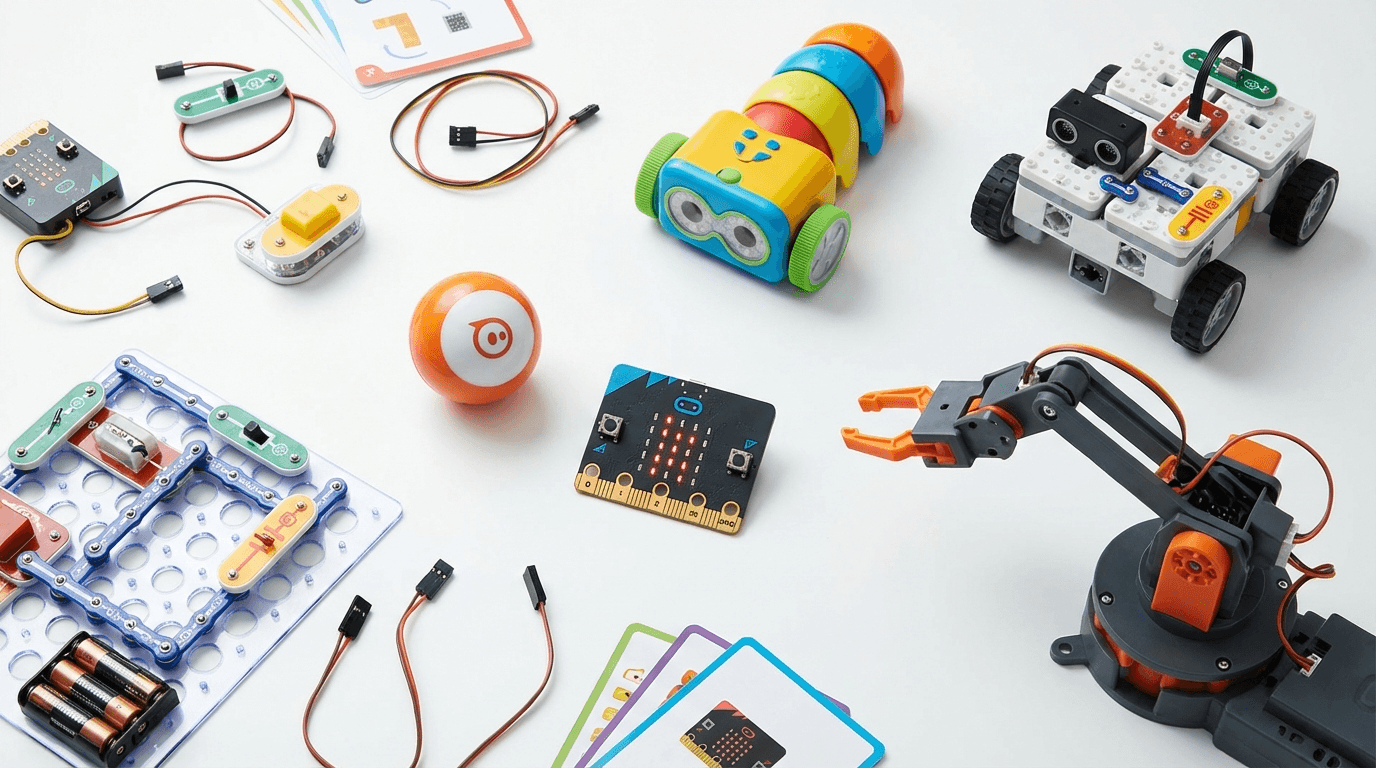
Best Coding Robots Under £100 UK 2026-10 Top Picks for Every Age
The 10 best coding robots under £100 in the UK for 2026: expert picks for ages 3 to 14. In-stock products, honest reviews, and where to buy.
You don't need to spend a fortune to give your child a brilliant start with coding. Some of the best coding robots on the market sit well under £100, and several cost less than £40. We've researched the field carefully to bring you ten real, in-stock products that deliver genuine educational value without breaking the bank.
Whether you're shopping for a curious 3-year-old or a motivated 14-year-old, there's a coding robot in this guide to match their age, their interests, and your budget. Every pick below was checked as available on Amazon UK at the time of writing, and we've been honest about what each one does (and doesn't) do well.
At a Glance: Best Coding Robots Under £100 UK 2026
| Product | Age Range | Approx. Price | Best For |
|---|---|---|---|
| MatataStudio VinciBot | 8-12 | ~£100 | AI-powered coding, all-rounder |
| Makeblock mBot | 8-14 | ~£90 | Scratch & Arduino learners |
| Botley 2.0 Activity Set | 5-10 | ~£68 | Screen-free beginners |
| Edison robot | 6-12 | ~£58 | Best value, school & home |
| BBC micro:bit V2 | 10-14 | ~£29 | Python & real hardware |
| MatataStudio Tale-Bot Pro | 3-5 | ~£90 | Screen-free for pre-schoolers |
| Code & Go Robot Mouse | 4-8 | ~£34 | Cheapest screen-free intro |
| Apitor Robot J | 7-12 | ~£70 | Build-it-yourself coding |
| Switcheroo Coding Crew | 4-8 | ~£64 | Modular screen-free play |
| Cooper the STEM Robot | 5+ | ~£58 | App-based early coding |
Prices are approximate and correct as of July 2026. Amazon UK prices change frequently: tap through for the current price.
Our Top Picks
1. MatataStudio VinciBot: Best Overall (AI-Powered Coding Robot)
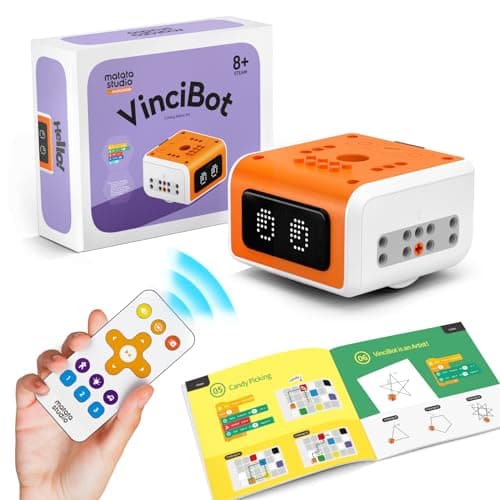
Ages: 8-12 | Approx. price: ~£100 | ASIN: B0CZ6Q8L4X
The VinciBot is our top all-round pick, and it earns the spot by doing something most budget robots can't: it uses genuine AI features. An onboard camera gives it colour recognition, line-following and simple computer vision, while a built-in microphone allows voice interaction, so children aren't just moving a robot around, they're teaching it to sense and respond to the world.
Crucially for longevity, VinciBot spans the whole coding journey. Younger or newer coders start with Scratch-style drag-and-drop blocks in the free MatataCode app; when they're ready, they graduate to Python and write real text-based programs. A bright LED matrix, distance sensors and gesture control give kids plenty to actually do with their code, which keeps motivation high.
At around £100 it sits right at the top of our budget, but you're getting a robot that a keen eight-year-old can grow with for years. For a site all about AI toys, this is the one we'd hand a child first.
What we like: Real AI features (camera vision, voice), a proper Scratch-to-Python path, and strong build quality. Worth knowing: You'll need a tablet or computer for the app, and the AI vision tasks need decent lighting to work reliably.
Around £99.99. Check price on Amazon UK →As an Amazon Associate, AIToys.co.uk earns from qualifying purchases.
For more advanced picks, our best AI toys for 9-12 year olds guide goes deeper on where to head next.
2. Makeblock mBot: Best for Scratch & Arduino Learners
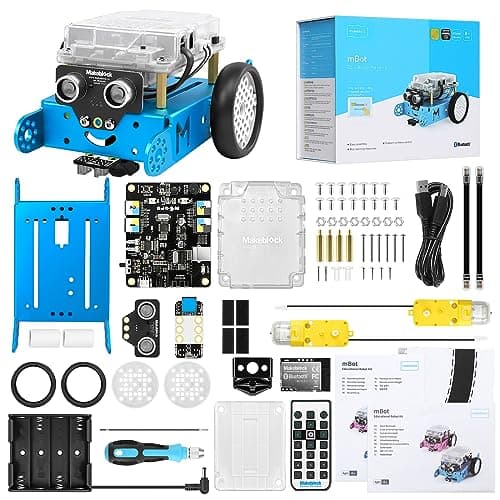
Ages: 8-14 | Approx. price: ~£90 | ASIN: B07XR98YYQ
The Makeblock mBot has been a classroom staple for years, and for good reason. It's a genuine dual-programming robot: children start with mBlock (a Scratch-based, drag-and-drop editor) and later move up to Arduino C++ when they're ready for real text code. That growth path makes it one of the best-value coding robots you can buy.
Assembly takes about 15-20 minutes and is deliberately part of the learning: your child sees how the motors, sensors and mainboard connect before they program them. Once built, the mBot follows lines, avoids obstacles and detects light, so early programs produce satisfying, visible results. There's a huge global community of shared projects and lesson plans, which means you'll never run out of things to try.
It's a little more involved than a button-press robot, so it suits confident 8-year-olds and up rather than absolute beginners. But if you want one robot that lasts from primary school into secondary, the mBot is hard to beat.
What we like: True Scratch-to-Arduino longevity, used in UK schools, massive project community. Worth knowing: The app interface feels dated, and the most advanced Arduino features need adult help.
Around £89.99. Check price on Amazon UK →
Want a side-by-side? Read our full Makeblock mBot review and our mBot alternatives guide.
3. Botley 2.0 Coding Robot Activity Set: Best Screen-Free for Beginners
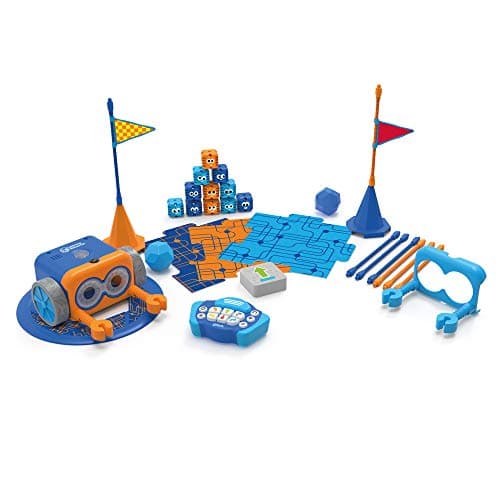
Ages: 5-10 | Approx. price: ~£68 | ASIN: B083T58PKM
Botley 2.0 by Learning Resources is the gold standard for screen-free coding in the early years. There's no app and no tablet. Just a chunky, friendly robot your child programs by pressing physical buttons on a remote. Botley then trundles off and follows the sequence exactly, which is where the real learning starts: when it goes wrong, children debug the steps and try again.
This Activity Set is the one to buy because it's complete out of the box: the robot, remote programmer, coding cards and a 78-piece kit of obstacles, tracks and tiles. Kids build a course, plan a path, and watch Botley navigate it, discovering loops and if/then logic long before they can spell "code". Detachable arms let it push and move objects, adding a lovely physical element.
It's brilliant for households worried about screen time, and the activities scale in difficulty as skills grow. Above about age 10 children will want something more open-ended, but for 5-8s this is our screen-free favourite.
What we like: Genuinely screen-free, teaches loops and conditionals through play, big pieces for small hands. Worth knowing: The remote takes a session or two to master; younger children benefit from a parent nearby at first.
Around £67.94. Check price on Amazon UK →
Not sure about screens? Our screen-free vs screen-based coding toys feature breaks down when each approach works best.
4. Edison robot: Best Value Coding Robot for School & Home
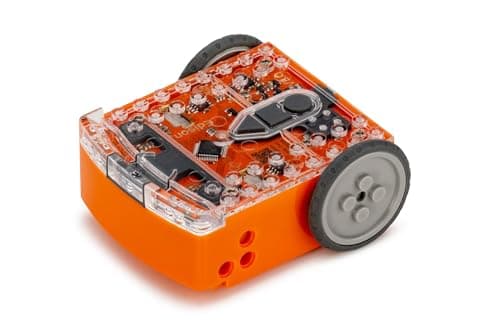
Ages: 6-12 | Approx. price: ~£58 | ASIN: B0747THB7M
If you want the most coding robot per pound, the Edison robot is remarkable. It's LEGO-compatible (it fits standard bricks, so builds are endless), rechargeable over USB-C, and programmable across three levels that grow with the child: barcode scanning for the youngest, EdBlocks for block coding, and EdPy for real Python.
The barcode trick is genuinely clever: young children scan pre-printed barcodes from a worksheet to give Edison different behaviours, no screen needed at all. When they're ready, the same robot moves up to drag-and-drop blocks and then Python, so a single £58 purchase can last from Year 2 to Year 7. Edison robots can also detect and respond to each other, which is why schools buy them by the classroom-load.
It's smaller and less flashy than some rivals, and the advanced modes need a computer with the free software. But as a durable, genuinely educational robot that won't be outgrown quickly, the value here is outstanding.
What we like: Superb value, LEGO-compatible, three coding levels from barcodes to Python, USB-C rechargeable. Worth knowing: Physically small and understated; block/Python modes need a computer.
Around £57.98. Check price on Amazon UK →
5. BBC micro:bit V2: Best for Python & Real Hardware
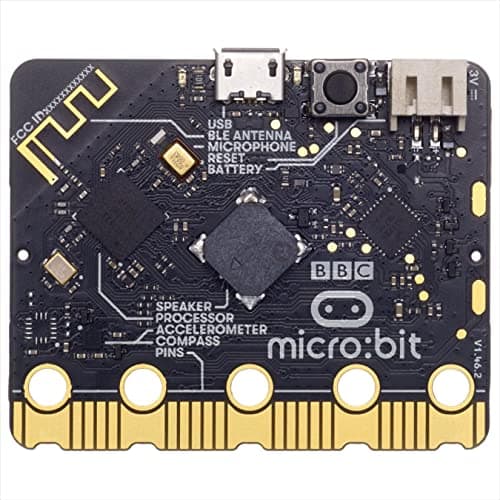
Ages: 10-14 | Approx. price: ~£29 | ASIN: B08NGKK3XW
The BBC micro:bit is the cheapest item on this list but arguably the most powerful for older, motivated children. For under £30 you get a fully programmable microcontroller with a 5×5 LED matrix, two buttons, Bluetooth, a built-in microphone, a speaker and motion sensors. It programs via MakeCode (block-based), MicroPython or JavaScript, all free and browser-based.
Designed by the BBC specifically for UK schoolchildren, the micro:bit underpins the KS3 computing curriculum and is a genuine stepping stone toward GCSE and A-Level Computer Science. Unlike a guided robot kit, it's an open platform: children invent their own projects (step counters, reaction games, weather sensors, wearable badges) rather than following a fixed activity set. That open-endedness is exactly what a curious 10-year-old needs.
It isn't a robot in the drive-around sense, and it needs project ideas or a bit of structure to shine. But as the most affordable route into real, text-based coding on physical hardware, nothing else comes close.
What we like: Extraordinary value, the actual tool UK schools use, free excellent editors, huge project library. Worth knowing: It's a board, not a wheeled robot; best with a computer and some guided projects.
Around £28.58. Check price on Amazon UK →
For the full breakdown of what it can do, see our BBC micro:bit V2 review.
6. MatataStudio Tale-Bot Pro: Best for Ages 3-5
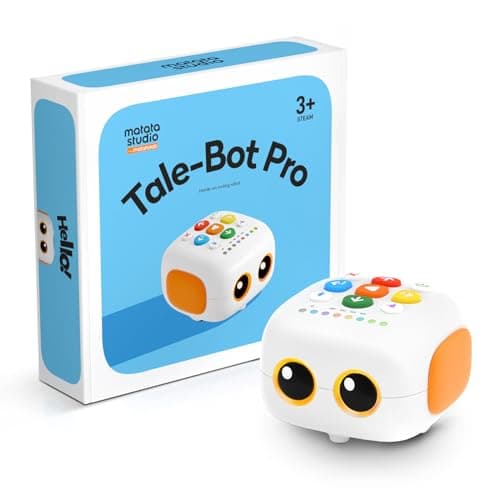
Ages: 3-5 | Approx. price: ~£90 | ASIN: B0CZ6R182M
Most coding robots start at age 5 or 6, which leaves the youngest would-be coders out. The Tale-Bot Pro is built specifically for 3-5s, and it's beautifully judged for little hands. Children press big, tactile buttons directly on the robot's back to build a sequence of movements (completely screen-free) then watch Tale-Bot drive it out across the included play mats.
What sets it apart at this age is feedback: Tale-Bot has colour lights, sound effects and a little marker slot, so toddlers get an immediate, delightful response to every command. The themed maps (town, space, maths) turn abstract sequencing into a story ("drive to the bakery, then turn to the park") which is exactly how pre-schoolers learn best. It quietly introduces direction, counting, cause-and-effect and simple debugging.
At around £90 it's a premium buy for the age group, but it's robust, rechargeable and genuinely developmentally appropriate rather than a cut-down older toy. If you're starting a three-year-old, this is the one.
What we like: Truly screen-free, designed for tiny hands, rich lights/sound feedback, lovely story-led maps. Worth knowing: Pricey for the age; children will outgrow it by around 6.
Around £89.99. Check price on Amazon UK →
7. Learning Resources Code & Go Robot Mouse: Best Cheap Screen-Free Intro
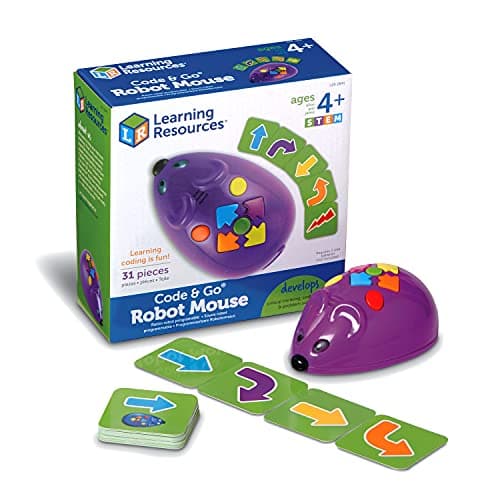
Ages: 4-8 | Approx. price: ~£34 | ASIN: B01B14XK00
Colby the Robot Mouse is the classic, affordable first step into coding, and at around £34 it's the easiest way to test whether your child enjoys this kind of play before spending more. It's completely screen-free: children build a maze from the included walls and tunnels, then press the directional buttons on Colby's back to program a path to the cheese.
Despite the low price, the learning is real. Kids plan a route, enter the sequence, run it, and debug when Colby bumps a wall: the exact loop of think, code, test, fix that underpins all programming. The set comes with 30 double-sided coding cards and activity challenges, so there's structure for parents who want it and free play for those who don't. Colby's light-up eyes and cheerful beeps keep four- and five-year-olds engaged.
It's simpler than Botley and tops out sooner, but as a low-risk, high-charm introduction for younger children, the Robot Mouse remains a genuine bargain.
What we like: Very affordable, fully screen-free, quick to set up, iconic and reliable. Worth knowing: Simpler than pricier robots and outgrown by around 8; needs AAA batteries.
Around £33.95. Check price on Amazon UK →
8. Apitor Robot J: Best Build-It-Yourself Coding Robot
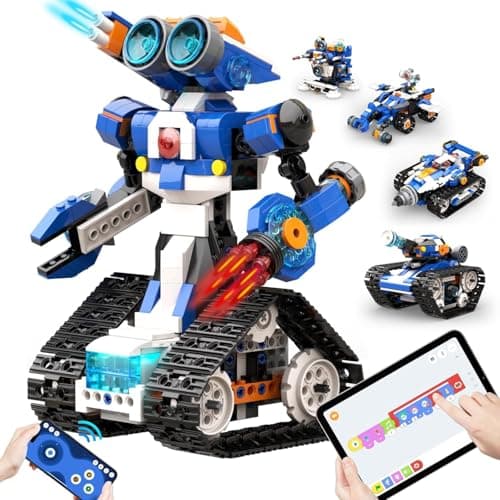
Ages: 7-12 | Approx. price: ~£70 | ASIN: B083B82JZ7
For children who love building as much as coding, the Apitor Robot J is a clever two-in-one. It's a brick-based construction kit (compatible with the big-name building blocks) that assembles into six different motorised robots, and once built, each one is programmed through the free Apitor app using Scratch-style blocks.
The build-then-code sequence is the whole appeal: kids follow the illustrated guide to construct a model, then bring it to life with light, sound, motion and sensor programs. Because there are six models plus free-build potential, it delivers far more hours than a single fixed robot, and the mechanical side (gears, motors, structures) teaches engineering alongside the coding. It's a great fit for the 7-12 child who's happiest with something to make.
Assembly is involved, so it suits patient builders and can need a hand the first time. But for the price you get a genuine construction-plus-coding kit that keeps giving well beyond the first afternoon.
What we like: Building and coding combined, six models plus free build, block programming via a clean app. Worth knowing: Fiddly first build; the app coding is block-only (no text code).
Around £69.99. Check price on Amazon UK →
For more kits like this, see our best coding robot kits for 8-12 year olds.
9. Learning Resources Switcheroo Coding Crew: Best Modular Screen-Free Play
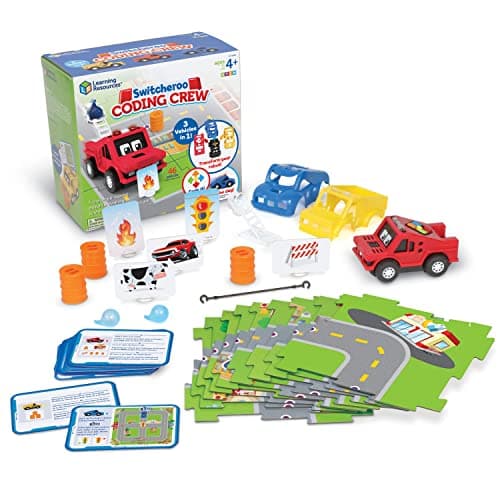
Ages: 4-8 | Approx. price: ~£64 | ASIN: B09SVRLNMY
Switcheroo puts a fun twist on screen-free coding: it's a robot base with three swappable character shells (a robot, a rocket and a car), so the same coding mechanic gets re-themed to whatever a child is into that week. You program a route by placing tactile coding tiles into the base, then press go and watch it drive the sequence. No app, no screen.
The 46-piece set includes tiles, track markers and challenge cards, and the physical-tile approach is lovely for 4-6s who aren't ready to read on-screen instructions. Swapping the shells keeps novelty high and quietly reinforces that the code is the same even when the robot looks different: a subtle but useful early lesson. It teaches sequencing, directions and problem-solving with a strong play-first feel.
It covers similar ground to the Robot Mouse but adds the character variety and a slightly richer challenge deck. If you want screen-free coding with more replay value for a younger child, it's a charming choice.
What we like: Three interchangeable characters, fully screen-free tile coding, great for pre-readers. Worth knowing: Similar depth to cheaper mice; batteries required and outgrown by around 8.
Around £63.55. Check price on Amazon UK →
10. Learning Resources Cooper the STEM Robot: Best App-Based Early Coding
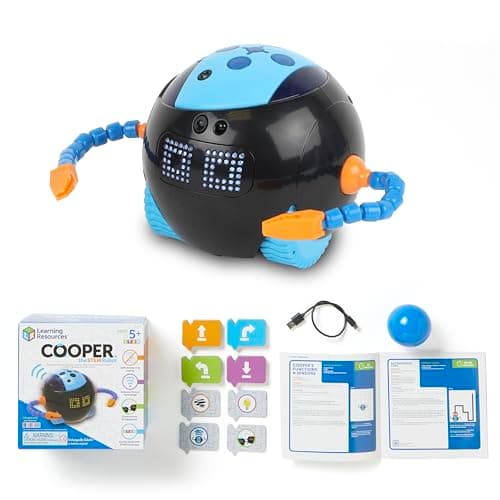
Ages: 5+ | Approx. price: ~£58 | ASIN: B0DXC4KFL7
Cooper is a friendly, expressive robot designed to bridge screen-free play and app-based coding for younger children. He responds to touch and movement with lights, sounds and personality out of the box, then connects to a free companion app where kids use simple block-style commands to control what he does: a gentle first taste of programming from a device.
The appeal is warmth: Cooper feels like a character rather than a gadget, which pulls in children who might find a bare robot chassis uninspiring. The app builds from very basic sequences up to slightly more involved challenges, so a five-year-old can start with a parent and gradually take the controls themselves. It's a nice option for families who are comfortable with a little screen use and want the engagement that a character-led robot brings.
It's more about early coding concepts and STEM play than deep programming, so keen coders will move past it, but as an approachable, likeable starter robot for the 5-7 range it does its job well.
What we like: Charming character kids bond with, easy app-based intro, good lights-and-sound feedback. Worth knowing: Coding depth is shallow (concepts, not real code); needs a tablet/phone for the app.
Around £57.95. Check price on Amazon UK →
Which Coding Robot Should You Buy?
The right choice comes down to your child's age and what you value most:
- Best all-rounder (and best AI features): MatataStudio VinciBot. Real camera vision and voice, plus a Scratch-to-Python path that lasts for years.
- Best for ages 3-5: Tale-Bot Pro for a premium screen-free start, or the Code & Go Robot Mouse if you'd rather test the water cheaply.
- Best screen-free for 5-8: Botley 2.0 Activity Set: physical, tactile and complete in the box.
- Best value at any age: Edison robot. LEGO-compatible, Python-capable and school-proven for under £60.
- Best for Scratch then real code (8+): Makeblock mBot, which grows from blocks to Arduino.
- Best for serious young coders (10+): BBC micro:bit V2: the tool UK schools actually use, for under £30.
- Best for builders: Apitor Robot J, where construction and coding meet.
Buying Tips: Coding Robots Under £100
Check the app requirements
App-based robots (VinciBot, mBot, Cooper, Apitor) need a compatible smartphone or tablet. Screen-free robots (Botley, Tale-Bot, Code & Go, Switcheroo, Edison in barcode mode) don't. A genuine plus if your child already has plenty of screen time.
Look for an upgrade path
The robots that last longest (VinciBot, mBot, Edison, micro:bit) let a child move from blocks to real text code (Python or Arduino). Starting affordable and growing into more advanced coding beats buying a toy that's outgrown in a year.
Match the age honestly
Manufacturers tend to overstate how young a child can use a product independently. Our age ranges reflect realistic solo use; if you're happy to sit alongside your child, you can usually go a year younger.
Factor in batteries and add-ons
Everything here is complete out of the box. Edison and VinciBot are USB rechargeable (no ongoing battery cost); Botley, the Robot Mouse, Switcheroo and the micro:bit battery pack need AAs or AAAs.
How we picked these
Every product here was checked against its live Amazon UK listing before publication: in stock, the listing matching the model we describe, and the price recorded at the time of writing. We read the manufacturer's own specifications for the figures quoted, and work through recent verified-purchase reviews looking for the same fault reported repeatedly rather than one-off complaints.
Picks are ordered by who each product actually suits: age, budget, and whether an app or subscription is involved. Not by commission. AIToys.co.uk earns from qualifying purchases through the links on this page; that does not affect the order. The full process, including what we don't do, is on our how we choose page.
FAQ: Coding Robots Under £100 UK
What is the best coding robot for a 3-year-old in the UK?
The MatataStudio Tale-Bot Pro is purpose-built for ages 3-5. It's fully screen-free (children press large buttons on the robot itself to build a sequence) and its lights, sounds and story-based maps make sequencing genuinely fun for pre-schoolers. The Code & Go Robot Mouse is a cheaper alternative from age 4.
Can a coding robot under £100 teach real programming?
Yes, especially at the upper end. The BBC micro:bit teaches MicroPython and JavaScript, the Makeblock mBot teaches Scratch and Arduino C++, and the VinciBot and Edison both offer a block-to-Python path. Even screen-free robots like Botley teach sequencing, loops and debugging: the same logic, just a different interface.
Which coding robot has actual AI features?
The MatataStudio VinciBot is the standout here. Its onboard camera provides colour recognition, line-following and simple computer vision, and a microphone enables voice interaction, so children program a robot that can genuinely sense and respond to its surroundings, not just follow fixed moves.
Are cheap coding robots worth buying?
Absolutely. The Edison robot (~£58) and the BBC micro:bit (~£29) are both used in UK schools. They're affordable because they're sold in volume to education, not because they're low quality. Don't equate price with educational value.
What age is best to start coding with robots?
Most children can begin with screen-free robots from age 3-4 with parental support. Independent block coding on a device tends to click around 7-8, and text-based coding (Python, JavaScript) is usually accessible from about 10-11, though keen children start earlier.
Also Consider: Beyond £100
If your budget stretches further, there are excellent step-up options. The Sphero BOLT adds a full programmable LED matrix and more advanced sensors, and dedicated build-and-code sets go deeper still: see our best coding robot kits for 8-12 year olds.
New to all this? Start with our how to choose your first coding robot guide, and for age-specific advice see best AI toys for 6-8 year olds and best AI toys for 9-12 year olds.
Last updated: July 2026. Prices are approximate and based on Amazon UK at the time of writing; actual prices may vary. As an Amazon Associate, AIToys.co.uk earns from qualifying purchases.
Read next
Best Screen-Free Coding Toys UK 2026-9 Top Picks for Device-Free Learning
The best screen-free coding toys for kids in the UK: no tablet, no smartphone required. Expert picks for every age from 3 to 14, with honest pros and cons.
Best STEM Kits Under £100 UK 2026-9 Top Picks for Every Age
Nine STEM kits under £100 for UK families, plus a hydraulic hand and a scarce LEGO Technic moon rover. Updated September 2026.
Best AI Toys for 6-8 Year Olds UK 2026-10 Top Picks for Smart STEM Fun
Discover the best AI toys for 6-8 year olds in the UK for 2026. Our top 10 picks offer smart STEM fun, coding challenges, and educational play for young minds.