Disclosure: This article contains affiliate links. As an Amazon Associate, AIToys.co.uk earns from qualifying purchases. If you buy through our links, we may earn a small commission at no extra cost to you. It never changes the price you pay, and it never changes our verdict.
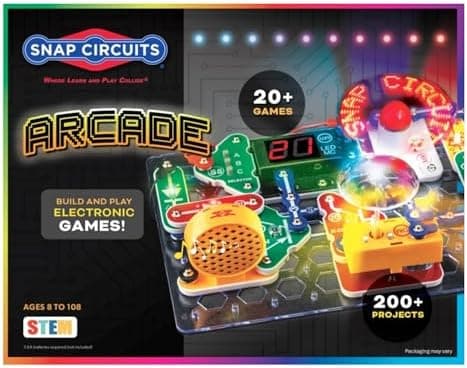
Most electronics kits ask a child to build a circuit, admire the light that comes on, and move on. The Snap Circuits Arcade Electronics Exploration Kit does something cleverer: it hands your child the parts to build their own arcade. A reaction-timer game that tests who has the fastest finger. A spinning prize wheel. A number game with a glowing scoreboard. Each one is a genuine, working electronic circuit, but because the end result is a game you actually play, a child stays at the table far longer than they would to light a single bulb. That "build a toy, then play with the toy you built" idea is the thread running through this whole review.
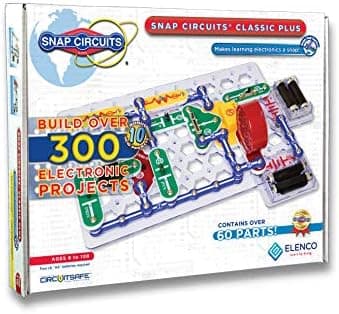
Snap Circuits, made by Elenco, has been a fixture of British STEM shelves for well over a decade, and the Arcade edition is one of the most engaging kits in the range. If you have already read our Snap Circuits Classic PLUS SC-310 review and wondered whether the games-focused version is worth a look, this is the kit that question is about. Here is our honest, hands-on take on whether it earns a place in your home.
👉 Short on time? Check the latest price on AmazonAs an Amazon Associate, AIToys.co.uk earns from qualifying purchases..
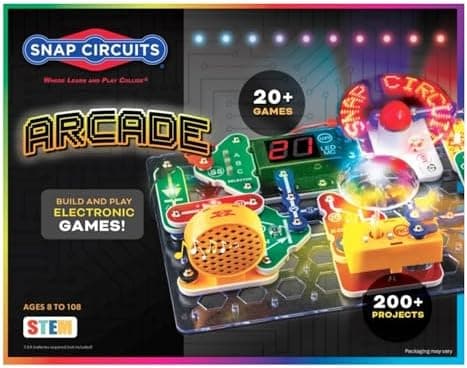
Quick Verdict: Snap Circuits Arcade
The Snap Circuits Arcade earns a strong 4.5 out of 5. It takes everything that makes Snap Circuits such a reliable STEM recommendation (real components, no soldering, months of content) and wraps it in a theme that children genuinely want to keep playing with. The 20-plus build-and-play games are the hook, and the 200-plus projects give it real longevity. What lifts it above the standard kits is a trio of more grown-up parts: a pre-programmed micro-controller, a spinning Word Fan and a dual LED display, which quietly introduce the idea of programmable electronics rather than just switches and bulbs. The trade-offs are minor and practical: you need to supply the AA batteries, and it costs more than the entry-level sets. For a child who has caught the electronics bug, or one who needs the extra motivation a game provides, it is an easy recommendation.
Pros
- Learning disguised as play: children build and then play more than 20 arcade-style games.
- Real longevity: 200-plus projects and a clear four-colour manual earn the kit its shelf space.
- A step towards coding: programmable parts introduce micro-controller ideas the simpler kits skip.
- No soldering, no tools: colour-coded parts snap onto a grid, so it is safe, independent play.
- Screen-free: no app, no tablet, no account: increasingly rare and genuinely valuable.
Cons
- Batteries not included: you need AA batteries before the first game will do anything.
- A considered buy: it costs more than the Junior kits, so it is a proper present, not a filler.
- Some overlap: the core electronics ideas echo the Classic range under a fun new theme.
What Exactly Is the Snap Circuits Arcade?
Snap Circuits is an electronics construction system. Rather than the traditional route of stripping wires and heating a soldering iron (neither remotely suitable for a primary-school child) Elenco mounts each component onto a chunky plastic module with press-studs on the corners. Those modules snap onto a grid baseplate and onto each other, and the metal studs carry the current between them. A child follows a numbered diagram in the manual, snaps the parts into place, flicks a switch, and the circuit springs to life.
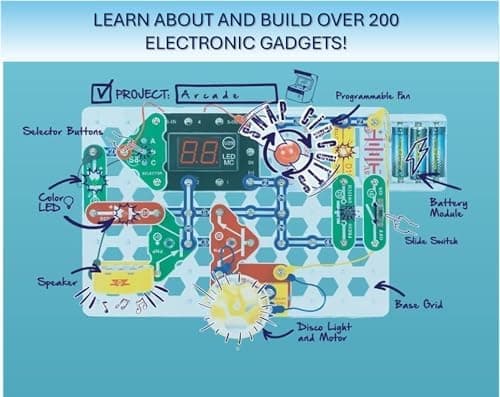
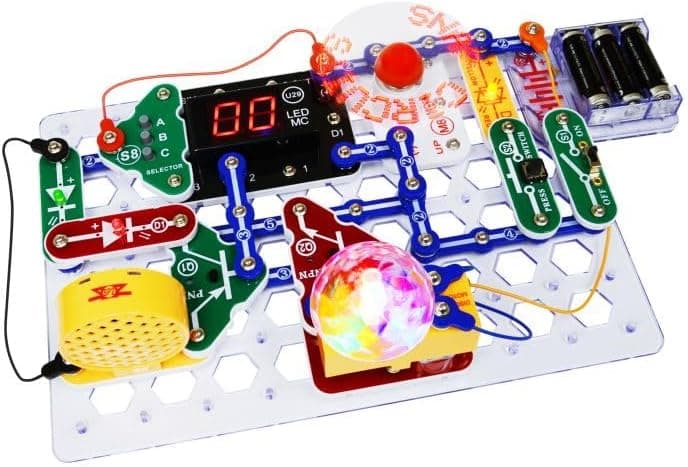
The Arcade kit ships with more than 35 snap modules and supports over 200 projects, with a four-colour, well-illustrated project manual to guide them. Its party trick is the 20-plus build-and-play games: reaction-time testers, spinning wheels, number and quiz games and light-and-sound challenges that turn each finished circuit into something the whole family can have a go at. Alongside the familiar switches, resistors and speaker, it adds three more ambitious parts: a pre-programmed PICAXE micro-controller, a programmable Word Fan that uses a spinning blade of LEDs to spell out messages, and a dual LED display that shows numbers and scores. Those are what give the Arcade its identity.
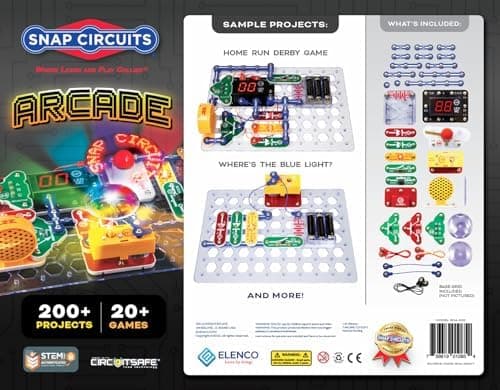
The manufacturer's recommended age is 8 and over, and in our experience that is honest. A confident seven-year-old with an adult nearby will manage the early builds, while a capable ten- or eleven-year-old will happily work through the harder projects alone and start to understand why each circuit behaves as it does. It sits squarely in our STEM and coding category as an electronics kit with a genuine programmable streak, a rung or two below fully code-it-yourself boards like the BBC micro:bit V2.
The Learning Value: Why the Games Matter
The reason a games theme is more than a marketing gimmick is motivation. The single biggest challenge with any educational toy is keeping a child engaged long enough to actually learn something, and a reaction-timer they can challenge their sibling to beat does that far better than an abstract "light the lamp" exercise ever could. The child builds the circuit to get the game, and in building it, they wire a sensor to a switching circuit to an output, which is exactly how real electronics works. The fun is the delivery mechanism, not a substitute for the substance.
There is a quiet cleverness to how the manual scaffolds difficulty. Early projects use a handful of parts and take a couple of minutes; by the middle of the book, a child is reading a proper circuit diagram and troubleshooting when a game does not light up. That troubleshooting is where much of the real learning lives: a project that fails first time forces a child to check each connection, reason about what is wrong and fix it, building resilience as much as knowledge.

The Arcade's more advanced parts are what set it apart from the standard sets. Meeting a micro-controller (even a pre-programmed one) plants an important seed: the idea that a single tiny chip can be given instructions and then run them, which is the conceptual leap that underpins every programmable device, from a games console to the Arduino Starter Kit your child might graduate to later. The Word Fan, meanwhile, is a lovely introduction to persistence of vision, and the LED display makes the abstract idea of "output" concrete every time a score ticks up. For a screen-free kit, that is a surprising amount of forward-looking learning.
Ease of Use and Build Quality
Getting started is almost frictionless: with one important caveat we will come to. The parts are colour-coded and clearly numbered, the baseplate has a labelled grid, and the manual tells you exactly which module goes where. That coordinate system is genuinely well thought out: it removes almost all ambiguity, so even a child who struggles with dense written instructions can follow the pictures and place parts correctly. Snapping components together is satisfying and gives a reassuring click, and completed circuits rarely fail because of a loose part.
Build quality is a real strength. The plastic modules are thick and robust, the press-studs are metal rather than flimsy, and Elenco's CircuitSafe design means the parts are made to be handled and reconnected safely over and over. This is a kit built to survive a childhood, and it is one of the reasons Snap Circuits holds its value and gets handed down between siblings.
The one thing to plan for: the Arcade needs AA batteries, and they are not included. Nothing in the kit does anything until they are fitted, so if this is a birthday or Christmas present, buy a pack of AAs to go with it. There are few things more deflating for a child than opening an electronics kit that cannot yet make a single light glow or a single game start. It is a minor gripe, but a genuinely common one, so it is worth flagging plainly.
Who Is It For? Age and Safety Notes
The Snap Circuits Arcade is aimed squarely at children aged 8 and over, and that is the age we would recommend it from. The projects assume a level of reading, patience and fine motor control that most eight-year-olds have and most younger children do not. That said, a keen six- or seven-year-old can absolutely enjoy the simpler builds with a parent working alongside them. It makes a lovely shared activity rather than solo play, and the games give you both something to do at the end.
On safety, the sensible notes apply. The kit contains small parts and is not suitable for children under three because of the choking hazard, so keep it well away from toddler siblings. The circuits run on low-voltage AA power and are designed to be safe to handle, but the manual quite rightly tells children never to connect the kit's parts to mains electricity or to household batteries, and that guidance is worth reinforcing. There is no screen time to manage and no online component to police, which keeps parental oversight refreshingly simple. Mainly, it is about supervising tidy-up so parts do not go missing. Look for the CE and UKCA conformity marks on the packaging, which Elenco's UK-distributed kits carry.
What Could Be Better
No kit is perfect, and it is only fair to be clear about the trade-offs. The most practical frustration is loose-part management. With 35-plus modules, an organised child keeps everything in the tray and can find the part they need in seconds; a less organised one ends up with a jumbled box, and a single missing snap wire can stall a project. The kit would benefit from more structured storage than it provides, so a cheap compartment box is a worthwhile add-on.
The second, gentler criticism is that the arcade theme, for all its motivational power, is a little gimmicky, and the underlying electronics overlaps with the standard Classic range. If your child is drawn to games, that theme is exactly the right hook, but if they are equally happy building a radio or an alarm, the Snap Circuits Classic PLUS SC-310 covers similar ground with a broader, less themed project list. It is worth choosing the version that matches your child's interests rather than assuming Arcade is automatically the upgrade.
Finally, the micro-controller is pre-programmed rather than freely reprogrammable in the box. It is a brilliant introduction to the idea of a programmable chip, but a child cannot sit down and write their own code for it the way they can on a micro:bit or an Arduino. Treat the Arcade as the kit that makes a child want to learn to code next, not the one that teaches the code itself.
Snap Circuits Arcade vs the Rest of the Range
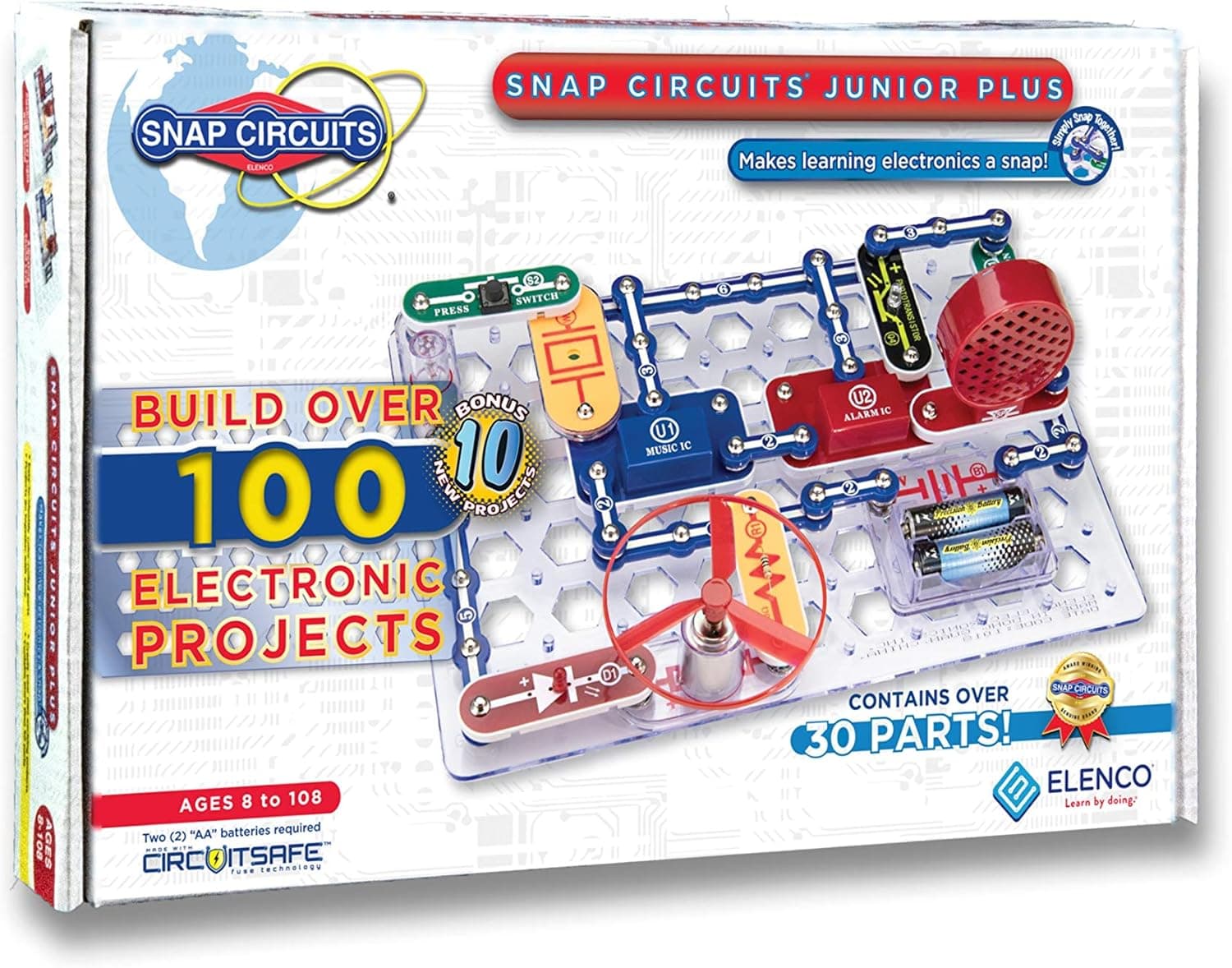
Snap Circuits can be confusing to shop for because the range is large and the naming is not obvious. In short: the Junior kits (like the SC-100 and the SC-110 PLUS) are the entry point, with fewer parts and simpler projects aimed at slightly younger children. The Classic tier is the mainstream family choice, offering a big jump in parts and projects. The Arcade sits alongside the Classic kits in difficulty but swaps some breadth for a themed, games-first experience and those extra programmable parts. Above all of them, the Pro kits add still more components and advanced builds for older, more serious young engineers.
For a child who loves games and needs extra motivation, the Arcade is the pick of the mid-range; for one happy with a broader, more varied project list, the Classic PLUS is the slightly better all-rounder. Either way, because every Snap Circuits part is cross-compatible, you can start with one and expand later: our best electronics kits for kids roundup sets out the full ladder of options.
How to Get the Most From It
A few small things make a real difference. Buy the AA batteries in advance and keep a spare set, and add a cheap compartment box so parts do not migrate under the sofa. Resist the urge to "help" too much. The troubleshooting when a game does not work is where the deepest learning happens, so let your child puzzle it out first. And lean into the theme: once they have built a game, get the family to play it, and the pride of "I made this" will pull them straight back to the next project.
For families building a broader STEM collection, the Arcade slots in as the "how electronics actually works, and it can be fun" foundation before a child moves on to programmable hardware like the BBC micro:bit V2 or a Raspberry Pi 4 starter kit, where they can combine real circuits with real code.
Frequently Asked Questions
Does the Snap Circuits Arcade need batteries? Yes. It requires AA batteries, which are not included in the box. Buy a pack to go with it, especially if it is a gift, because none of the games or projects will work until the batteries are fitted.
What age is the Snap Circuits Arcade suitable for? The manufacturer recommends ages 8 and over, and we agree. A confident younger child can enjoy the simpler builds with an adult alongside, but the full range of projects suits eights and up. It is not suitable for children under three due to small parts.
Is any soldering or special tool required? No. That is the whole point of Snap Circuits. Every component is mounted on a module with press-studs, and parts simply snap together on a grid. There are no tools, no soldering and no sharp edges.
How is the Arcade different from the Snap Circuits Classic kits? The Arcade focuses on 20-plus build-and-play games and adds programmable parts (a pre-programmed micro-controller, a Word Fan and an LED display) that the standard kits do not include. The Classic range offers a broader, less themed project list. They sit at a similar difficulty level.
Can my child program the micro-controller themselves? Not in the box. The PICAXE micro-controller comes pre-programmed, so it introduces the idea of a programmable chip and how it drives the games, but it is not designed for a child to write and load their own code. For that, look at a micro:bit or an Arduino as the next step.
Is it a screen-free toy? Completely. There is no app, no tablet and no online account. Your child builds physical circuits and games from a printed manual, which makes it a genuinely screen-free STEM activity.
The Verdict
The Snap Circuits Arcade is one of the most engaging ways to get a child hooked on electronics, and it earns a well-deserved 4.5 out of 5. It keeps everything that makes Snap Circuits such a dependable STEM buy (real components, no soldering, months of content and rugged build quality) and adds a genuinely motivating games theme plus a trio of more grown-up, programmable parts that point a child towards coding. Yes, you need to supply the batteries and keep the parts tidy, and the theme is a touch gimmicky, but those are small prices for a kit that can teach a child how the electronic world actually works while they think they are just playing. For a curious eight-to-eleven-year-old (especially one who loves games) this is a confident recommendation.
👉 Ready to buy? Check the latest price and availability on Amazon.
Price and availability were correct at the time of writing (24 July 2026) but can change; always check the current price on Amazon before buying.