Best Telescopes for Kids UK 2026: Top 10 for Summer Stargazing
Expert roundup of the best telescopes for kids in the UK for 2026. Compare smart app-enabled, beginner and budget telescopes for summer stargazing.
As an Amazon Associate, AIToys.co.uk earns from qualifying purchases. We only recommend products we'd happily set up in our own back gardens.
Best Telescopes for Kids UK 2026: Top 10 for Summer Stargazing
There is a particular kind of wonder that arrives the first time a child sees the craters of the Moon swim into focus, or spots the rings of Saturn hanging in the eyepiece like a tiny, impossible toy. Summer is the perfect time to bottle that feeling. The evenings are warm, the school pressure is off, and the August sky delivers one of the year's great free shows: the Perseid meteor shower, peaking around the 12th and 13th. A decent telescope turns a few clear summer nights into a memory your child will carry for life.
But telescope shopping is genuinely confusing, and the market is full of toys that promise "525x magnification!" on the box and deliver a blurry smudge in reality. The good news is that 2026 is a brilliant year to buy. App-enabled "smart" telescopes (which use your phone's camera and clever sky-recognition software to point you straight at planets, star clusters and galaxies) have come right down in price, and the classic beginner brands are as solid as ever.
We have researched the current UK market in detail to bring you this guide to the best telescopes for kids and beginners available right now on Amazon UK. There are app-enabled smart scopes, grab-and-go travel models, proper deep-sky reflectors for older children, and budget first telescopes that genuinely work. Every product here is in stock at the time of writing and earns its place.
If your family enjoys hands-on science, you might also like our roundups of the best STEM toys UK 2026, the best drones for kids UK 2026 and the best STEM kits under £100 UK 2026: astronomy sits beautifully alongside all of them.
Quick Comparison Table
| Telescope | Best For | Type | Aperture | Smart / App | Age Guide |
|---|---|---|---|---|---|
| Celestron StarSense Explorer DX 102AZ | Best overall | Refractor | 102mm | Yes (StarSense) | 10+ |
| Celestron StarSense Explorer LT 70AZ | Best budget smart | Refractor | 70mm | Yes (StarSense) | 8+ |
| NASA Lunar Telescope for Kids | Best for younger children | Refractor | 60mm | No | 6+ |
| Celestron Travel Scope 70 | Best for travel & holidays | Refractor | 70mm | No | 8+ |
| Celestron AstroMaster 130EQ | Best for deep-sky on a budget | Reflector | 130mm | No | 12+ |
| Celestron StarSense Explorer DX 130 | Best smart reflector | Reflector | 130mm | Yes (StarSense) | 10+ |
| Aomekie 70/400 Refractor | Best budget all-rounder | Refractor | 70mm | Phone adapter | 8+ |
| Science Mad 50mm Telescope | Best cheapest first scope | Refractor | 50mm | No | 6+ |
| National Geographic 50/600 AZ | Best classic starter | Refractor | 50mm | No | 7+ |
| DWARFLAB Dwarf 3 Smart Telescope | Best for astrophotography | Smart camera | 35mm lens | Yes (AI auto-track) | 12+ |
Telescopes vary widely in price and stock changes quickly. Always check the live Amazon UK price and availability before buying.
How to Choose a Telescope for a Child
Before we get to the picks, a few minutes on what actually matters will save you from the most common (and most disappointing) telescope buying mistakes.
Aperture matters far more than magnification. Aperture is the diameter of the main lens or mirror (the 70mm, 102mm or 130mm figure). It controls how much light the telescope gathers, and light is everything in astronomy. More aperture means brighter, sharper, more detailed views. Ignore the giant "magnification" numbers on the box. Any telescope can be pushed to high magnification with a cheap eyepiece, but without the aperture to feed it, you just get a bigger, dimmer, fuzzier blur.
Refractor or reflector? Refractors (the classic long tube with a lens at the front) are robust, need almost no maintenance and are forgiving for children: ideal as a first scope. Reflectors (which use a mirror) give you much more aperture for your money, so they are the better choice for an older child who wants to chase galaxies and nebulae, though they occasionally need their mirrors aligned.
Understand the mount. A wobbly mount ruins more first telescopes than poor optics ever do. Altazimuth (alt-az) mounts move simply up-down and left-right and are intuitive for kids. Equatorial (EQ) mounts track the sky's rotation smoothly but have a learning curve. App-assisted mounts, like Celestron's StarSense system, use your phone to tell you exactly where to nudge the scope.
What "smart" telescopes actually do. A smart or app-enabled telescope uses your smartphone's camera to photograph the star field, recognise the pattern and work out precisely where the telescope is pointing, then an on-screen arrow guides you to whatever you want to see. It removes the single biggest barrier for beginners: actually finding things. Fully robotic smart telescopes like the Dwarf 3 go further, automatically tracking objects and stacking images to reveal colour and detail your eye could never catch.
A word on safety. This matters more than anything else on this page: never let a child point a telescope at the Sun without a proper, certified solar filter fitted over the front. Doing so can cause instant, permanent blindness. Discard any flimsy "solar filter" eyepiece that screws into the bottom. They are dangerous. Young children should always be supervised when using a telescope outdoors after dark.
Our Top Picks
1. Celestron StarSense Explorer DX 102AZ: Best Overall Telescope for Families
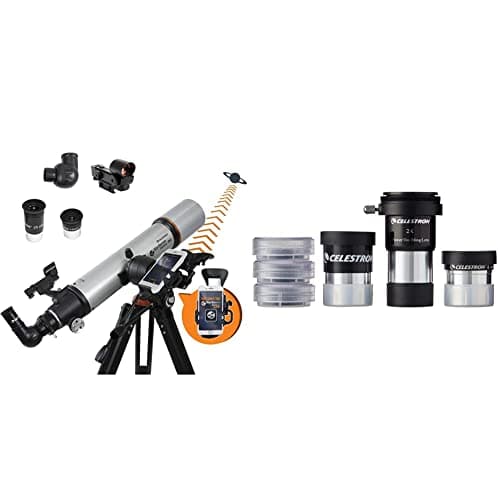
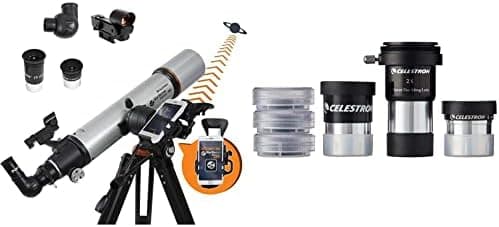
The Celestron StarSense Explorer DX 102AZ is the telescope we recommend most often for families, and it is our overall pick for 2026. It pairs a generous 102mm (4-inch) refractor (with Celestron's high-transmission XLT optical coatings) with the genuinely clever StarSense Explorer app. You dock your phone in the cradle, the app reads the real star field overhead, and within a minute it knows exactly where the telescope is aimed. From there, an on-screen bullseye guides you to whatever is visible tonight: the Moon's craters, the rings of Saturn, the cloud belts of Jupiter, the Orion Nebula and more.
That sky-recognition technology is what makes this scope so child-friendly. There is no star-hopping, no confusing setup ritual, no parent quietly despairing in the dark. The dual-axis slow-motion controls let young hands make fine adjustments smoothly, and the 102mm aperture shows enough detail to keep the whole family hooked well past bedtime.
Key features:
- 102mm refractor with fully-coated XLT optics
- Patented StarSense sky-recognition app (iOS and Android)
- Manual alt-azimuth mount with dual-axis slow-motion control
- Includes two eyepieces, red-dot finder and adjustable tripod
Best for: Families who want the easiest possible route to finding real objects in the night sky.
Check price on AmazonAs an Amazon Associate, AIToys.co.uk earns from qualifying purchases.
2. Celestron StarSense Explorer LT 70AZ: Best Budget Smart Telescope
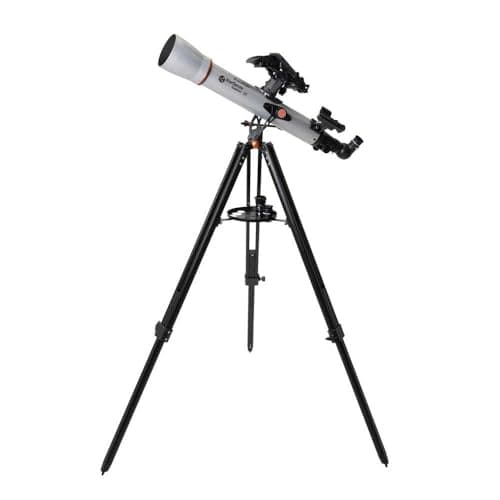
If the DX 102AZ is a little beyond your budget, the StarSense Explorer LT 70AZ brings the same brilliant smartphone-guided experience to a much friendlier price. It uses the identical, award-winning StarSense app (so your child still gets that magical "follow the arrow to Saturn" experience) wrapped around a lighter 70mm refractor that is quick to set up and easy for younger astronomers to handle.
You inevitably give up some light-gathering power compared with larger scopes, so the faintest galaxies will stay out of reach. But for the headline targets that actually thrill children (the Moon in crisp detail, Jupiter and its four bright moons, Saturn's rings, the Pleiades star cluster) the LT 70AZ delivers, and the app means they will actually find them rather than giving up in frustration.
Key features:
- 70mm refractor with the full StarSense Explorer app experience
- Smartphone dock with on-screen guidance to visible objects
- Lightweight manual alt-azimuth mount with slow-motion adjustment
- Two eyepieces and a full-height tripod included
Best for: Parents who want a true smart telescope without the premium price tag.
3. NASA Lunar Telescope for Kids: Best for Younger Children
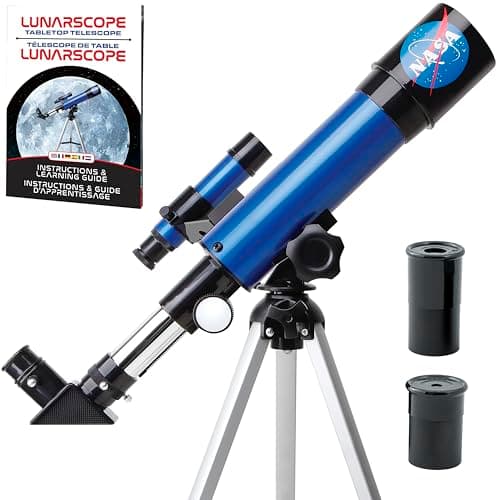
Officially licensed by NASA and built specifically for younger stargazers, this Lunar Telescope for Kids is one of the best introductions to astronomy for the 6-to-9 age group. As the name suggests, it is optimised for the Moon (far and away the most rewarding first target for a child) and it shows craters, ridges and the dark lunar "seas" in pleasing detail with its two supplied eyepieces and 90x maximum magnification.
The whole thing is refreshingly simple. It assembles in minutes, sits on a stable tabletop tripod (no fiddling with full-height legs in the dark), and includes a finderscope to help line things up. It is light enough for small hands to aim, and robust enough to survive the inevitable knocks. For a birthday or a first "proper" telescope that won't overwhelm a young child, it is hard to beat.
Key features:
- NASA-licensed beginner refractor, 90x maximum magnification
- Two eyepieces plus a finderscope for easy aiming
- Stable tabletop tripod and smooth mount
- Quick, tool-free assembly aimed at younger children
Best for: Children aged roughly 6-9 taking their very first look at the Moon.
4. Celestron Travel Scope 70: Best for Travel and Summer Holidays
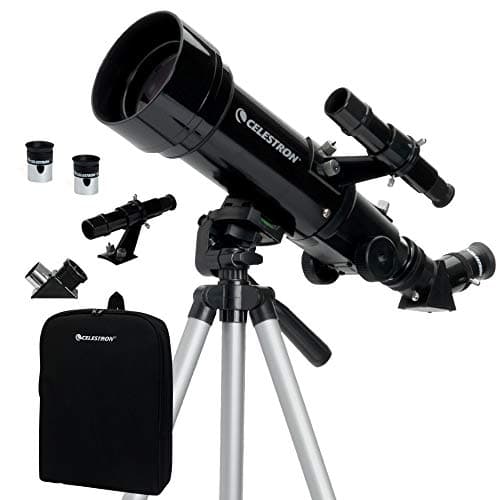
Summer means holidays, and holidays often mean genuinely dark skies. A campsite in Wales or a cottage in Cornwall can deliver views you would never get from a light-polluted town. The Celestron Travel Scope 70 is built for exactly those trips. It packs the 70mm refractor, a full-height tripod and accessories into a dedicated backpack, weighs very little and sets up in moments.
The fully-coated 70mm optics punch above their weight on the Moon and bright planets, and because it works just as well in daylight, it doubles as a spotting scope for landscapes, wildlife and birdwatching during the day. It is a versatile, sling-it-over-your-shoulder option that encourages families to actually take the telescope somewhere dark, which is, after all, the whole point.
Key features:
- 70mm fully-coated refractor in a portable package
- Included backpack, full-height tripod and two eyepieces
- Lightweight and quick to assemble for travel
- Doubles as a daytime spotting scope
Best for: Family camping trips, holidays and anyone who wants a grab-and-go scope. Pairs nicely with our best camera drones for adults UK 2026 for outdoor adventures.
5. Celestron AstroMaster 130EQ: Best for Deep-Sky on a Budget
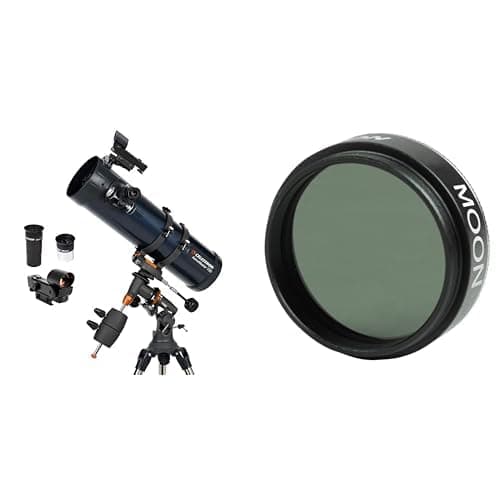
When an older child or teenager is ready to move beyond the Moon and planets and start hunting galaxies, star clusters and nebulae, aperture is what counts, and the Celestron AstroMaster 130EQ delivers a lot of it for the money. Its 130mm Newtonian mirror gathers far more light than any of the small refractors above, revealing fainter deep-sky objects that simply do not show up in a 70mm scope.
The trade-off is the equatorial (EQ) mount, which takes a little learning. Once it is roughly aligned, though, it tracks the sky's gentle rotation with a single smooth motion: a real advantage at higher magnifications when objects otherwise drift out of view quickly. With its two eyepieces and StarPointer red-dot finder, this is a proper entry-level astronomer's telescope rather than a toy, and it rewards a child who is genuinely getting into the hobby.
Key features:
- 130mm Newtonian reflector for bright deep-sky views
- Tracking equatorial mount with slow-motion controls
- Two eyepieces (20mm and 10mm) and StarPointer finder
- Lightweight steel tripod with accessory tray
Best for: Teens and committed beginners ready to explore beyond the Moon and planets.
6. Celestron StarSense Explorer DX 130: Best Smart Reflector
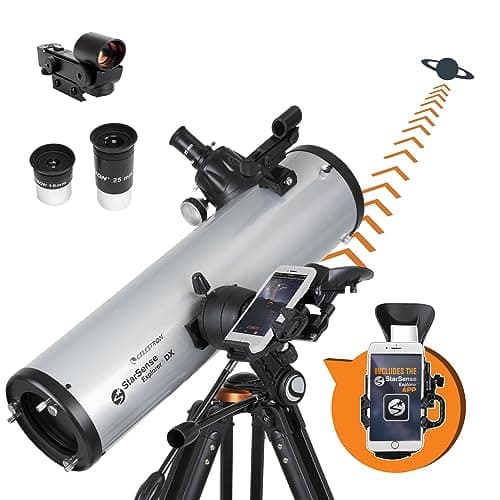
The StarSense Explorer DX 130 is, in many ways, the best of both worlds: it marries the larger 130mm reflector optics that deep-sky objects demand with the same phone-guided StarSense app that makes finding them effortless. For a child who wants to see galaxies and nebulae but isn't ready to wrestle with star charts, this is the sweet spot.
The extra aperture over the 102mm refractor means fainter targets (the Andromeda Galaxy, the Hercules Globular Cluster, the wispy Lagoon Nebula) come within reach, while the app takes care of the tricky business of locating them. It sits on an intuitive alt-azimuth mount with slow-motion control, so there is no equatorial learning curve to slow a youngster down. If your child has caught the astronomy bug and wants to go deeper without the frustration, this is the smart scope to grow into.
Key features:
- 130mm Newtonian reflector with StarSense sky-recognition app
- Phone-guided location of hundreds of objects
- Beginner-friendly alt-azimuth mount with slow-motion control
- Two eyepieces and red-dot finder included
Best for: Keen young astronomers who want deep-sky reach plus effortless, app-guided finding.
7. Aomekie 70/400 Refractor: Best Budget All-Rounder
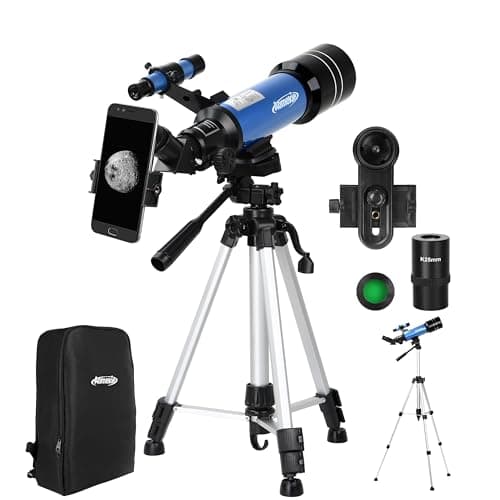
For families who want a capable, do-everything telescope without spending a great deal, the Aomekie 70/400 is a strong, sensible choice. It is a 70mm refractor with a 400mm focal length, supplied with two Kellner eyepieces (10mm and 25mm), an adjustable tripod, a carry backpack and (a lovely touch for children) a smartphone adapter so they can photograph the Moon through the eyepiece and share it.
A 45-degree erecting prism means the image is the right way up, which makes the scope genuinely usable for daytime nature-watching as well as evening astronomy. The shorter focal length gives wide, easy-to-find views that suit beginners, and the whole kit packs into the included bag. It is not going to rival a 130mm reflector on faint galaxies, but as an affordable, flexible first telescope that the whole family can share, it offers excellent value.
Key features:
- 70mm refractor with 10mm and 25mm Kellner eyepieces
- Smartphone photo adapter and 45° erect-image prism
- Adjustable-height tripod and carry backpack included
- Works for both astronomy and daytime nature viewing
Best for: Budget-conscious families wanting one flexible scope for day and night.
8. Science Mad 50mm Telescope: Best Cheapest First Scope
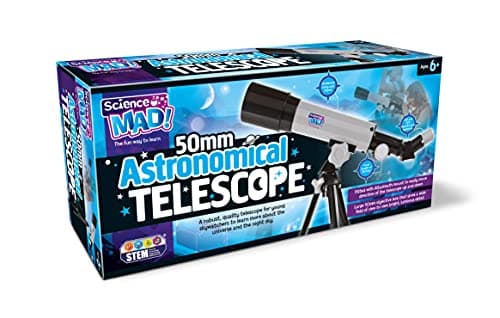
From the well-known Science Mad STEM brand, this 50mm telescope is the most affordable pick on our list and an ideal "does my child even like astronomy?" starter. With a 50mm objective lens, two eyepieces (20mm and 4mm) and up to 90x magnification, it shows the Moon's craters and the brighter planets clearly: enough to spark genuine excitement without a big outlay.
It comes with a lightweight tabletop tripod and a simple alt-azimuth mount, so a child can set it up on a windowsill or garden table and start exploring straight away. Naturally, at this price the build is plasticky and the views are modest compared with the larger scopes above, but as a first telescope for a curious six- or seven-year-old (or a low-risk gift to test the waters) it does exactly what it should. For more hands-on science to go alongside it, see our best STEM toys UK 2026 guide.
Key features:
- 50mm refractor, up to 90x magnification
- Two eyepieces (20mm and 4mm) for low and high power
- Compact tabletop tripod and simple alt-azimuth mount
- From a recognised children's STEM brand
Best for: A low-cost first telescope or a gift to test a young child's interest.
9. National Geographic 50/600 AZ: Best Classic Starter Refractor
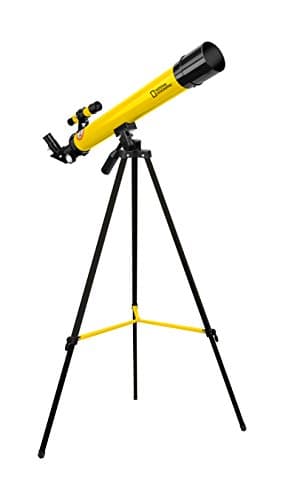
The National Geographic 50/600 AZ is a tidy, traditional starter refractor from a brand families instinctively trust. Its longer 600mm focal length (paired with the 50mm lens) gives steadier, higher-contrast views of the Moon and bright planets than the very short budget scopes, and it offers up to around 100x magnification. The simple azimuth mount is intuitive (just point and look) and at under a kilogram, it is genuinely light enough for a child to carry and aim without help.
It is a no-frills, no-app telescope, and that is rather the point: there are no batteries, no software, no setup faff, just a child, a clear sky and the Moon. For parents who want a straightforward, dependable first scope with a name they recognise, it is an easy recommendation.
Key features:
- 50mm refractor with a longer 600mm focal length
- Up to roughly 100x magnification
- Simple, lightweight azimuth mount (under 1kg)
- Trusted brand, no batteries or app required
Best for: Families wanting a simple, recognisable, fuss-free first telescope.
10. DWARFLAB Dwarf 3 Smart Telescope: Best for Astrophotography
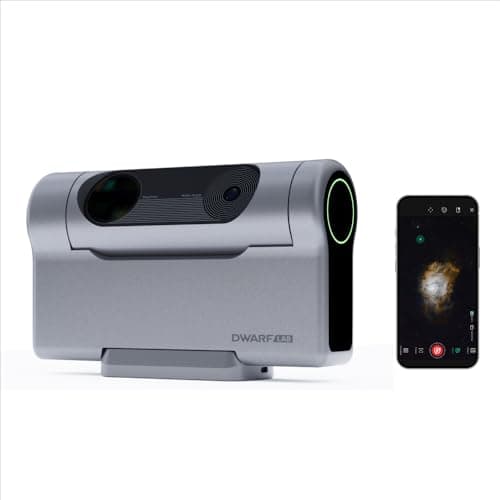
The DWARFLAB Dwarf 3 is something quite different, and a perfect fit for a tech-obsessed teenager. There is no eyepiece to squint through. Instead, this book-sized, 1.35kg device is a fully automated smart telescope that you control entirely from your phone or tablet. Tell it what to photograph and its AI does the rest: it plate-solves the sky to find the target, tracks it automatically as the Earth turns, and stacks dozens of exposures in the cloud to pull out colour and detail no eyepiece could ever show: the pink glow of nebulae, the dusty arms of galaxies.
Its clever dual-lens system means it also works in daylight as a 4K telephoto wildlife and landscape camera, making it a genuine year-round gadget rather than a clear-nights-only purchase. It is the priciest pick here and aimed at older children and adults rather than little ones, but for a teen fascinated by astrophotography and AI, nothing else on this list comes close. If they love smart, app-driven kit, our best drones for kids UK 2026 roundup is well worth a look too.
Key features:
- Fully automated AI smart telescope: controlled by app, no eyepiece
- Plate-solving target finding and automatic tracking
- Cloud-powered image stacking for colourful deep-sky photos
- Dual-lens design doubles as a 4K daytime wildlife camera
Best for: Teens and adults who want to photograph the night sky, not just look at it.
What Will My Child Actually See?
It is worth setting honest expectations, because the glossy nebula photos on telescope boxes are taken with professional equipment and long exposures. Not what the eye sees live. Through a good beginner telescope, your child can genuinely expect to see the Moon's craters and mountains in jaw-dropping detail, the rings of Saturn, the four largest moons of Jupiter (and its cloud bands on a steady night), the phases of Venus, and brighter star clusters like the Pleiades. With a larger reflector and a dark sky, fainter "fuzzies" such as the Orion Nebula and the Andromeda Galaxy come into view as soft grey smudges. Exciting once you know what you are looking at, but not Hubble-bright.
The single biggest upgrade to what you can see is not the telescope at all. It is the sky. Escaping town lights to somewhere properly dark will reveal more than doubling your aperture ever could. That is exactly why the summer holidays, with trips to the countryside and coast, are such a wonderful time to start.
How we picked these
Every product here was checked against its live Amazon UK listing before publication: in stock, the listing matching the model we describe, and the price recorded at the time of writing. We read the manufacturer's own specifications for the figures quoted, and work through recent verified-purchase reviews looking for the same fault reported repeatedly rather than one-off complaints.
Picks are ordered by who each product actually suits: age, budget, and whether an app or subscription is involved. Not by commission. AIToys.co.uk earns from qualifying purchases through the links on this page; that does not affect the order. The full process, including what we don't do, is on our how we choose page.
Frequently Asked Questions
What age is a telescope suitable for? Around six is a sensible starting age for a simple, supervised tabletop telescope like the NASA Lunar or Science Mad models. From about eight, children can manage a 70mm refractor with help, and the app-guided StarSense scopes make finding objects easy enough for this age. Larger reflectors and the equatorial-mount AstroMaster suit roughly 12 and up. Whatever the age, an adult should always supervise outdoor use after dark.
Do I need a smartphone for a "smart" telescope? Yes. App-enabled telescopes such as the Celestron StarSense range and the DWARFLAB Dwarf 3 use your phone or tablet to find and (in the Dwarf's case) photograph objects. They work with both iPhones and Android devices. The optical StarSense scopes can still be used manually without a phone, but you lose the guided-finding feature that makes them special.
Is a telescope or binoculars better for a beginner? Both are excellent, and many seasoned astronomers recommend starting with binoculars. A pair of 10x50 binoculars is cheap, needs no setup and gives lovely wide views of the Moon, star fields and the Milky Way. A telescope, however, is the only way to see Saturn's rings or Jupiter's moons clearly, which is usually what captures a child's imagination. If budget allows, a small telescope wins for the "wow" factor.
Can you really stargaze from a UK garden? Absolutely. The Moon and bright planets are easily visible even from light-polluted towns and cities. They are bright enough to cut through the glow. Fainter deep-sky objects need darker skies, so a trip to the countryside helps, but nobody should feel they need to wait for a perfect location to start. A back garden and a clear night are plenty to begin.
When is the best time to stargaze this summer? Plan around the Moon and the meteors. A bright full Moon washes out faint objects, so the darker nights around a new Moon are best for deep-sky viewing, though the Moon itself is most spectacular through a telescope when it is a crescent or half, when shadows make the craters stand out. The summer highlight is the Perseid meteor shower, which peaks around 12-13 August; for that you need no telescope at all, just a reclining chair, a dark sky and patience.
The Verdict
For most families, the Celestron StarSense Explorer DX 102AZ is the best telescope to buy in 2026: its phone-guided sky recognition removes the frustration that ends so many beginners' astronomy journeys, and its 102mm aperture shows enough to keep everyone hooked. If the budget is tighter, the StarSense Explorer LT 70AZ brings that same clever app experience down to a friendlier price, while the Science Mad 50mm and NASA Lunar Telescope are superb, inexpensive first scopes for younger children.
Older, more committed youngsters should look at the AstroMaster 130EQ or the app-guided StarSense Explorer DX 130 for serious deep-sky reach, holidaymakers will love the packable Travel Scope 70, and a budding teenage astrophotographer will be enchanted by the AI-driven DWARFLAB Dwarf 3.
Whichever you choose, the real magic is simply getting outside on a clear summer night and looking up together. Wrap up, find a dark spot, give your eyes twenty minutes to adjust, and let your child discover the universe for themselves. For more ideas to feed a curious young mind, browse our best AI toys for 9-12 year olds UK 2026 roundup.
As an Amazon Associate, AIToys.co.uk earns from qualifying purchases. Prices and availability were checked in July 2026 and can change at any time. Always confirm the current price on Amazon before buying.
Read next
Best Magnetic Tiles UK 2026: 12 Sets Compared for Every Age and Budget
The best magnetic tiles in the UK for 2026. Connetix, Magna-Tiles, Playmags and budget sets compared on magnet strength, piece mix, marble runs and value.
Best Microscopes for Kids UK 2026-10 Top Picks for Young Scientists
The best microscopes for kids and beginners in the UK for 2026. Compare digital, compound, stereo and smartphone microscopes by age, magnification and price.
Best STEM Toys for 8 Year Olds UK 2026
Discover the top STEM toys for 8-year-olds in the UK, from coding robots to science kits, designed to spark curiosity and develop critical skills in 2026.