Best Science Kits for Kids UK 2026: 14 Picks by Age
Chemistry sets, crystal kits and earth science labs for UK kids aged 4 to 14, grouped by age with safety notes. Prices are correct as of 25 October 2026.
As an Amazon Associate, AIToys.co.uk earns from qualifying purchases.
Science kits for kids, in this guide, means chemistry, crystals, slime, volcanoes and earth science you can buy on Amazon UK. It does not mean coding robots or electronics labs. Those already have their own pages, linked at the end, and repeating them here would not help a parent who asked for a chemistry set. The fourteen kits below were in stock on 25 October 2026, including two with only a handful left. They are grouped by the age on the box, which is not the same as reading age. A keen six-year-old can still be too young for real reagents, and a ten-year-old can still need an adult for anything that heats or stains.
AIToys.co.uk selects and researches from the listings and manufacturer claims. We do not run the experiments and we do not claim a first-hand test. There are no scores. Prices are correct as of 25 October 2026 and they will move.
Quick picks by age
| Age on the box | Start here | Why | Price |
|---|---|---|---|
| 4 to 6 | Fizzy Volcano | Kitchen-chemistry style reactions, 13 pieces | £15.99 |
| 4 and up, more to do | National Geographic Junior Chemistry | 50 experiments using household items | £27.99 |
| 5+ and messy | Galt Slime Lab | Seven slime experiments, glow in the dark | £13.60 |
| 6 to 8, broader | Galt Science Lab | 20 experiments across chemistry, biology and physics | £15.99 |
| 8 to 12, crystals | Mega Crystal Growing Kit | Six crystals in 3 to 4 days | £34.99 |
| 10+ real chemistry | Thames & Kosmos C1000 | Proper lab kit. Only 5 left | £81.17 |
| Step above C1000 | Thames & Kosmos C2000 | Includes an alcohol burner. Strict supervision | £137.49 |
Science kits for ages 4 to 6
At this age the win is noticing what changed: a fizz, a colour, a slime that was powder a minute ago. An adult measures, an adult reads, and the child predicts and watches. None of these is a set of laboratory acids.
1. Learning Resources Fizzy Volcano Science Experiments
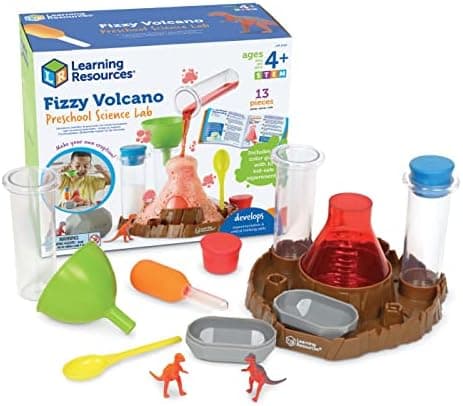
Age range: 4+ on the listing. Developmental fit: observation and prediction. The child is not running a lone experiment. Safety notes: Baking-soda style reactions. Adult supervision. Keep powders out of mouths and eyes. Sold by Amazon, in stock. Parental involvement: High. You do the pouring. Privacy: None. No app.
Thirteen pieces and a guide for 10 experiments, including a fizzy "fossil" and slime, described as child-friendly tools based on lab equipment. A volcano kit at this age should stay fizzy, not fiery.
Pros: Clear 4+ age, in stock, short experiments. Cons: One-sitting fun unless you buy more bicarbonate, adult does the work, easy to outgrow.
£15.99 (price correct as of 25 October 2026). In stock. Check the fizzy volcano kit on Amazon UK
2. National Geographic Junior Chemistry Set
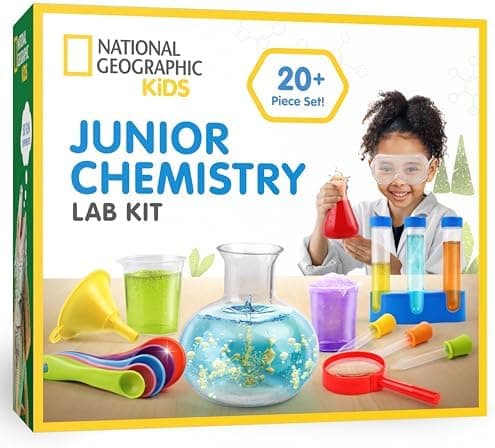
Age range: 4 and up on the listing. Developmental fit: a long menu of small experiments for a child who will come back to the book. Safety notes: Uses household items such as baking soda and vinegar, plus 20 or more child-friendly tools. Still supervise. Sold by National Geographic Science Toys, in stock. Parental involvement: High at 4, shared by 6. Privacy: None.
Blue Marble's junior set is the "50 experiments" option when the fizzy volcano feels thin. The age on the box starts at 4, and many of the activities still need you in the room.
Pros: Lots of experiments for the money, household chemicals rather than a reagent cabinet, in stock. Cons: 4+ is optimistic for independent use, you supply the kitchen ingredients, tools are small.
£27.99 (price correct as of 25 October 2026). In stock. Check the junior chemistry set on Amazon UK
3. Learning Resources Rainbow Reactions
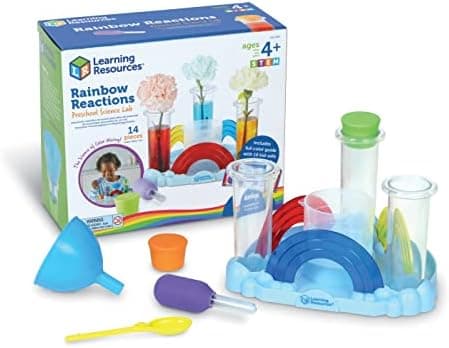
Age range: 4+. Developmental fit: colour mixing and careful pouring. Safety notes: Food-colour style mess. Protect the table and clothes. Sold by Amazon, in stock. Parental involvement: High. Privacy: None.
Fourteen pieces and 10 experiments. The listing examples are colourful flowers and a rainbow volcano. Choose this over the fizzy volcano if colour is the interest and fizz is not.
Pros: Focused on one idea, in stock, 4+. Cons: Messy, overlaps the fizzy set if you buy both, not a chemistry set in the secondary-school sense.
£19.96 (price correct as of 25 October 2026). In stock. Check Rainbow Reactions on Amazon UK
4. Galt Slime Lab
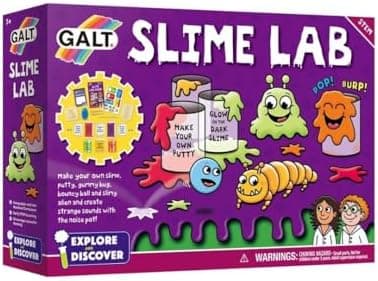
Age range: 5+. Developmental fit: following a method, then a tactile result. Safety notes: Slime activator is not food. Adult supervision, wash hands, keep it away from mouths, eyes and soft furnishings. Sold by Amazon, in stock. Parental involvement: High for mixing, then the child plays with the result. Privacy: None.
Seven experiments, including a glow-in-the-dark alien and a slime bug. Galt links this range to the National Curriculum on the listing. That is a curriculum-adjacent activity kit, not a school assessment.
Pros: £13.60, clear 5+, glow is a real reason children ask for it. Cons: Activator chemicals, slime migrates, seven experiments then you are done unless you buy refills.
£13.60 (price correct as of 25 October 2026). In stock. Check Galt Slime Lab on Amazon UK
Science kits for ages 7 to 9
Children this age can read a step and still skip the warning. Stay for anything that fizzes, stains or grows a crystal. Crystal chemicals and perfume oils are not preschool leftovers.
5. Galt Science Lab
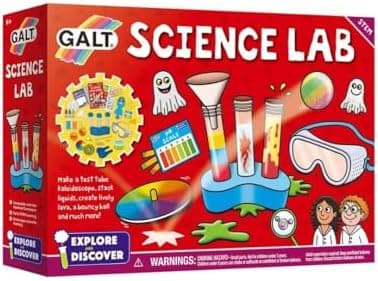
Age range: 6+ on the listing, and it sits happily with 7 to 9. Developmental fit: a sampler across chemistry, biology and physics, 20 experiments. Safety notes: Follow the booklet. Sold by Amazon, in stock. Parental involvement: Medium. Read the messy ones with them. Privacy: None.
The listing examples include a floating ghost, a test-tube kaleidoscope and erupting lava. It is a broader kit than Slime Lab and a gentler step than a real chemistry cabinet.
Pros: 20 experiments, 6+, in stock, under £16. Cons: Breadth means each activity is short, some need household extras, easy to lose small tools.
£15.99 (price correct as of 25 October 2026). In stock. Check Galt Science Lab on Amazon UK
6. Galt Horrible Science Explosive Experiments
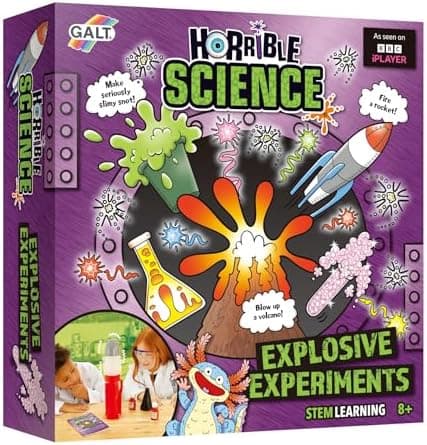
Age range: 8+. Developmental fit: children who like the Horrible Science books and a noisy result. Safety notes: Fizzing and popping. Use eye protection where the manual says so. A plastic rocket is in the box. Sold by Amazon, in stock. Parental involvement: High for the rocket and the volcano. Privacy: None.
Eight experiments: a volcano, slime and a rocket, tied to the UK Horrible Science series and described as National Curriculum linked. "Explosive" is marketing. Treat it as a supervised fizz, not a firework.
Pros: 8+, in stock, a known book series. Cons: Only eight experiments, the name oversells the bang, eye protection is not optional when the manual asks for it.
£17.00 (price correct as of 25 October 2026). In stock. Check Explosive Experiments on Amazon UK
7. Clementoni Science & Play Extra Chemistry Lab
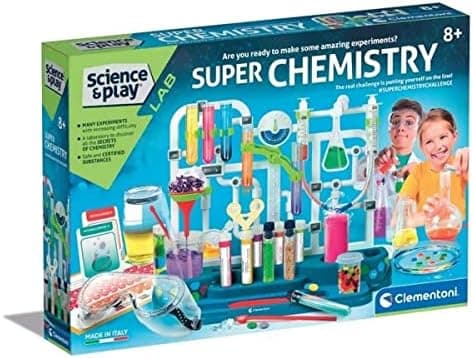
Age range: 8+. Developmental fit: a first proper "lab" tray for a child who wants to mix, using materials Clementoni calls safe. Safety notes: Follow the manual. Do not decant chemicals into food containers. Sold by Amazon, in stock. Parental involvement: Medium to high. Privacy: None.
The listing pitches reactions and mixing you do at the table, aimed at critical thinking rather than a single wow. It is a bridge between Galt's activity kits and Thames & Kosmos.
Pros: 8+, in stock, £19. Cons: Less famous in UK classrooms than Galt, "safe materials" still need the manual, small parts.
£19.00 (price correct as of 25 October 2026). In stock. Check the Clementoni chemistry lab on Amazon UK
8. National Geographic Mega Crystal Growing Kit
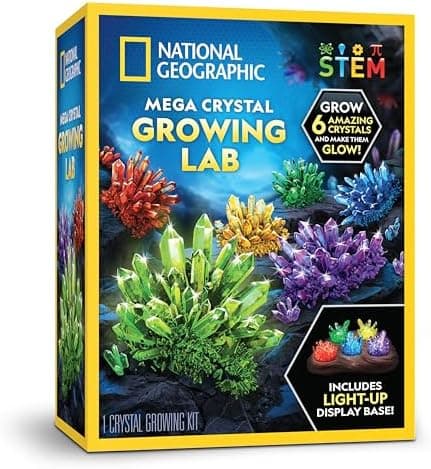
Age range: 8 to 12 in the listing title. Developmental fit: patience. Crystals take 3 to 4 days. Good for a child who can wait and bad for one who wants a result before tea. Safety notes: Crystal chemicals. Not for younger siblings. Do not taste the solution. Keep the growing chambers out of bedrooms of children who still mouth objects. Parental involvement: Medium. You supervise mixing, then everyone waits. Privacy: None. The light-up stand may need batteries. Check the box.
Six colours, including glow in the dark, two silicone chambers, and four real gemstone specimens. Sold by National Geographic Science Toys, in stock.
Pros: A clear 8 to 12 age, a display at the end, in stock. Cons: Chemicals, several days of waiting, not a one-afternoon gift if the party is tonight.
£34.99 (price correct as of 25 October 2026). In stock. Check the crystal kit on Amazon UK
9. National Geographic Mega Earth Science Kit
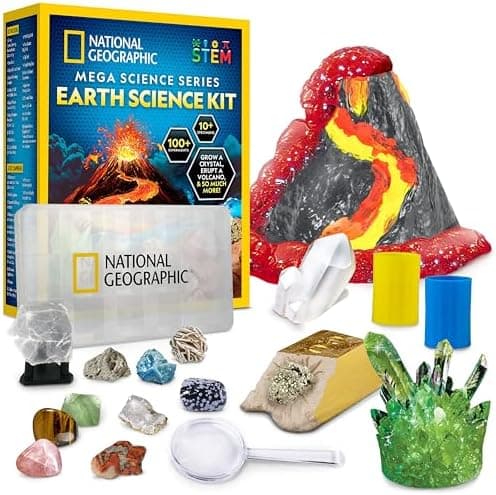
Age range: Not stated in the API data. It is grouped here with 7 to 9 because the activities (volcano, crystals, rocks) match that stage. Confirm the box age. Developmental fit: earth science rather than a pure chemistry set. Safety notes: Volcano and crystal steps need the same supervision as the kits above. An 8-specimen rock collection is safe to handle and easy to lose. Parental involvement: Medium. Privacy: None.
The listing says 15 included experiments, plus a bonus guide of 85 or more that use household materials. Sold by National Geographic Science Toys, in stock at £27.99. The bonus guide is paper, not 85 extra boxes of chemicals.
Pros: Broad earth-science set, rocks you can keep, in stock. Cons: Age missing from the data, the "100+" count includes the paper bonus, crystal steps still need care.
£27.99 (price correct as of 25 October 2026). In stock. Check the earth science kit on Amazon UK
10. Clementoni Smart-Tech Greenhouse
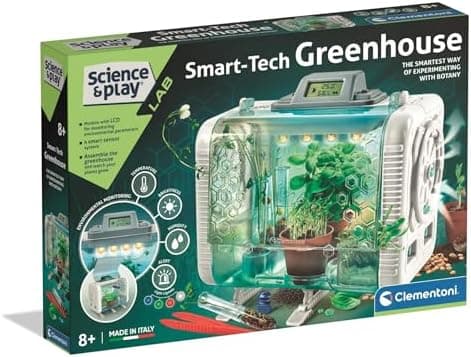
Age range: 8+. Developmental fit: watching a plant respond to water, light and temperature. Slower than slime and more repeatable. Safety notes: Electronic sensors, an LCD and batteries. Soil and water near electronics. Do not let younger children mouth seedlings or button cells if the greenhouse uses them. Confirm the battery type on the box. Sold by Amazon, in stock. Parental involvement: Medium, especially for batteries and the first planting. Privacy: Sensors are local readings of the greenhouse, not a cloud camera, on the listing we saw. There is no mention of an account.
LED alerts when the plants need water. This is the kit for a child who likes looking after something.
Pros: 8+, repeatable, in stock under £20. Cons: You need seeds and patience, electronics plus water is a spill risk, not a chemistry set.
£19.99 (price correct as of 25 October 2026). In stock. Check the smart greenhouse on Amazon UK
11. Science4you Perfume Super Lab
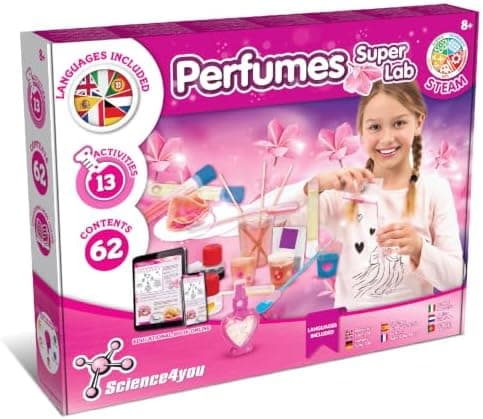
Age range: 8 to 14, and 8+ on the listing. Developmental fit: measuring and smelling. Thirteen activities, with a gift-making angle. Safety notes: Fragrance oils. Skin-test caution. Supervise. Not for faces and not for children with fragrance sensitivity. Wash hands. Sold by Amazon, in stock. Parental involvement: High for the first mixes. Privacy: None.
Sixty-three contents is a lot of small bottles. Store them shut, and away from younger siblings.
Pros: 8 to 14 stated, in stock, the result is something they can give. Cons: Oils on skin, many small parts, scent is a matter of taste.
£24.99 (price correct as of 25 October 2026). In stock. Check the perfume lab on Amazon UK
Science kits for ages 10 to 14
This is where a chemistry set starts to look like school lab kit. Goggles, a clear table, and an adult who will read the manual are the entry ticket. The video below is about the C1000, which is the kit most families mean when they ask for a "real" set.
Video: John Stanton. A review of the C1000, which the film describes as 125 experiments for ages 10 and up. Not filmed by AIToys.co.uk.
12. Thames & Kosmos Intro to Chemistry
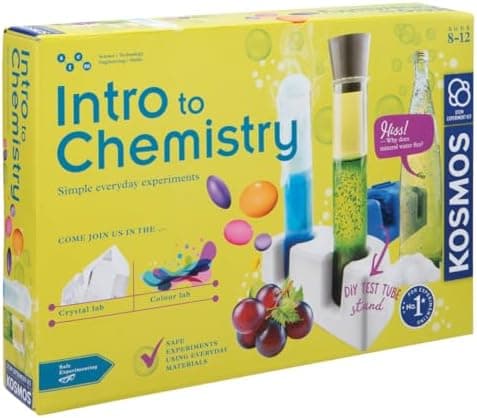
Age range: 8 to 12 on the listing. It is the bridge into the 10+ cabinet, so it can suit a careful eight-year-old or a ten-year-old who is not ready for C1000. Developmental fit: atoms, molecules, reactions and lab safety, with beginner equipment. Safety notes: Test tubes, pipettes and chemicals the maker calls safe for beginners. Only 9 left on 25 October 2026. Third-party seller Grasshopper Toys. Parental involvement: High. Privacy: None.
Pros: A real step toward lab skills, age range stated. Cons: Only 9 left, third-party seller, still needs supervision.
£36.91 (price correct as of 25 October 2026). Only 9 left. Check Intro to Chemistry on Amazon UK
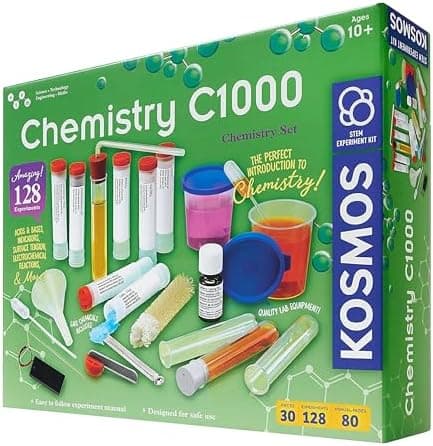
13. Thames & Kosmos Chemistry C1000
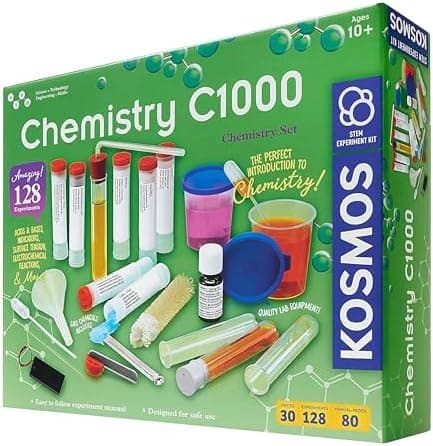
Age range: 10+. Developmental fit: children who will follow a manual over many weekends. The John Stanton video cites 125 experiments. Safety notes: Real chemicals, goggles, adult supervision. Keep the box away from younger children. Only 5 left. Seller Grasshopper Toys. Parental involvement: High, every session that uses reagents. Privacy: None.
Acids, bases and lab technique are the point. This is the kit to buy when a junior or Galt set would feel like a toy.
Pros: The standard "proper chemistry set" brief, 10+ stated, safety gear mentioned in the listing. Cons: Only 5 left, £81.17, third-party seller, not a gift to open and abandon.
£81.17 (price correct as of 25 October 2026). Only 5 left. Check the C1000 on Amazon UK
14. Thames & Kosmos Chemistry C2000
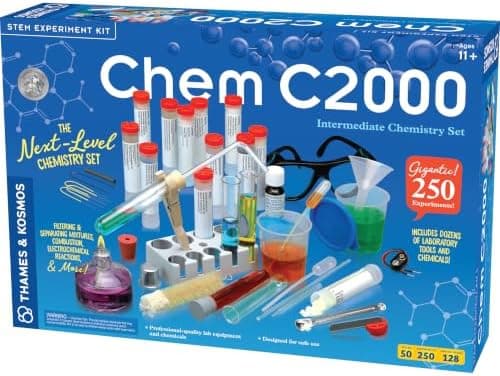
Age range: Not stated in the API data. Thames & Kosmos positions C2000 above the 10+ C1000. Treat it as a supervised teen kit and confirm the box. Developmental fit: a longer course for a teenager who finished the ideas in C1000, or who is ready to start at that level with an adult. Safety notes: The listing introduces an alcohol burner for heated experiments. That is a naked flame. Strict adult supervision. Keep it away from younger children, hair and solvents. Third-party seller Grasshopper Toys, in stock. Parental involvement: Very high. An adult is present for every heated experiment. Privacy: None.
Professional-style equipment is the claim. The burner is the reason this is not a casual birthday buy.
Pros: In stock, the fullest set on the page, heated experiments for teenagers who are ready. Cons: £137.49, alcohol burner, age not in the API data, third-party seller.
£137.49 (price correct as of 25 October 2026). In stock. Check the C2000 on Amazon UK
Safety
Read the manual that arrives in the box. A few rules cover this whole list.
- An adult is in the room for powders, oils, crystals and anything that fizzes into eyes.
- Goggles go on when the manual says so, and for every C1000 or C2000 session.
- UKCA or CE marking belongs on toys sold in the UK. Check the box and the listing. This page does not assert a mark we did not see printed in the API fields.
- Younger siblings are the usual accident. Crystal solutions, slime activator, perfume oils, small pipettes and the C2000 burner are not shared with under-3s.
- Do not store reagents in food tubs, and do not pour leftovers down a cup a child might drink from.
- Slime and perfume need hand washing. Crystals need a surface you can wipe.
These kits are not connected toys. There is no camera, microphone or account on the listings above, apart from the greenhouse sensors, which read the plant tray rather than the room.
How to choose
Age on the box against reading age. A strong reader of 7 is still 7 when the warning is about chemicals. Prefer the stated age, and step up only with an adult who will stay.
Mess. Slime, volcanoes and perfume mark tables. Crystals mark less, then sit for days. The greenhouse is ongoing.
Refills. Galt and the junior sets end when the powders end. C1000 and C2000 are built as a course. Crystals are a one-grow unless you buy more solution.
One afternoon or a month. Fizzy volcano and slime are parties. Crystals and the greenhouse are projects. C1000 is a term.
A Christmas note
If the kit is a present, check stock early. Intro to Chemistry had 9 left and the C1000 had 5 left on 25 October 2026. Wider present ideas, including coding toys this page deliberately leaves out, are in the Christmas 2026 gift guide.
Frequently asked questions
What is the best science kit for an 8 year old?
For a broad sampler, Galt Science Lab (6+) or Horrible Science Explosive Experiments (8+). For crystals, the National Geographic mega kit states 8 to 12. For a first lab tray, Clementoni's extra chemistry lab is 8+ and was in stock at £19. Skip C1000 until 10, and skip C2000 while there is a younger child in the kitchen.
Are chemistry sets safe?
The preschool and junior sets use household or "safe" materials and still need an adult. C1000 and C2000 use real lab chemicals and, on C2000, a flame. Safe means following the manual, wearing the goggles, and locking the box away afterwards. It does not mean unsupervised.
What age is a real chemistry set for?
Thames & Kosmos prints 10+ on the C1000. Intro to Chemistry is labelled 8 to 12 and is the step before that. C2000 sits above C1000 and adds a burner.
How do crystal kits differ from chemistry sets?
A crystal kit grows a display over a few days from a solution. A chemistry set teaches reactions, acids and bases, and lab kit. The mega crystal kit is the better present when they want something to keep on a shelf. C1000 is the better present when they want to learn the subject.
Related reading
Coding robots and electronics are in best STEM toys UK 2026 and best electronics kits for kids. Looking down a lens is a different hobby: microscopes and telescopes. Subscription build crates are covered in the CrunchLabs guide.
As an Amazon Associate, AIToys.co.uk earns from qualifying purchases. Prices and the "only N left" notes are correct as of 25 October 2026.
Read next
Best Language Learning Toys UK 2026: Buyers Guide
UK 2026 buyers guide to language-learning toys: LeapFrog, phonics, French, spelling games. In-stock Amazon UK picks. Updated September 2026.
Best Maths and Logic Toys UK 2026: Buyers Guide
UK 2026 buyers guide to maths and logic toys: Numberblocks, Gravity Maze, Maths Island and more. In-stock Amazon UK picks. Updated September 2026.
LeapFrog 100 Words Book Review UK 2026: First Words Ages 1-3
LeapFrog Learning Friends 100 Words Book review for UK parents: bilingual English and French, ages 12 months to 3 years, Amazon UK stock. Updated September 2026.