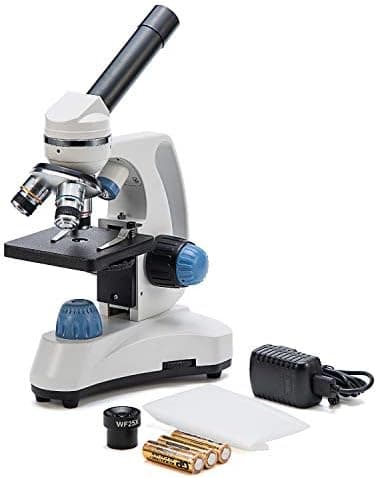
Best Microscopes for Kids UK 2026-10 Top Picks for Young Scientists
The best microscopes for kids and beginners in the UK for 2026. Compare digital, compound, stereo and smartphone microscopes by age, magnification and price.
_This article contains affiliate links. As an Amazon Associate, AIToys.co.uk earns from qualifying purchases: at no extra cost to you._
If a telescope opens up the universe above your child's head, a microscope opens up the equally astonishing one beneath their fingertips. A single drop of pond water turns out to be teeming with life. A scrap of onion skin becomes a tidy brick wall of cells. A feather, a fly's wing, a strand of their own hair: all reveal hidden structure that looks like science fiction. For a curious child, that first "whoa" down the eyepiece can spark a lifelong love of biology, and the best microscopes for kids make getting there genuinely easy.
The timing is good, too. With the summer holidays here and a new school year approaching in September, a microscope is the kind of gift that quietly builds science confidence before term even starts: turning rainy afternoons into experiments and garden walks into specimen hunts. It's the perfect companion to a first telescope; if you're weighing up both, our guide to the best telescopes for kids UK 2026 covers the night-sky half of the toolkit.
Today's options go well beyond the brass-and-glass classic, as well. Alongside traditional optical microscopes you'll find digital models with built-in colour screens the whole family can crowd around, and clever little gadgets that clip onto a smartphone. We've reviewed the market to bring you the ten best microscopes for children and beginners available in the UK for 2026, spanning a £10 first microscope to a proper £86 student compound. Every pick below was confirmed in stock on Amazon UK at the time of writing, with prices correct as of 22 June 2026.
One honest word on magnification: boxes love to shout "2000x!", but for children that number is mostly marketing. Beyond roughly 400x, cheap optics produce a big, blurry, hard-to-light image that's more frustrating than fun. A steady 40x-400x with good glass and decent lighting will show far more than a wobbly scope straining for impossible figures. Aperture, optics and ease of use matter more than the headline number: every time.
Comparison Table: Best Kids' Microscopes UK 2026
| Microscope | Best For | Type | Magnification | Price |
|---|---|---|---|---|
| Swift SW150 Compound | Best overall | Compound (optical) | 40x-1000x | ~£85.99 |
| Science Mad 100X Microscope | Best budget first scope | Compound (optical) | 25x-100x | ~£19.99 |
| Brainstorm Outdoor Adventure | Little ones (4-7) | Handheld field | 20x-40x | ~£9.99 |
| Science Can 40X-1600X | Best beginner kit | Compound (optical) | 40x-1600x | ~£29.99 |
| BEBANG 4K Digital | Best digital screen | Digital (LCD screen) | 200x-1000x | ~£35.99 |
| National Geographic STEM Kit | Best branded bundle | Compound (optical) | 100x-1200x | ~£68.05 |
| Bresser Junior 40-640x | Trusted-brand optical | Compound (optical) | 40x-640x | ~£39.99 |
| Nat Geo Phone Microscope 200x | Best smartphone clip-on | Smartphone | 200x | ~£46.89 |
| National Geographic Stereo 20x | Bugs, rocks & coins | Stereo (3D) | 20x | ~£79.09 |
| ESAKO Compound 100X-2000X | Best step-up compound | Compound (optical) | 100x-2000x | ~£59.99 |
🔬 Also on the high street: Browse microscopes & science kits at The Entertainer →
_Prices correct as of 22 June 2026 and may vary. We never claim a price is the lowest. Always check the live price on Amazon before buying._
1. Swift SW150 Compound Monocular Microscope: Best Overall
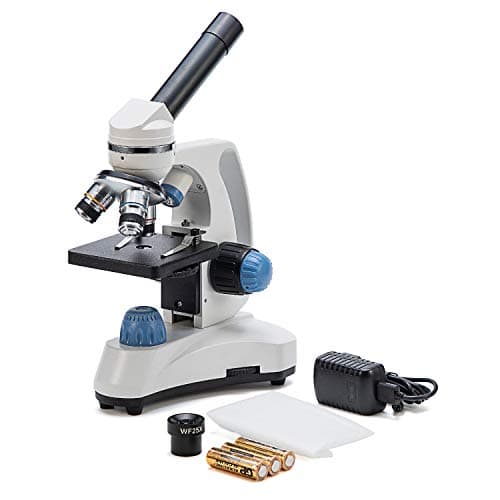
For a child who's ready to do real science, the Swift SW150 is our top overall pick, and Swift is a respected optics brand rather than a toy maker, which tells you a lot. It offers five genuine magnification settings (40x, 100x, 250x, 400x and 1000x) through proper glass objectives, so it grows with a child from first cells right through to secondary-school biology.
The detail that sets it apart is the dual LED illumination: a light below the stage for transparent specimens like onion skin and pond life, and a light above for solid objects like coins, insects and leaves. That means it can do the job of two microscopes. A fully rotatable monocular head makes sharing easy, the metal-framed body feels reassuringly solid, and cordless battery power plus a carry handle means your young scientist can take it into the garden or on holiday.
Who it's for: Keen children from around eight upwards who want a microscope they won't outgrow in a year.
Pros:
- Real glass optics from a trusted microscope brand
- Dual LED lights handle both see-through and solid specimens
- Sturdy metal build that survives enthusiastic use
Cons:
- Pricier than toy-grade options (but worth it)
- 1000x setting needs steady hands and good slides to shine
Around £85.99. Check price on Amazon UK →
2. Science Mad 100X Microscope: Best Budget First Microscope
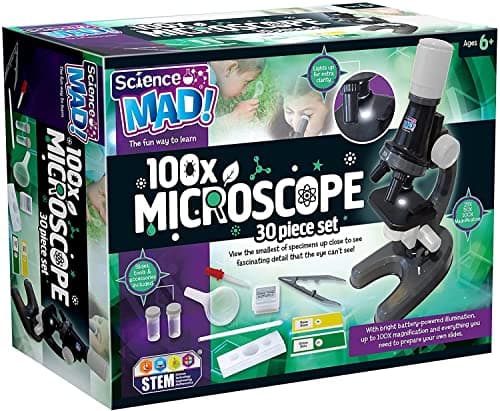
If you want to find out whether the science bug will bite before spending much, the Science Mad 100X Microscope is a brilliant, low-cost place to start. For under £20 you get a real working microscope offering three magnifications from 25x to 100x (a sensible, usable range for a beginner rather than an over-ambitious one) plus a generous 30-piece kit.
Crucially, it comes with everything a child needs to get going on day one, including two pre-prepared slides (rose stem and onion skin) so there's an instant "wow" moment without any setup faff, along with blank slides and tools to make their own. Science Mad is a UK STEM-toy brand built specifically for children, so the instructions, the build and the expectations are all pitched at a first-timer aged roughly six and up. It needs two AA batteries (not included) for its light, so grab some before the big reveal.
Who it's for: Younger children and cautious budgets: the ideal "let's see if they love it" gift.
Pros:
- Outstanding value with a complete 30-piece starter kit
- Pre-prepared slides give an instant first success
- Sensible magnification range that's actually usable
Cons:
- Limited headroom as skills grow
- Batteries not included
Around £19.99. Check price on Amazon UK →
3. Brainstorm Toys Outdoor Adventure Microscope: Best for Little Ones
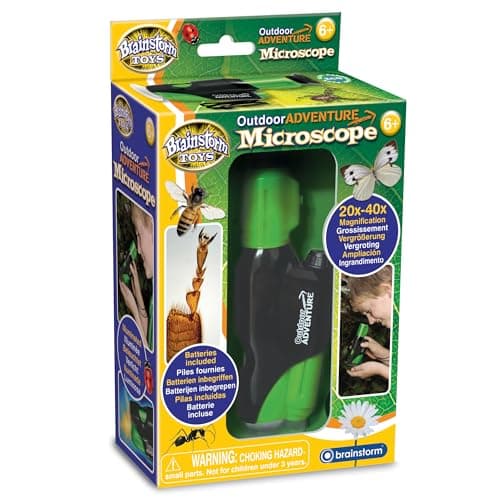
Sometimes the best microscope is the one a four-year-old can actually hold. The Brainstorm Toys Outdoor Adventure Microscope is a pocket-sized, handheld field scope built for tiny explorers, and at under a tenner it's the most affordable pick on our list. Instead of sitting at a desk, your child takes it outside and presses it up against bark, leaves, insects, rocks and flowers to see them in fascinating close-up.
An easy zoom dials in 20x to 40x magnification, a built-in LED lights up whatever they're examining even under a hedge, and a break-away lanyard keeps it safely round their neck while they scramble about. Best of all, it arrives with batteries included, so it's ready to use straight out of the box. No flat-pack frustration on a birthday morning. It won't show cells, but for sparking curiosity about nature in the very youngest scientists, it's hard to beat.
Who it's for: Pre-schoolers and infants (around 4-7) who love being outdoors.
Pros:
- Genuinely pocket-sized and child-proof simple
- Built-in LED and batteries included: ready immediately
- Encourages outdoor, hands-on nature discovery
Cons:
- Low magnification: it's a field explorer, not a lab tool
- Too basic for older children wanting to see cells
Around £9.99. Check price on Amazon UK →
4. Science Can 40X-1600X Microscope: Best Beginner Science Kit
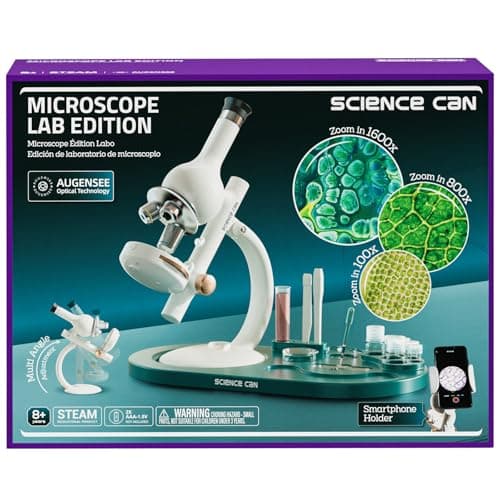
The Science Can 40X-1600X Microscope hits a lovely sweet spot between toy and tool, which is exactly what most 8-10 year olds need. It's a proper monocular compound microscope with built-in LED lighting and two eyepieces (10x and 20x), but it's wrapped in a friendly, durable ABS body and sold as a complete science kit: over 40 accessories, including eight prepared slides to explore immediately and blank slides for making their own.
What we like is how much guided learning is built in: clear instructions walk a child through placing a slide, securing it with the stage clips and focusing, so a parent doesn't need a biology degree to help. It's a confidence-building first compound microscope that looks like a gift and behaves like a lab. Pair it with a notebook and you've got weeks of rainy-day experiments, from onion cells to pond samples to a close look at a strand of hair.
Who it's for: Primary-age children (8-10) ready for their first "proper" desk microscope.
Pros:
- Complete kit with 40+ accessories and prepared slides
- Beginner-friendly instructions build independence
- Durable ABS build designed for younger hands
Cons:
- Top-end 1600x is more theoretical than practical
- Single-eyepiece viewing takes practice for very young kids
Around £29.99. Check price on Amazon UK →
5. BEBANG 4K Digital Microscope: Best Digital-Screen Microscope
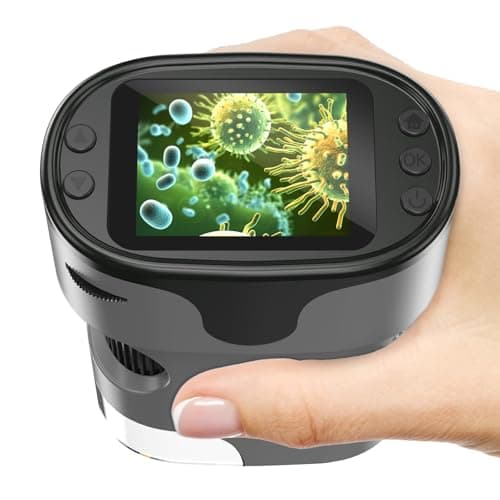
Squinting through an eyepiece is a learned skill, and not every child takes to it. The BEBANG 4K Digital Microscope sidesteps it entirely with a built-in 2.0-inch colour screen, so there's no closing one eye and no straining. Your child simply points and looks, and everyone can watch together. It's the most modern, tech-forward pick here, offering a 200x to 1000x five-level zoom and the ability to snap photos and record video of whatever they find.
At just 200g and pocket-sized, it's brilliantly portable, with a rechargeable battery good for around 2.5 hours, lab-grade glass slides in the box and a tough EVA case for chucking in a school bag. Being a digital handheld, the optics are more "fun and shareable" than scientifically precise, but for engagement (especially with reluctant or younger viewers) the shared screen is a genuine winner. It also makes a lovely gift, arriving in a presentation box.
Tech focus: A screen-based digital microscope with photo and video capture: the easiest format for group viewing and for saving discoveries to show at school.
Pros:
- Shared colour screen: no eyepiece skill needed
- Captures photos and video of discoveries
- Pocket-sized, rechargeable and travel-ready
Cons:
- Digital optics trade precision for convenience
- Small 2-inch screen suits one or two viewers at a time
Around £35.99. Check price on Amazon UK →
6. National Geographic Microscope STEM Kit: Best Branded STEM Bundle
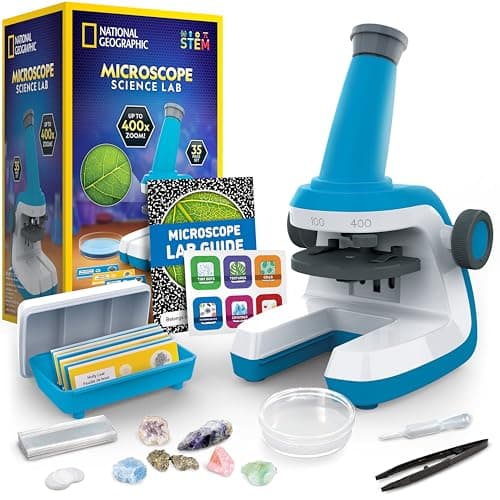
When you want a recognised, trusted name and a complete experience in one box, the National Geographic Microscope STEM Kit delivers. Made by Blue Marble under the National Geographic brand, it's designed from the ground up to be kid-friendly: large focus knobs that little fingers can actually turn, a soft-touch eyepiece and an adjustable platform that keeps specimens neatly in view.
The standout is everything that comes with it. Your child gets six prepared plant slides, six real rocks and minerals, and six blank slides to make their own samples, plus a pipette, specimen dish, tweezers and a proper lab guide packed with viewing activities. It's less "here's a microscope, good luck" and more "here's a term's worth of structured experiments." That guided, batteries-and-all completeness is what makes it such a reliable gift, and the National Geographic name carries real weight with science-mad kids.
Who it's for: Families who want a trusted brand and a do-it-all kit with no extra buying required.
Pros:
- Genuinely child-friendly controls and design
- Huge bundle of slides, rocks and lab tools
- Excellent printed lab guide with set activities
Cons:
- Usually dispatched within a few days rather than instantly
- Mid-range optics rather than precision glass
Around £68.05. Check price on Amazon UK →
7. Bresser Junior Microscope 40-640x: Best Recognised-Brand Optical
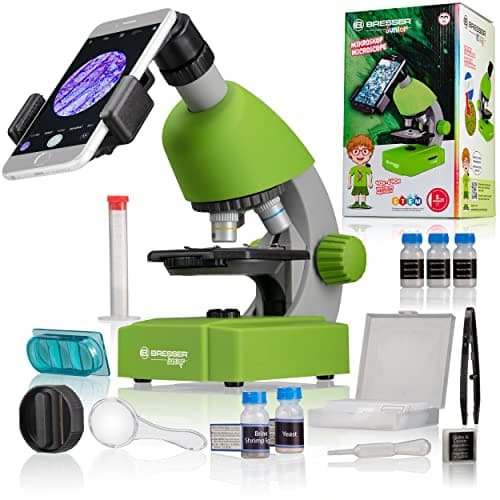
Bresser is one of Europe's best-known optics names, and the Bresser Junior 40-640x brings that pedigree to a colourful, beginner-friendly package. It's a transmitted-light microscope with LED illumination and a sensible 40x-640x range, using an objective nosepiece that lets a child flick quickly between magnifications. A small thing that makes a big difference to how much they actually use it.
The accessory pack is where it really shines for hands-on learning: as well as permanent and blank slides, it includes sample material like yeast and shrimp eggs plus a little incubator, so children can hatch brine shrimp and watch living things develop under the lens. That leap from "looking at a ready-made slide" to "growing my own specimens" is exactly the kind of moment that hooks a young scientist. Battery-powered illumination (3x AA included) means it works anywhere, and at around 556g it's light enough to move from kitchen table to bedroom desk.
Who it's for: Children around 8+ who'd love to grow and observe living specimens, from a name parents recognise.
Pros:
- Trusted European optics brand
- Brilliant living-specimen kit (hatch your own brine shrimp)
- Quick-change nosepiece and included batteries
Cons:
- Usually dispatched within a few days
- Plastic body is light rather than lab-solid
Around £39.99. Check price on Amazon UK →
8. National Geographic Mobile Phone Microscope 200x: Best Smartphone Clip-On
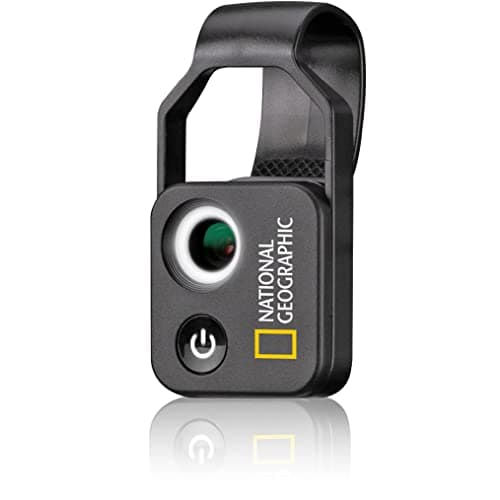
For sheer spontaneous fun, nothing beats a microscope you can clip to the phone that's already in your pocket. The National Geographic Mobile Phone Microscope 200x is a tiny 35g gadget that turns almost any smartphone (it's compatible with around 98% of phones) into a 200x microscope, complete with its own adjustable LED lighting and a CPL filter that cuts glare and keeps colours natural.
The clever part is that it needs no app at all: you clip it on, open your normal camera, and you're instantly photographing and filming the veins in a leaf, the print on a banknote or the scales on a butterfly wing. For a child, the appeal is huge: their discoveries land straight in the camera roll to share, and the whole thing tucks into a coat pocket for impromptu science on a walk. It's not a replacement for a desk microscope's power, but as a modern, take-anywhere companion (or a brilliant stocking filler) it's tremendous value.
Tech focus: A no-app smartphone clip-on that uses your phone's own camera and screen for instant, shareable 200x photos and video.
Pros:
- Turns a phone you already own into a 200x microscope
- No app needed: works with the normal camera
- Ultra-portable for science on the go
Cons:
- Needs a smartphone to use at all
- Best for quick exploration rather than serious study
Around £46.89. Check price on Amazon UK →
9. National Geographic Stereo Microscope 20x: Best for Bugs, Rocks & Coins
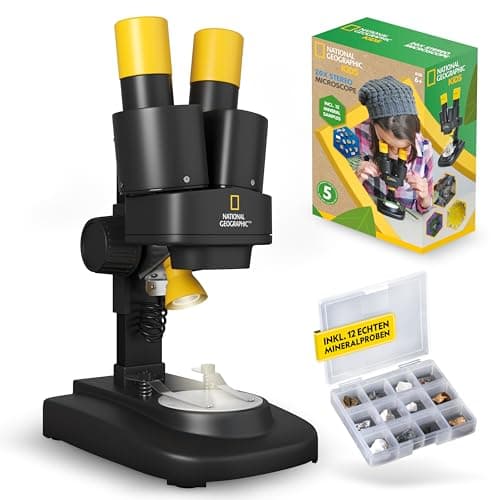
Most microscopes are designed for thin, see-through slides, but children are often far more interested in whole, solid things: beetles, crystals, coins, circuit boards, their own fingertip. That's exactly what a stereo microscope is for, and the National Geographic Stereo Microscope 20x is a lovely introduction to it. Instead of one eyepiece, it has two, giving a comfortable, three-dimensional view that's much easier on young eyes and far more natural to use.
Its top-down (incident) LED lighting illuminates solid objects beautifully (no slide preparation required) so a child can simply pop a shell, a leaf or a fossil on the stage and start exploring. The magnification tops out at a modest 20x, but that's the point: for examining real-world objects in 3D, low magnification with a big, bright, upright image beats high-power blur every time. It even comes with 12 mineral samples to get a budding geologist started.
Who it's for: Hands-on collectors (bug hunters, rock hounds and coin inspectors) of any age.
Pros:
- Comfortable two-eye 3D viewing
- No slides needed: examine solid objects straight away
- Includes a mineral sample set to start
Cons:
- Low magnification won't show cells
- A specialist second microscope rather than an all-rounder
Around £79.09. Check price on Amazon UK →
10. ESAKO Compound Microscope 100X-2000X: Best Step-Up Compound
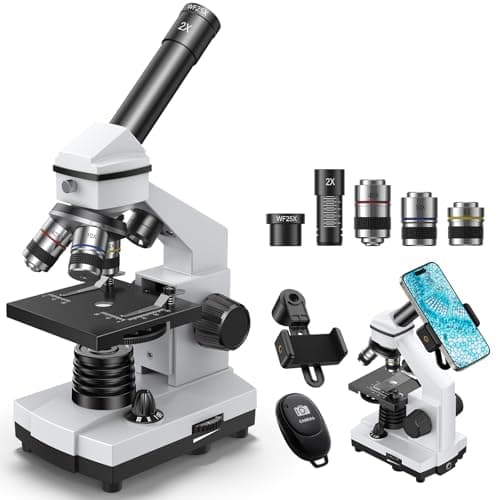
For an older child or teen who's outgrown a starter scope, the ESAKO Compound Microscope is a capable step up that still keeps things approachable. It pairs a 25x wide-field eyepiece with 4x, 10x and 40x objectives for a 100x to 2000x range, and (usefully for keen beginners) dual adjustable LED lighting top and bottom, so it copes with both transparent slides and chunkier opaque samples.
It arrives ready to explore with 15 prepared slides and five blank ones, and includes a smartphone holder that clamps over the eyepiece so your child can photograph and film what they see and build a digital collection of their discoveries. As with every microscope, treat the headline 2000x as a ceiling rather than an everyday setting (the lower powers are where the crisp, satisfying views live) but as an affordable bridge towards genuine teenage biology, it offers a lot of capability for the money.
Tech focus: A traditional compound microscope with a smartphone adapter, so discoveries can be captured and shared on screen.
Pros:
- Wide magnification range with dual LED lighting
- Generous slide set plus a phone-camera adapter
- A sensible upgrade for older kids and teens
Cons:
- Maximum 2000x is marketing more than useful science
- Single-eyepiece focusing rewards a little patience
Around £59.99. Check price on Amazon UK →
How to Choose a Microscope for a Child: A Buying Guide
Pick the right type first. A compound microscope (most of this list) looks through thin, lit-from-below slides at high power: perfect for cells, pond life and onion skin. A stereo microscope gives a low-power 3D view of solid objects like insects and rocks. A digital microscope shows everything on a built-in screen, while a smartphone clip-on uses your phone. Many families end up wanting both a compound and a stereo over time, because they reveal completely different worlds.
Don't chase magnification numbers. As we said up top, "2000x" is mostly marketing. For children, the genuinely useful, satisfying views happen between about 40x and 400x. Good glass optics and bright, even lighting matter far more than a big number on the box. A steady 100x image you can actually focus beats a 2000x blur every time.
Lighting makes or breaks it. Look for LED illumination (cool, safe and battery-friendly). A light below the stage is essential for see-through slides; a light above the stage lets you examine solid objects too. Models with both, like the Swift SW150 and the ESAKO, are the most versatile.
Check what's in the box. Prepared slides are the secret to an instant first success. A child who sees onion cells in their first five minutes is hooked. Kits with ready-made slides, tools and a lab guide (the Science Mad, Science Can and National Geographic options) save a frustrating trip back to the shops.
Match it to their age. Roughly: 4-7s do best with a simple handheld field scope or a digital-screen model (the Brainstorm and BEBANG); 8-11s thrive with a complete beginner kit (Science Can, Science Mad, National Geographic); and keen 10+ scientists will appreciate a real compound like the Swift or ESAKO. If you're shopping for a specific birthday, our best STEM toys for 8 year olds guide has more ideas at that age.
A quick safety note. Microscope LEDs are safe to look at, but glass slides and coverslips have sharp edges, so younger children need a little supervision when handling them. Remind kids never to point any microscope mirror or bright light toward the sun, and to wash their hands after collecting pond or soil samples.
Related reading
How we picked these
Every product here was checked against its live Amazon UK listing before publication: in stock, the listing matching the model we describe, and the price recorded at the time of writing. We read the manufacturer's own specifications for the figures quoted, and work through recent verified-purchase reviews looking for the same fault reported repeatedly rather than one-off complaints.
Picks are ordered by who each product actually suits: age, budget, and whether an app or subscription is involved. Not by commission. AIToys.co.uk earns from qualifying purchases through the links on this page; that does not affect the order. The full process, including what we don't do, is on our how we choose page.
Frequently Asked Questions
What age can a child start using a microscope? Children as young as four can enjoy a simple handheld field microscope like the Brainstorm Outdoor Adventure, especially with a grown-up alongside. Most children manage a desk microscope from around seven or eight, particularly a kit with clear instructions and pre-prepared slides. Digital-screen models are the easiest entry point of all, because they skip the tricky business of looking down an eyepiece.
What's the difference between a compound and a stereo microscope? A compound microscope uses high magnification and lights the specimen from below, so it's made for thin, transparent things on slides: cells, pond water, onion skin. A stereo microscope uses low magnification, lights from above and gives a 3D view, so it's made for whole solid objects like insects, coins and rocks. Compound scopes show the "invisible" microscopic world; stereo scopes make everyday objects fascinatingly detailed. Many keen children eventually want one of each.
How much magnification does my child actually need? Less than the boxes suggest. For children, 40x to 400x covers almost everything worth seeing, and it's where cheaper optics still produce a sharp, well-lit image. Magnifications above roughly 400x demand excellent glass, careful lighting and a steady hand, so "2000x" claims are best treated as a theoretical ceiling rather than a daily setting. Prioritise good optics and lighting over headline numbers.
Are digital and smartphone microscopes any good for kids? Yes: for engagement, they're superb. A digital-screen model like the BEBANG lets the whole family watch together and saves photos and video, while a smartphone clip-on like the National Geographic 200x turns a phone into an instant, shareable microscope. Their optics are tuned for fun rather than scientific precision, so a keen older child studying cells will still want a proper compound scope, but as a first, frustration-free taste of the micro world, they're brilliant.
What will my child actually be able to see? More than you'd think. Even a modest beginner microscope reveals plant cells, the structure of a feather, the eye of a fly, the wriggling life in a drop of pond water, salt and sugar crystals, fabric fibres and the ridges of their own fingerprint. A stereo microscope brings insects, minerals and coins to vivid 3D life. The first time a child sees cells with their own eyes is genuinely unforgettable.
Microscope or telescope first? Both are wonderful, and the "right" answer depends on your child. A microscope delivers results any time, day or night, rain or shine (there's always something to look at) which makes it a slightly more reliable first hit for younger children. A telescope is seasonal and weather-dependent but delivers that jaw-dropping first view of Saturn. If you're deciding, our best telescopes for kids UK 2026 guide is the companion to this one.
The Verdict
A microscope is one of the most reliable ways there is to turn a child into a scientist, because the wonder is on tap. There's always a leaf, a hair or a drop of water waiting to amaze them. For most families, the Swift SW150 is our top recommendation: real optics, dual lighting and a build that will see a child through years of biology. On a budget, the Science Mad 100X and the Brainstorm Outdoor Adventure are low-risk ways to test the waters, while the BEBANG digital screen and National Geographic STEM Kit win on engagement and completeness.
Whichever you choose, prepare a slide of onion skin together on the first evening. It's the classic "wow" that starts it all. For more ways to feed a curious mind, explore our best STEM toys UK 2026, our best STEM kits under £100, and our best AI toys for 9-12 year olds.
_As an Amazon Associate, AIToys.co.uk earns from qualifying purchases. Prices and availability were correct at the time of writing (22 June 2026) but may change. Always check the current price on Amazon before buying._
Read next
Best Electronics Kits for Kids UK 2026-10 Circuit-Building Sets Tested
The 10 best electronics kits for kids in the UK for 2026: snap-together circuit sets compared by age, projects and price, from £11.99 to £79.95.
Best Solar-Powered STEM Kits for Kids UK 2026-10 Eco Robot Builds
The 10 best solar-powered STEM kits for kids in the UK for 2026: solar rovers, robots and planetariums compared by age, builds and price.
Best STEM Toys UK 2026: Our Top Picks by Age and Budget
Discover the best STEM toys for kids in the UK in 2026. Expert picks covering coding robots, science kits, and electronics: for every age and budget.