Disclosure: This article contains affiliate links. As an Amazon Associate, AIToys.co.uk earns from qualifying purchases. If you buy through our links, we may earn a small commission at no extra cost to you. It never changes the price you pay, and it never changes our verdict.
Update, 12 October 2026: availability. The WowWee Dog-E is not currently available to buy on Amazon UK. We have kept the full review below for reference.
Not currently available from Amazon UK. See our best robot dogs UK roundup for in-stock alternatives.
Prefer to compare a few options? See our pick of in-stock robot pets in the In-Stock Alternatives section near the end of this review, or browse the full best AI robot pets round-up.
If your child has been begging for a puppy and you are not quite ready for the walks, the vet bills and the chewed shoes, WowWee's Dog-E is the closest thing to a halfway house we've seen. Sold under WowWee's MINTiD line, this app-connected robot dog promises a pet that is, in the maker's words, "one in a million", and for the most part it delivers a surprising amount of charm for a toy that, when in stock, often sold for around £30.
It is not a coding robot and it will not teach your child Python. What it does instead is lean hard into personality, play and the simple joy of a robotic companion that reacts to a voice, a stroke and a (virtual) treat. After living with it and weighing it against the wider field of robot pets, here is our honest take for UK families in 2026.
Quick Verdict: WowWee Dog-E
The Dog-E earns a solid 4.1 out of 5. It is genuinely endearing, well-made for the money and a hit with the 6-to-10 age group in particular. The headline tricks (the personality "minting", the talking tail and the daft, puppy-like sounds) land brilliantly. It loses marks for an app that can be temperamental, sensors that occasionally ignore a perfectly good stroke, and the odd report of an early hardware niggle. Treat it as a fun, affordable companion toy rather than an educational investment and you are unlikely to be disappointed.
When it was widely available it sold for around £30, which made it one of the better-value robot pets on the shelf. It is now hard to find in the UK, so if you cannot track one down, jump straight to our in-stock alternatives below.
Key Features
The Dog-E is aimed at children aged 6 and up, and the box contains the robot, a charging lead and a small set of accessories. Everything clever happens through a combination of onboard sensors, lights and sound, with an optional free app unlocking the deeper features. Here is what you are actually getting.
The "minting" personality. The all-white Dog-E arrives blank. The first time you power it up, it goes through a "minting" sequence that reveals a unique blend of light colour, sounds and behavioural quirks. WowWee's claim is that no two are the same. In practice this is a clever bit of randomised combination rather than true machine learning, but the effect on a child is exactly the same: this one is mine, and it is different from my friend's. That emotional hook is the whole point, and it works.
A tail that talks. This is the standout. Using persistence-of-vision (POV) technology, a strip of lights on the wagging tail paints icons, hearts and short text messages in the air. Dog-E uses it to tell you when it is hungry, when it wants a fuss and when it fancies a game. It is the kind of detail that makes children (and, honestly, the adults watching) grin the first time they see it.
200+ sounds and reactions. Dog-E barks, whimpers, pants and "sings", and its mood shifts depending on the personality it was minted with. One might be playful and affectionate; another might be permanently hungry and prone to licking. It responds to touch on its head and nose, to voice commands, and to being "fed" virtual treats through the app.
App-connected care and games. The free Dog-E app adds a layer of Tamagotchi-style care: feeding, training new tricks, playing mini-games and checking on your dog's mood. You can use Dog-E happily without a phone, but the full experience leans on the app.
Built for real play. At a shade under a kilogram it feels reassuringly solid rather than flimsy, and most owners report it copes well with the daily handling and occasional drop that any children's toy has to survive.
What We Like
The first thing that strikes you is how much character WowWee has packed into an inexpensive toy. The minting moment is a genuinely lovely piece of theatre, and it gives a child a sense of ownership that a generic toy simply cannot. We have seen the same emotional pull with pricier companions such as the Loona robot dog and the expressive little Eilik desktop companion, and it is impressive that Dog-E captures a slice of that feeling for a fraction of the cost.
The talking tail is the feature children show their friends, and it never quite stops being charming. Pair that with the sheer variety of sounds and reactions and you have a toy that resists becoming background furniture after a week: a common fate for cheaper interactive pets.
We also rate the value. Robot pets can climb well past £100, and many of the most advanced models reviewed in our best AI robot pets round-up are serious investments. Dog-E gave younger children most of the fun for around £30, which made it a far easier "yes" as a birthday or Christmas gift.
Finally, it is refreshingly self-contained. Although the app deepens things, a child can switch Dog-E on and start playing immediately, without a parent needing to set up an account first. For households that are cautious about screen time, that screen-optional design is welcome.
What Could Be Better
Honesty is the whole point of a review, so here are the things that stop Dog-E being a five-star toy.
The biggest issue in 2026 is simply finding one. The Dog-E has become very hard to buy on Amazon UK and is frequently unavailable, which is why we have added a full in-stock alternatives section below.
The app is the next weakest link. While many families pair it without trouble, a meaningful number of owners report difficulty connecting on certain phones, and the experience on some newer Android handsets has been patchy. When the app misbehaves you lose the care, training and mini-game features, which are a big part of the appeal.
The sensors are a little hit-and-miss. Dog-E is supposed to recognise a stroke on its head and a boop on its nose, but it occasionally insists you have not petted it when you clearly have, or miscounts boops. It is rarely a deal-breaker, but it can briefly frustrate a younger child who is trying to do everything "right".
Lastly, set your expectations correctly. Dog-E is a companion toy, not a learning tool. If your aim is to teach coding or computational thinking, a programmable robot like those in our coding robots for beginners guide will serve you far better. Dog-E is about delight, not curriculum.
Who Is It For?
Dog-E is at its best for children aged roughly 6 to 10 who want the companionship of a pet and love a toy with personality. It suits families who are not ready for a real dog, children who enjoy nurturing and "caring for" their toys, and anyone who simply finds a daft robot puppy irresistible.
It is less suited to teenagers, to children specifically interested in building and programming, or to parents hoping for an educational payoff. If you want a robot that grows with a child's coding skills, look instead at app-and-block programmable options; if you want a high-end emotional companion with computer vision and autonomous movement, the premium models in our round-up of the best AI robots for kids are a better fit.
One practical note for parents: because Dog-E connects to an app, it is worth a two-minute read of our guide to smart-toy privacy before you set it up, so you are comfortable with what the app does and does not collect.
In-Stock Alternatives to the Dog-E (2026)
Because the Dog-E is so hard to find now, this section looks at other robot pets that cover a similar brief: an affordable, characterful robot companion for children. The wider shift towards these affordable companions is something we explore in our feature on the rise of AI pet robots.
LEXIBOOK Power Puppy: closest brand-name alternative
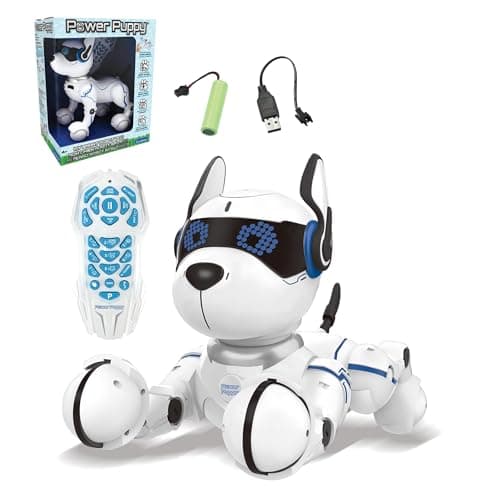
The Power Puppy is the nearest spiritual successor to the Dog-E: a smart robot dog that walks, sings and dances, responds to voice commands and lets children teach it tricks. It is not app-dependent, so it is a good choice for families who liked the Dog-E idea but found the app fiddly. It is a "smart interactive" toy rather than a true AI (there is no machine learning under the bonnet) but for the £6-to-10 age group that distinction rarely matters.
Not currently available from Amazon UK. See our best robot dogs UK roundup for in-stock alternatives.
VATOS Remote Control Robot Dog: best budget buy
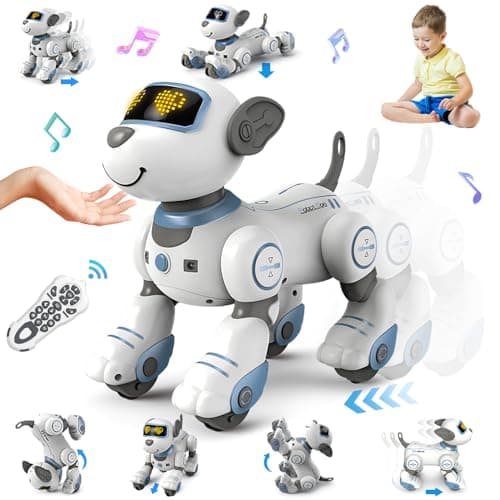
If it was the Dog-E's roughly £30-£40 price that appealed, the VATOS robot puppy is the closest match on cost. It offers touch-and-follow interaction, 17 functions, dancing and gesture control, and is aimed at ages 3 to 12. Be clear on what it is, though: this is remote-control and gesture-based fun, not an app-connected or AI companion. For younger children who simply want a playful robot dog, it is hard to beat for the money.
Around £43. Check the VATOS Robot Dog price on Amazon UK →As an Amazon Associate, AIToys.co.uk earns from qualifying purchases.
Learning Resources PYXEL: best step up for coding-curious kids
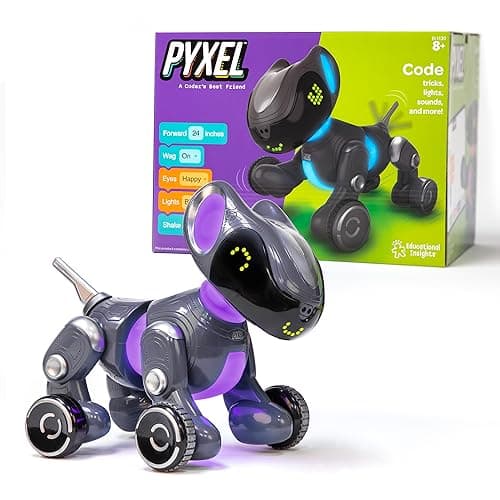
If your child loved the companionship angle but you would also like an educational payoff, PYXEL is the upgrade the Dog-E never was. It is a coding pet that behaves like a playful companion out of the box, then teaches real programming through Blockly and Python as your child grows. It costs more, but it lasts far longer. We cover it in detail in our full PYXEL review.
Around £125. Check the PYXEL price on Amazon UK →
Verdict
The WowWee Dog-E is a small triumph of personality over price. It will not teach your child to code and its app can test your patience, but it nails the thing that matters most in a robot pet: it makes children light up. The minting moment, the talking tail and the puppy-ish chorus of sounds give it a charm that belies its modest cost, and the build quality is better than the price suggests.
The catch in 2026 is availability. It is now genuinely hard to buy in the UK. If you can find one at a sensible price, it remains an easy recommendation for younger children. If you cannot, the VATOS robot dog is the budget option linked above, and PYXEL is the smarter long-term buy.
Our rating: 4.1 out of 5.
Not currently available from Amazon UK. See our best robot dogs UK roundup for in-stock alternatives.
Age guidance reflects the manufacturer's recommended age of 6+. Always supervise young children with small parts and follow the safety guidance in the box.