Best AI Toys for Teenagers UK 2026: Advanced Robotics & Coding
Advanced AI robots and coding kits for teens 13+ in the UK. Arduino, Raspberry Pi, Python robotics and a real AI companion: researched picks.
Affiliate Disclosure: AIToys.co.uk is reader-supported. As an Amazon Associate, AIToys.co.uk earns from qualifying purchases. When you buy through links on our site, we may earn an affiliate commission at no cost to you.
"AI toy" might feel like an odd label for a 14-year-old, but the products in this guide are genuinely sophisticated engineering platforms. We're talking a Python-programmable quadruped robot dog, a real Linux computer small enough to fit a coat pocket, coding systems used in actual university STEM courses, and one honest-to-goodness AI companion with a ChatGPT-connected voice.
One honest note before we start: most of what follows teaches the logic behind AI rather than running AI itself. Only Anki Vector 2.0 in this list uses genuine artificial intelligence: computer vision, voice understanding, cloud-connected conversation. Everything else is real engineering: microcontrollers, single-board computers and Python robotics that teach the skills AI is built on. We say clearly which is which, because at 13+ your teenager deserves an honest answer, not marketing.
The key difference at 13+ is that teenagers can engage with real engineering challenges: servo calibration, GPIO wiring, sensor fusion, command-line Linux. These aren't toys that get boring after a week. They're platforms that can grow with your teen through GCSEs, A-levels and beyond. We re-checked every listing in July 2026 and replaced the two picks that had quietly gone out of stock or been delisted (more on that in the FAQ).
Why Teenagers Need Different AI Toys
The under-12 bracket prioritises accessibility and engagement. At 13+, the priorities shift:
Depth over hand-holding: Teenagers benefit from platforms that require genuine problem-solving, not step-by-step instructions with only one right answer. Every product below has a deep rabbit hole to fall into.
Portfolio-worthy projects: For teens interested in computer science or engineering degrees, projects built on BBC micro:bit, Raspberry Pi or Arduino can genuinely appear on personal statements and EPQ submissions.
Python and beyond: Most serious platforms at this level support real Python, not a simplified subset. Several support C++, Arduino and Linux command-line tools as well.
Community and career context: Platforms with active maker communities (GitHub repos, YouTube channels, forum support) provide learning far beyond the box contents.
Quick Comparison
| Pick | Best for | Ages | AI or coding? | Price (approx.) |
|---|---|---|---|---|
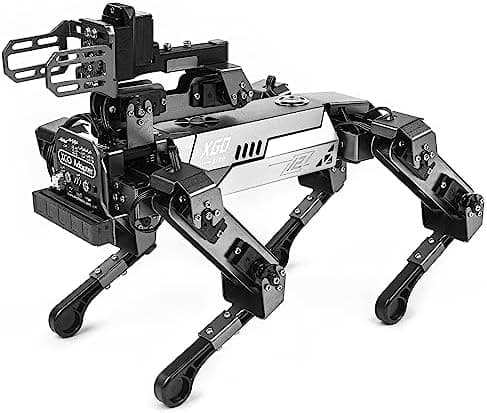
| ELECFREAKS XGO V2 | Advanced robotics (not a current buy) | 12+ | Programmable robot dog | Unavailable (5 Aug 2026) |
| BBC micro:bit V2 | Best value advanced platform | 11+ | MicroPython microcontroller | £31 |
| Makeblock mBot | Best for Python robotics | 10+ | CyberPi Python robot | £59 |
| Anki Vector 2.0 | Best AI companion | 13+ | Genuine AI (ChatGPT) | £190 |
| Official Arduino Starter Kit | Best for real C++ engineering | 13+ | Arduino/C++ electronics | £99 |
| db-tronic Raspberry Pi 4 Kit | Best for AI & ML projects | 13+ | Full Linux computer | £135 |
| Makeblock Codey Rocky | Best for Python + IoT | 11+ | CyberPi Python robot | £121 |
| Makeblock mBot Ranger | Best multi-build robot | 12+ | 3-in-1 coding robot | £159 |
| ELEGOO Smart Robot Car Kit | Best budget build project | 12+ | Arduino robot kit | £59 |
Prices are approximate and correct as of 13 July 2026. Always check the live Amazon listing.
Our Top Picks for Teenagers (13+)
1. ELECFREAKS XGO V2: Advanced robotics spec (not a current buy)
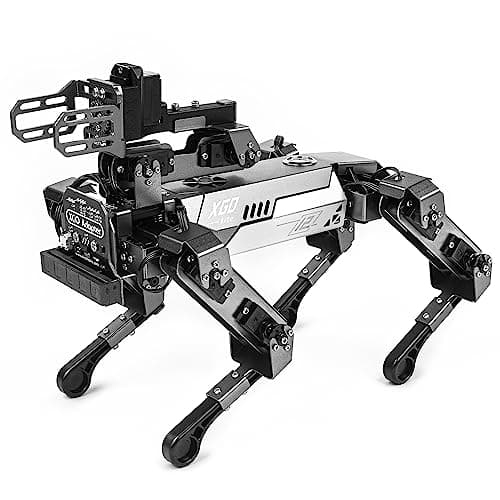
The XGO V2 is where teenage robotics shades into proper engineering. This palm-sized quadruped robot dog has fifteen servo-driven joints, walks and self-balances like a miniature Boston Dynamics homage, and is programmed through the BBC micro:bit ecosystem, so your teen can start in MakeCode blocks and step up to Python as their confidence grows. An optional camera module opens the door to genuine computer-vision projects.
Why we love it:
- Real quadruped locomotion with 15 servo motors and a self-balancing gait
- Programmed via micro:bit: MakeCode blocks or full Python
- Optional camera module for computer-vision experiments
- Assembly and calibration are themselves a multi-hour engineering project
- Genuinely impressive "wow factor" for open days, EPQs and coding club demos
Age recommendation: 12+ for confident builders, 14+ to get the most from the programming depth. It's unashamedly an enthusiast's kit: assembly, calibration and coding all reward patience, and at around £418 it's the most expensive pick here. For a teen who has outgrown line-following robots, nothing else on this list offers the same ceiling.
Availability note (last known 5 August 2026): ASIN B0C7KPJCLX was recorded as currently unavailable on Amazon UK. We have removed it from featured products and it is not a current buy recommendation.
2. BBC micro:bit V2: Best Value Advanced Platform
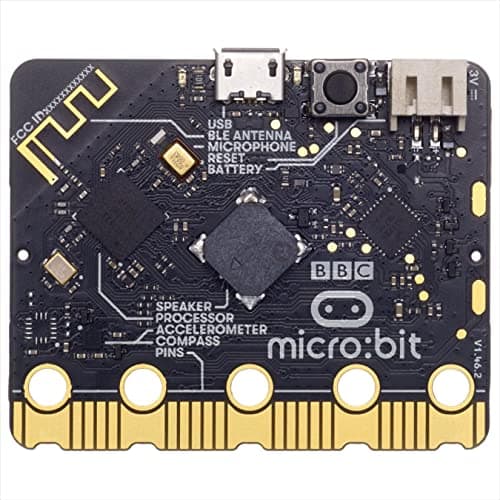
Don't be fooled by the modest price: in the hands of a motivated teenager, this tiny device becomes extraordinarily capable. A 14-year-old with Python skills can build wireless sensor networks, weather stations with real-time data logging, gesture-controlled devices and basic machine-learning classifiers. The V2 adds a built-in microphone and speaker, opening up audio projects too, and it's the same board that powers the XGO V2 above, so skills transfer directly.
Why we love it:
- MicroPython on a real microcontroller: transferable, portfolio-worthy skills
- Bluetooth and radio for wireless and IoT projects
- Massive free resource library from the Micro:bit Educational Foundation and community
- UK curriculum aligned: directly relevant to GCSE Computer Science
- At around £31, the best-value serious computing platform available
Read our full BBC micro:bit V2 review for project ideas and classroom notes.
Around £31. Check price on Amazon UK →As an Amazon Associate, AIToys.co.uk earns from qualifying purchases.
3. Makeblock mBot: Best for Python Robotics
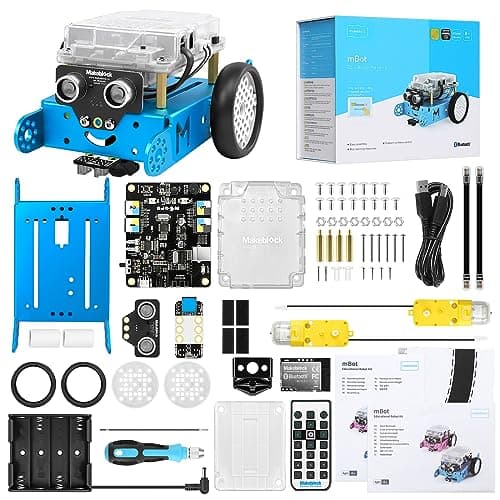
The mBot's CyberPi processor is what separates it from simpler drive-in-circles robots. Teens can program it in Python, connect it to Wi-Fi, log sensor data and integrate it with other devices: the robot chassis provides instant physical feedback while the CyberPi's capabilities extend well beyond navigation. Ultrasonic, colour and IR sensors mean autonomous-navigation projects are genuinely achievable, not just a demo mode.
Why we love it:
- Full Python support on a capable onboard processor
- Wi-Fi connectivity for real-world data projects
- Can be programmed as a standalone Python device, chassis or no chassis
- Ultrasonic, colour and IR sensors for autonomous navigation
- Active maker community with open-source project shares
Our full Makeblock mBot review covers first-build time and common gotchas.
Age recommendation: 10+ for Scratch, 12+ for Python, no real ceiling for advanced projects.
Around £59. Check price on Amazon UK →
4. Anki Vector 2.0: Best AI Companion for Teens
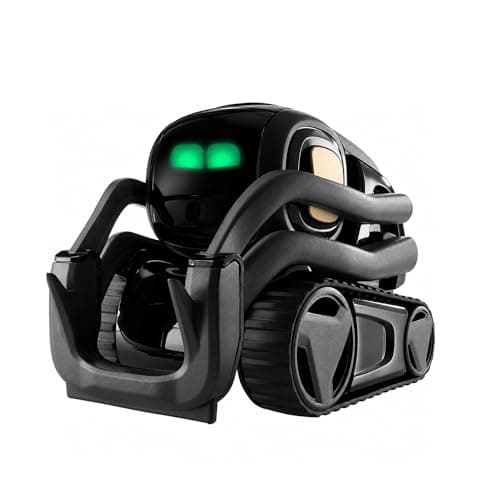
For teens more interested in AI behaviour than programming mechanics, Vector 2.0 is the honest pick, because it's the only product on this list running genuine AI rather than teaching the fundamentals behind it. He recognises faces, holds surprisingly natural conversations via a ChatGPT-connected voice assistant, and demonstrates real-time computer vision and autonomous navigation in a way that's immediately impressive. Teens interested in AI or ML careers will find him a fascinating case study in consumer AI implementation.
Two honest caveats worth knowing before you buy: the full voice and ChatGPT experience needs a Digital Dream Labs subscription (roughly £8 a month), and without it Vector reverts to basic autonomous behaviour. He also carries an always-on camera and microphone that process voice in the cloud, so it's worth reviewing the privacy settings together before first switch-on: we cover this in our Anki Vector 2.0 review.
Why we love it:
- Genuine AI: computer vision, face and emotion recognition, autonomous navigation
- Real conversation via a ChatGPT-connected voice assistant
- No programming required, though a companion SDK exists for teens who want to extend him
- The most realistic consumer AI companion available in 2026
Around £190. Check price on Amazon UK →
5. Official Arduino Starter Kit: Best for Real C++ Engineering
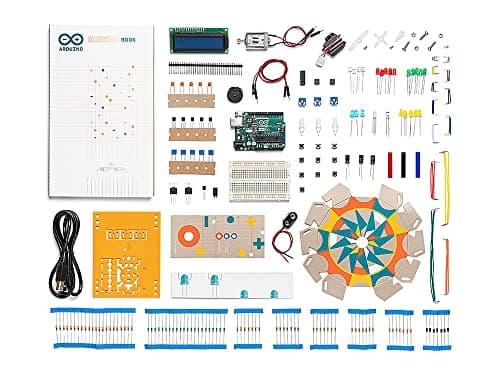
This is the genuine article. Not a toy trying to look like electronics, but the actual manufacturer-made introduction to the Arduino ecosystem millions of engineers cut their teeth on. The 170-page printed project book walks through 15 increasingly complex builds, taking a confident beginner from "what is a resistor?" to a light-sensitive theremin and a motorised pinwheel, all programmed in real C++ via the Arduino IDE.
Why we love it:
- Genuine C++ programming on real embedded hardware, not a simulator
- 15 guided projects plus an open-ended breadboard for original designs
- Skills transfer directly to electrical engineering and embedded systems degrees
- Enormous global community and over a decade of tutorials online
Read our full Arduino Starter Kit review for a breakdown of the 15 projects.
Age recommendation: 13+ to work through the book independently; younger builders can manage with adult support.
Around £99. Check price on Amazon UK →
6. db-tronic Raspberry Pi 4 Starter Kit: Best for AI & Machine Learning Projects
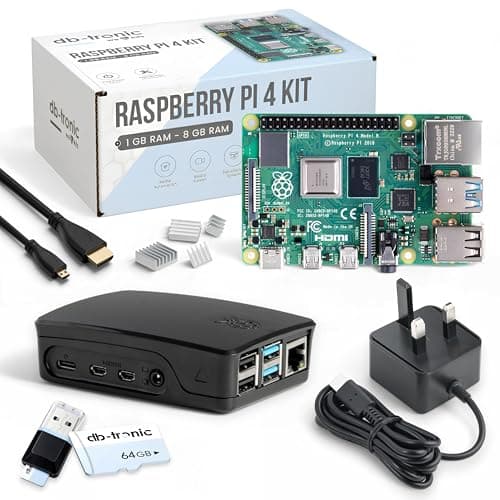
A Raspberry Pi isn't a toy at all. It's a full Linux computer the size of a credit card, and that's exactly the point. Teens who've outgrown block-based coding can install TensorFlow Lite for basic machine-learning projects, run a Python-controlled camera for computer vision, host a personal web server, or turn it into the brains of a custom robot. This db-tronic kit bundles the board, a cooling case, power supply and a pre-loaded SD card, so the first session is spent building something rather than fighting the setup.
Why we love it:
- A genuine general-purpose Linux computer, not a fixed-function gadget
- Runs real machine-learning frameworks (TensorFlow Lite, OpenCV) for computer-vision projects
- GPIO pins connect directly to the Arduino and micro:bit projects above
- Complete kit (case, fan, power supply, HDMI cable, SD card): no separate purchases needed
Our full db-tronic Raspberry Pi Starter Kit review walks through first setup and a starter AI project.
Age recommendation: 13+. Comfortable reading documentation and troubleshooting is genuinely useful here.
Around £135. Check price on Amazon UK →
7. Makeblock Codey Rocky: Best for Python + IoT Projects
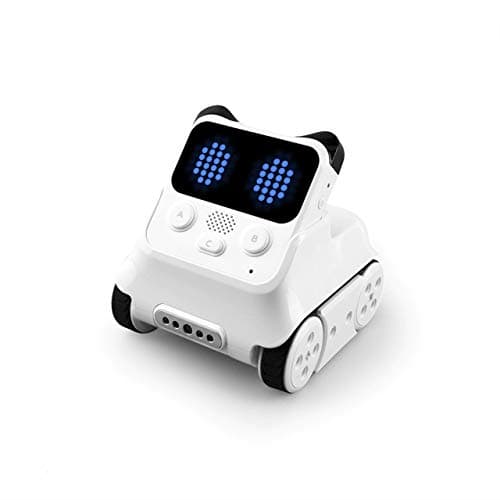
Codey Rocky pairs a friendly, expressive robot (Rocky) with a detachable programmable controller (Codey) that has its own screen, speaker, microphone and sensors. Teens progress from Scratch-style blocks to genuine Python, and because Codey works standalone with no chassis required, it doubles as a wearable or desk-mounted IoT experiment once your teen is ready to move past robot-car projects.
Why we love it:
- Genuine progression path from blocks to Python on the same hardware
- Built-in screen, speaker, microphone and light sensor for IoT-style projects
- Detachable controller works independently of the robot body
- Wi-Fi connectivity for cloud and data-logging projects
Read our full Makeblock Codey Rocky review for the block-to-Python learning curve in detail.
Age recommendation: 11+ for the coding progression to make sense; younger children can still enjoy Rocky in block mode.
Around £121. Check price on Amazon UK →
8. Makeblock mBot Ranger: Best Multi-Configuration Robot
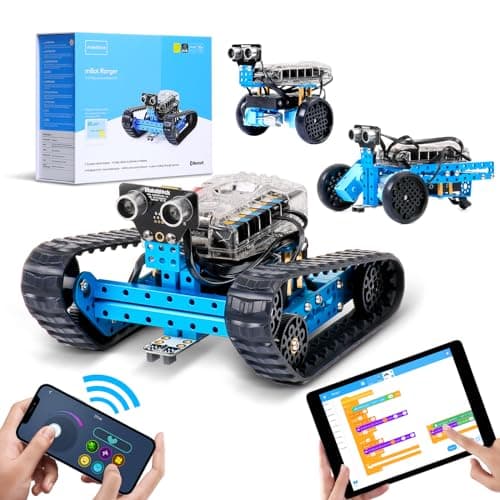
Ranger is the mBot family's flagship: similar electronics to the standard mBot, but rebuildable into three distinct chassis: a tank-tracked crawler, a three-wheeled balancer and a standard car. Reconfiguring between builds is itself a genuine mechanical-engineering exercise, and each chassis behaves differently enough in code that "the same robot" ends up needing three separate programming approaches.
Why we love it:
- Three physically distinct builds from one kit: real mechanical variety
- Scratch-based and Python programming both supported
- Gyroscope and ultrasonic sensors enable genuinely different behaviours per build
- More metal, more motors, more scope for teens who've outgrown the standard mBot
Our full Makeblock mBot Ranger review covers rebuild time and durability after repeated reconfiguration.
Age recommendation: 12+. The mechanical reconfiguration is fiddlier than the standard mBot and rewards patience.
Around £159. Check price on Amazon UK →
9. ELEGOO Smart Robot Car Kit: Best Budget Build-From-Scratch Project
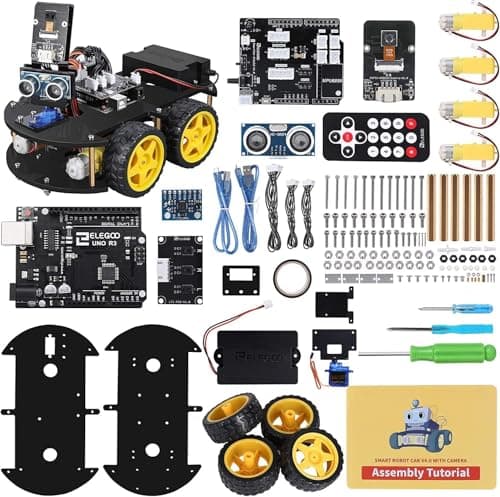
Where the products above arrive largely pre-built, the ELEGOO kit is proudly the opposite: 24 kinds of module (obstacle avoidance, line tracing, an FPV camera, Bluetooth and infrared control) assembled from scratch onto an Arduino UNO R3 board using genuine electronic wiring, not snap-fit connectors. It's the closest thing on this list to an actual robotics-engineering module, and at under £60 it's the cheapest way to get a teenager wiring real circuits.
Why we love it:
- Genuine from-scratch build: 24 modules, real wiring, Arduino IDE programming
- Built-in FPV camera for first-person remote driving and vision projects
- Obstacle-avoidance, line-tracking and Bluetooth/app control modes all included
- HD-rendered instructions make the build achievable solo at 13+
Read our full ELEGOO Smart Robot Car Kit review for our build-time notes and first-project ideas.
Age recommendation: 12+ to assemble largely independently; basic electronics knowledge helps, and total beginners benefit from adult support for the first build.
Around £59. Check price on Amazon UK →
Buying Guide: Choosing the Right Platform for Your Teen
Start from what they already know. If your teen has used a BBC micro:bit at school, the XGO V2 (programmed through the same micro:bit ecosystem) is a natural next step. If they've never coded, start with micro:bit or mBot rather than jumping straight to Raspberry Pi or Arduino.
Decide how you feel about cameras and microphones. Anki Vector 2.0 needs its camera and microphone to work, and processes voice in the cloud. If that sits uncomfortably, every other product here collects no personal data at all.
Watch for subscriptions. Vector 2.0's full feature set requires a monthly Digital Dream Labs plan. Every other pick in this guide is pay-once, with no ongoing fees.
Match the budget to the commitment. The ELEGOO kit and micro:bit are sensible ways to test whether a teenager will actually stick with a platform before committing £400-plus to the XGO V2. Several teens who "grow out of" mBot move naturally to Arduino or Raspberry Pi rather than a more expensive robot.
Check the safety basics. All picks here carry CE/UKCA marking. Kits with small parts (XGO V2, ELEGOO, mBot Ranger) are unsuitable for younger siblings, and any rechargeable robot should charge with its supplied cable under supervision.
Connecting AI Toys to GCSE and A-Level Study
GCSE Computer Science (AQA, OCR, Edexcel): BBC micro:bit projects using Python directly reinforce the programming units. Building projects that implement searching, sorting and data structures in a physical context helps abstract concepts stick.
A-Level Computer Science: The Raspberry Pi and Arduino kits both support A-level projects on computational thinking, algorithms and systems architecture, and several A-level computing teachers use Raspberry Pi in classroom robotics units.
EPQ (Extended Project Qualification): A robotics or AI project on any of these platforms (particularly the XGO V2 or a Raspberry Pi computer-vision build) makes an outstanding EPQ topic. It's practical, demonstrably self-directed, and aligns with the kinds of projects STEM universities want to see.
How we picked these
Every product here was checked against its live Amazon UK listing before publication: in stock, the listing matching the model we describe, and the price recorded at the time of writing. We read the manufacturer's own specifications for the figures quoted, and work through recent verified-purchase reviews looking for the same fault reported repeatedly rather than one-off complaints.
Picks are ordered by who each product actually suits: age, budget, and whether an app or subscription is involved. Not by commission. AIToys.co.uk earns from qualifying purchases through the links on this page; that does not affect the order. The full process, including what we don't do, is on our how we choose page.
Frequently Asked Questions
Is the XGO V2 too difficult for a 13-year-old? A confident, motivated 13-year-old who enjoys building things will manage the assembly fine. The programming depth scales. They can start with the pre-loaded MakeCode gaits and gradually dive into servo calibration and custom Python behaviours as their skills develop.
What happened to the Petoi Bittle and Loona that used to be on this list? Both featured in earlier versions of this guide but are currently unavailable or delisted on Amazon UK. We had briefly pointed to the ELECFREAKS XGO V2 as a quadruped alternative, but the 5 August 2026 availability report recorded that ASIN as currently unavailable too, so it is no longer a featured buy. Anki Vector 2.0 remains the featured AI companion. If stock returns we will reassess.
Which of these would look best on a university application? Projects demonstrating autonomous behaviour or original engineering (an XGO V2 with a custom gait algorithm, a Raspberry Pi computer-vision classifier, or an Arduino project built beyond the guided book) show initiative and genuine technical depth. Document the process, including what went wrong and how it was fixed, and it becomes compelling application material.
Can these AI toys genuinely teach skills used in industry? Yes. Python on micro:bit, mBot and Raspberry Pi, C++ on Arduino, and general maker skills such as reading datasheets, debugging sensors and version control with GitHub are all directly transferable to engineering and computer science careers.
Do any of these need an ongoing subscription? Only Anki Vector 2.0, for its full voice and ChatGPT features (roughly £8 a month via Digital Dream Labs). Every other product in this guide is a one-off purchase.
Related Articles
- BBC micro:bit V2 Review
- Anki Vector 2.0 Review
- Arduino Starter Kit Review
- 11 Best AI Robots for Kids in 2026
- How to Choose Your First Coding Robot
Building a Learning Path from Toy to Career
The most valuable thing these platforms offer isn't the product itself. It's the transferable skills architecture:
Stage 1: Physical computing (BBC micro:bit, ELEGOO kit): Learning that code affects the real world. Cause and effect. Input, processing, output. This is the mental model that underpins all of software engineering.
Stage 2: Systems integration (mBot, mBot Ranger, Codey Rocky): Multiple components working together. Sensor data feeding decisions. Outputs affecting physical systems. This is the foundation of IoT, robotics and embedded systems.
Stage 3: Complex systems (Raspberry Pi, Arduino, XGO V2): Multi-component coordination, real operating systems, servo stability control. Genuine engineering alongside code. This is where the strongest university personal statements come from.
What these skills lead to:
- Software engineering (Python and C++ experience is directly relevant)
- Robotics engineering (servo control and sensor fusion are professional skills)
- AI/ML research (Vector demonstrates what consumer AI looks like; Raspberry Pi lets a teen build the real thing)
- Electronics and embedded systems (Arduino and Raspberry Pi projects introduce genuine circuit thinking)
Getting the Most From These Platforms
Use GitHub from day one: Create a repository for every project. Commit regularly. Write real commit messages. This is a genuinely career-relevant habit, and a portfolio built over two to three years of coding projects is exactly what university admissions tutors and employers want to see.
Document the failures: The most impressive project write-ups show what went wrong and how it was fixed. "I originally tried X, which failed because Y, so I switched to Z" demonstrates genuine engineering thinking far more than "it worked perfectly."
Join the maker community: Instructables, Hackaday, the Raspberry Pi Foundation forums and the Makeblock community are full of advanced projects. Contributing, even just commenting or asking questions, builds confidence and exposes your teen to professional-level engineering discourse.
Enter competitions: Raspberry Pi Foundation competitions, FIRST Robotics UK, and STEM for Britain all welcome student projects. External validation of skills is valuable for university applications and self-confidence.
All prices shown are approximate UK retail prices as of 13 July 2026 and may vary. Always check current Amazon UK pricing before purchasing. As an Amazon Associate, AIToys.co.uk earns from qualifying purchases.
Final thought: The teenagers who get the most from these platforms are those who see them not as toys but as tools. An XGO V2 that's been fully mastered, documented and iterated on over 18 months (or a Raspberry Pi that's quietly run a home project for a year) is genuinely impressive to any university admissions office or employer. The toy is just the starting point.
Read next
Best Easter Gifts: AI Toys & STEM Kits for Kids UK 2026
Looking for the perfect Easter gift for kids who love tech? Our curated guide to the best AI toys, coding robots, and STEM kits available in the UK this…
Best mBot Alternatives UK 2026: Coding Robots Like the Makeblock mBot
Loved the Makeblock mBot? Here are the best alternatives in the UK for 2026: coding robots across every budget, from £30 screen-free starters to advanced kits.
Best Coding Robot Kits for 8-12 Year Olds UK 2026
Top 10 coding robot kits for 8-12 year olds in the UK: VinciBot, Apitor, mBot, Codey Rocky, PYXEL and more compared by price, coding level and age.