
Best AI Toys for 3-5 Year Olds UK 2026: Safe, Fun & Educational
The best AI and screen-free smart toys for toddlers and preschoolers in the UK. Coding robots, audio companions, and STEM toys safe for ages 3-5. Updated July 2026.
Finding the right AI toy for a 3-5 year old can feel overwhelming. At this age, children are developing foundational skills (hand-eye coordination, cause-and-effect thinking, basic problem solving) and the wrong toy can frustrate rather than inspire. The right one, however, can spark a lifelong love of technology and learning.
This guide focuses on screen-free or low-screen toys that are safe, durable, and genuinely fun for toddlers and preschoolers. Every pick below was checked against the live Amazon UK listing at the time of writing and confirmed in stock: prices correct as of 12 July 2026 and may move around, so tap any "Check price" link for the current figure before you buy.
A quick, honest word on "AI": at ages 3-5, almost none of these toys use genuine artificial intelligence, and we'd be doing you a disservice to pretend otherwise. Most are screen-free coding and logic robots that build the sequencing and cause-and-effect thinking that underpins AI, which is exactly the right starting point for this age. A couple of our picks are screen-free audio companions rather than coding toys at all. We've included them because they're the smart, low-screen alternative many parents are actually looking for instead of a tablet or "AI" gadget. We flag exactly what each toy does and doesn't do throughout. If your child is specifically after coding robots, our dedicated best coding robots for under 5s guide goes deeper on that category alone.
Comparison Table: Top AI & Smart Toys for Ages 3-5
| Product | Age Range | Type | AI / Smart Angle | Price |
|---|---|---|---|---|
| Apitor Robot Bear | 3-5 | Screen-free coding robot | Logic & sequencing | ~£49.99 |
| Primo Toys Cubetto | 3-6 | Screen-free wooden coding robot | Logic & sequencing | ~£180.00 |
| Botley 2.0 Activity Set | 5+ | Screen-free, remote programmer | Logic & sequencing | ~£67.94 |
| Sphero indi Student Kit | 4+ | Screenless, colour tiles | AI-literacy foundations | ~£146.00 |
| Coding Critters: Rumble & Bumble | 4+ | Screen-free pet-themed coder | Logic & sequencing | ~£41.45 |
| Code & Go Robot Mouse | 4+ | Screen-free, on-body buttons | Logic & sequencing | ~£33.70 |
| Toniebox 2 Storytime Bundle | 3+ | Screen-free audio player | Smart, not AI | ~£129.99 |
| Yoto Mini (2024) | 3+ | Screen-free audio player | Smart, not AI | ~£79.99 |
| Osmo Little Genius Starter Kit | 3-5 | iPad + physical pieces | Genuine AI: computer vision | ~£159.06 |
🏬 Also available on the high street: Browse AI & electronic toys at The Entertainer →
_Prices correct as of 12 July 2026 and may vary. We never claim a price is the lowest. Always check the live price on Amazon before buying._
What to Look for in AI Toys for Ages 3-5
Before diving into our picks, here's what separates a great toy from an overhyped one for this age group:
Safety first: Look for CE or UKCA certification, no small parts, rounded edges, and drop-resistant construction. Toddlers will throw things: your toy needs to survive it.
Screen-free or minimal screen time: The NHS and paediatric experts recommend limiting screen time for under-5s. Most of the best toys in this category work via physical buttons, tiles, and sounds rather than apps: see our screen-free vs screen-based coding toys guide for more on this trade-off.
Simple controls: Big buttons, clear colour-coded actions, and immediate feedback. Complex programming interfaces belong in the 8+ category. Our guide to choosing a first coding robot has more on matching complexity to age.
Durability: This age group is not gentle. Rubberised exteriors, reinforced joints, and splash-resistant designs are worth paying extra for.
Grow-with-me potential: The best buys remain engaging as your child develops. Not just for six weeks. Once they've outgrown this bracket, our best AI toys for 6-8 year olds guide picks up where this one leaves off.
Our Top Picks for Ages 3-5
1. Apitor Robot Bear: Best Overall for Ages 3-5
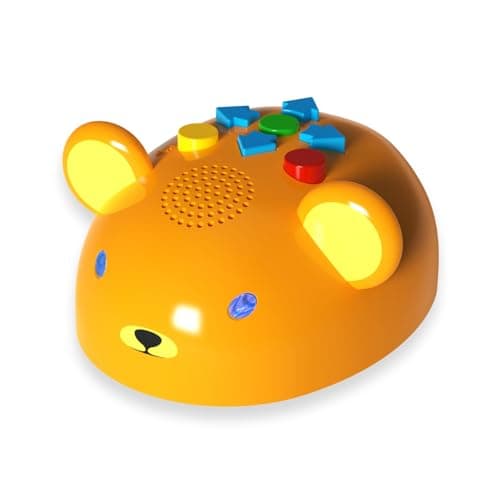
The Apitor Robot Bear tops our list because it's one of the very few coding robots explicitly designed and rated for ages 3-5. Not a toy pitched at older kids that "can" work for a younger one. Children direct the bear using simple lights, sounds and an alphabet map rather than any app or screen, making it a genuinely first-step introduction to programming logic.
The soft, rounded, friendly-bear design is deliberately toddler-proof, and the sequencing challenges scale gently, so a 3-year-old can succeed on day one while a 5-year-old still has room to be stretched.
AI Focus: Not AI. It teaches the cause-and-effect and sequencing logic that underpins how AI systems make decisions.
Pros:
- Officially rated for ages 3-5, not just "suitable for"
- Completely screen-free, with lights, sounds and an alphabet map
- Friendly, rounded, toddler-durable design
Cons:
- Simpler feature set than robots aimed at older children
- Limited long-term challenge once mastered
Around £49.99. Check price on Amazon UK →
2. Primo Toys Cubetto: Best Montessori Choice
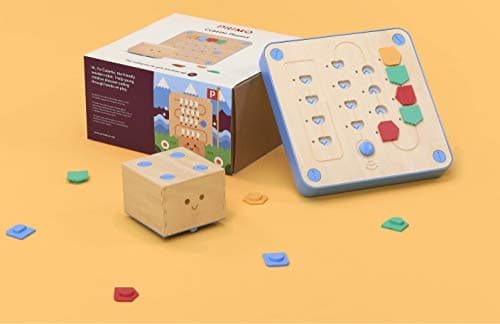
Cubetto is the toy that arguably started the "screen-free coding for toddlers" category, and it remains the gold standard. A friendly wooden robot is programmed by slotting colourful blocks into a wooden control board. No screen, no app, nothing to charge incorrectly or break in a way a 3-year-old can't understand. It's built around genuine Montessori principles: tactile, open-ended, and designed to be explored rather than instructed.
Cubetto ships with a fabric world map and a storybook, so early sessions are guided play rather than a blank robot with no context. It's the priciest pick on this list, but the build quality and educational pedigree (developed with the London Knowledge Lab at UCL's Institute of Education) justify it for families who want the very best screen-free option.
AI Focus: Not AI: pure physical, tactile sequencing. The gentlest possible introduction to programming logic.
Pros:
- Genuinely screen-free from box to play
- Montessori-informed design, tactile and open-ended
- Comes with a map and storybook for guided first sessions
Cons:
- Premium price for what is a relatively simple robot
- Stock runs low regularly: check availability before you commit
Around £180.00. Check price on Amazon UK →
3. Botley 2.0 Activity Set: Best Step-Up Robot for Age 5
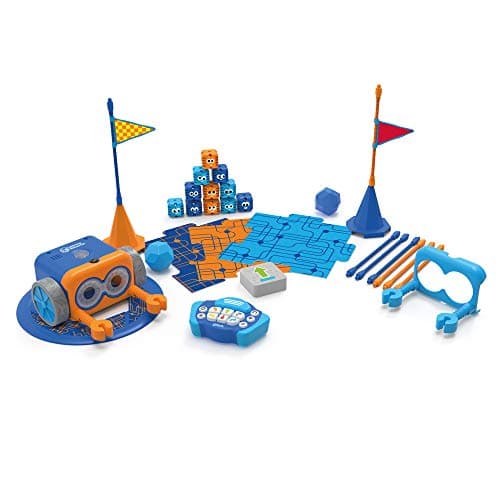
Botley 2.0 is the toy we recommend most often as children reach the top of this age bracket. Using a simple handheld remote, kids build sequences of directional commands that Botley then carries out: navigating mazes, following black lines and detecting obstacles to dodge. The included 78-piece set adds obstacles, tiles and challenge cards, so there's structure from the first session.
Because there's no app or tablet involved, Botley suits parents trying to keep screen time down while still teaching genuine computational thinking. It's officially rated 5+, so it's best treated as the toy to graduate to once Cubetto or the Apitor Bear feel mastered.
AI Focus: Not AI. Introduces loop and sequence programming, the logical building blocks AI systems are built from.
Pros:
- Completely screen-free: a simple remote programmer
- Generous 78-piece kit with ready-made challenges
- Obstacle detection keeps early sessions frustration-free
Cons:
- Officially 5+, so younger children will need more help
- Less expandable than app-based robots once mastered
Around £67.94. Check price on Amazon UK →
4. Sphero indi Student Kit: Best for AI-Literacy Foundations
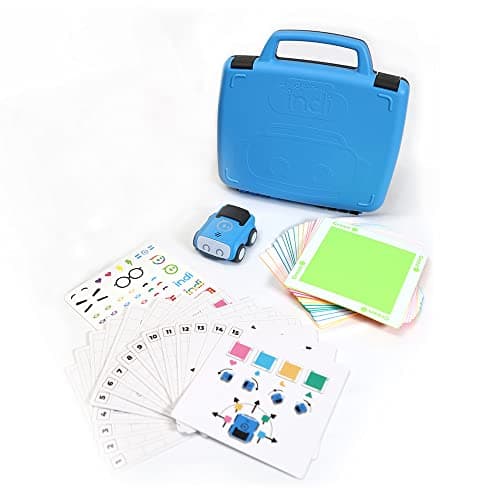
The Sphero indi Student Kit uses colour-sensing tiles to follow programmed paths. No app, no smartphone required. Children as young as 4 can lay out tile sequences and watch indi follow different routes, learning cause-and-effect in the most tactile way possible. Sphero markets it explicitly around "AI literacy," and while indi itself isn't AI, the sequencing and pattern-recognition skills it builds are genuinely the right foundation for later, more advanced robotics.
It's also the toy on this list with the longest runway: the tile system scales into genuinely complex mazes and logic puzzles well beyond the preschool years.
AI Focus: Not AI itself, but Sphero designs it specifically to build the pattern-recognition and logic skills AI literacy depends on.
Pros:
- Completely screen-free: learning through physical tiles
- Rugged design handles rough toddler handling
- Genuinely grows in complexity as your child does
Cons:
- One of the pricier picks here
- Best suited to 4+ rather than younger threes
Around £146.00. Check price on Amazon UK →
5. Learning Resources Coding Critters: Rumble & Bumble: Best First Coding Friend
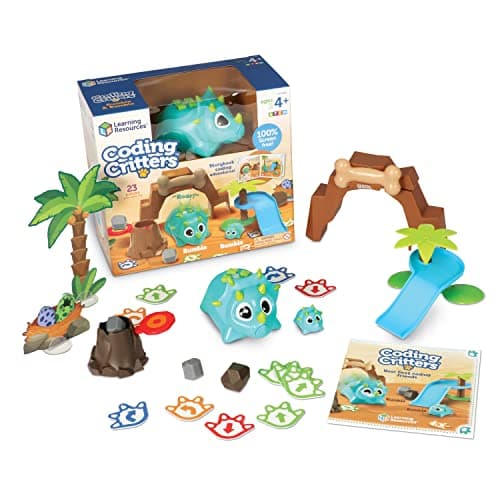
Coding Critters: Rumble & Bumble is built for children who respond better to a character than a machine. Rather than a robot chassis, your child programmes a pair of huggable pet-themed critters using simple button sequences, turning coding practice into imaginative pet play. Learning Resources pitches it explicitly as "your first coding friend," and the button interface really is about as simple as programming gets.
For a preschooler who isn't drawn to Cubetto or the Apitor Bear's more robot-like presentation, this is the toy most likely to hold their attention, because the play pattern is pretend-play first and coding second.
AI Focus: Not AI: the simplest possible button-sequence logic, wrapped in imaginative pet play.
Pros:
- Character-led play appeals to kids who dislike "robot" toys
- About the simplest coding interface available
- Screen-free and durable for daily toddler play
Cons:
- Very basic once the sequences are mastered
- Less STEM depth than dedicated coding robots
Around £41.45. Check price on Amazon UK →
6. Learning Resources Code & Go Robot Mouse: Best Budget Buy
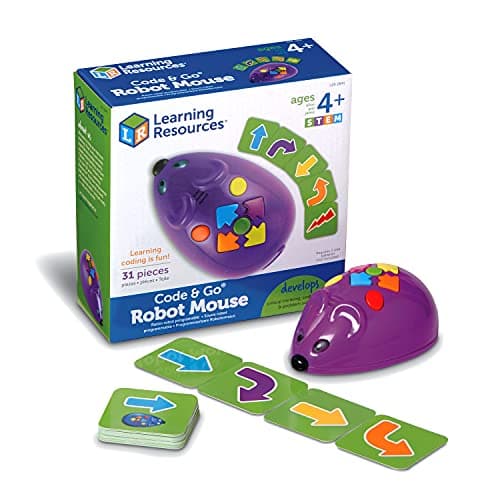
The Code & Go Robot Mouse remains one of the best-value screen-free coding toys on Amazon UK. Children press directional buttons on the mouse's back to plan a route through a maze of cardboard walls and cheese wedges, then watch it play out the sequence. Instant, tactile feedback on whether their logic was right.
At under £35 it's the cheapest genuinely good coding toy on this list, and it's a sensible way to test whether your 4-5 year old takes to sequencing play before spending more on Cubetto or Sphero indi.
AI Focus: Not AI: sequencing and directional logic, taught through a maze-and-cheese game a preschooler instantly understands.
Pros:
- Excellent value at under £35
- Simple, satisfying maze-based sequencing play
- Comes with 30 coding cards to structure early sessions
Cons:
- Basic compared with tile- or app-based robots
- Cardboard maze pieces are less durable than the mouse itself
Around £33.70. Check price on Amazon UK →
7. Toniebox 2 Storytime Bundle: Best Screen-Free Audio Companion
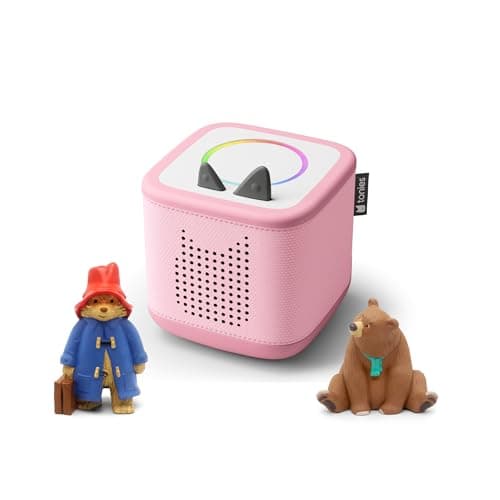
The Toniebox 2 isn't a coding toy or an AI toy: we want to be upfront about that. It's a screen-free audio player: your child places a figurine ("Tonie") on top of the padded box and it plays that character's story, songs or audiobook, with no screen, app interaction or algorithm involved during play. We've included it because for many parents of 3-5 year olds, the real competition isn't another coding robot. It's a tablet, and Toniebox is the single most effective screen-free alternative we've seen. This bundle comes with We're Going on a Bear Hunt and Paddington Bear built in.
If you'd like the fuller picture, we've reviewed it in depth in our Toniebox 2 review.
AI Focus: Not AI, and not marketed as such: a genuinely screen-free "smart" audio player, included as the low-screen alternative many parents actually want.
Pros:
- Genuinely no screen at any point during play
- Durable, chunky, drop-proof design built for toddlers
- Independent play builds confidence away from a tablet
Cons:
- Additional story figures cost extra over time
- No coding or STEM element: it's entertainment, not education
Around £129.99. Check price on Amazon UK →
8. Yoto Mini (2024 Edition): Best Portable Audio Player
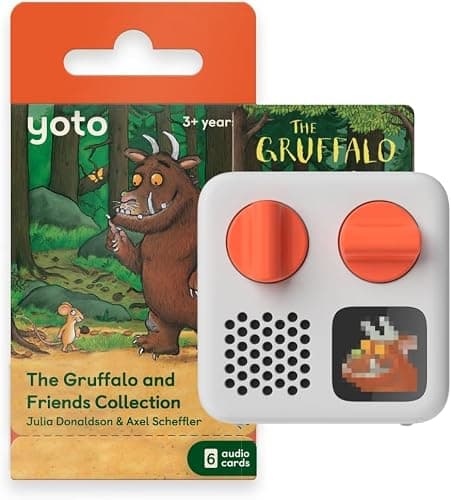
The Yoto Mini plays the same screen-free role as the Toniebox but in a smaller, more portable format: physical cards slot into the top of the device to play stories, music, radio and podcasts, with a simple pixel-art display instead of any screen your child interacts with. Like the Toniebox, it isn't AI and we won't pretend otherwise; it earns its place here as a genuinely excellent screen-free alternative for car journeys, bedtime and quiet play. This bundle includes the classic Gruffalo card.
We cover the full range in our hands-on Yoto Mini review.
AI Focus: Not AI: a screen-free audio device, included for parents specifically looking for a low-screen alternative to tablets and AI companions.
Pros:
- Small and genuinely portable: ideal for the car or travel
- Card-based library is easy for a 3-year-old to manage independently
- Volume-limited and screen-free by design
Cons:
- Individual story/music cards add up in cost
- No coding or STEM content: purely audio entertainment
Around £79.99. Check price on Amazon UK →
9. Osmo Little Genius Starter Kit: Best for iPad Families
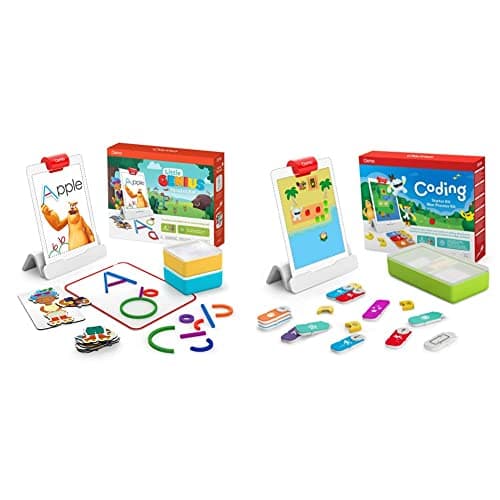
The Osmo Little Genius Starter Kit is the one toy on this list that uses genuine AI-adjacent technology: a mirrored attachment lets the iPad's camera see physical pieces your child moves on the table, using real computer vision to recognise letters, shapes and creative drawings and bring them to life on screen. Unlike the standard Osmo Coding kits (better suited to 5-10 year olds), the Little Genius edition is purpose-built and age-rated for 3-5, with four gentler, less text-heavy games covering phonics, creativity and early problem-solving.
Note: requires a compatible iPad, sold separately. For the step-up kit once your child outgrows this one, see our Osmo Genius Starter Kit review.
AI Focus: The closest thing to genuine AI on this list: real computer vision recognising physical objects, not just remote-controlled movement.
Pros:
- Purpose-built for ages 3-5, not a hand-me-down from an older kit
- Genuine computer vision bridges physical and digital play
- Four games cover phonics, creativity and early logic
Cons:
- Requires an iPad you must already own
- Still screen-mediated, so not a screen-free pick
Around £159.06. Check price on Amazon UK →
Safety Checklist for AI Toys (Ages 3-5)
Before purchasing any AI or smart toy for a toddler or preschooler, run through this checklist:
- ✅ UKCA or CE certified: required for UK toy safety
- ✅ Age rating clearly states 3+ or lower: do not buy "8+" toys for 5-year-olds
- ✅ No small parts: anything smaller than a 50p coin is a choking hazard
- ✅ Cord-free design: no USB charging cables left accessible during play
- ✅ Wipe-clean surfaces: toddlers and hygiene are not natural allies
- ✅ Battery type: rechargeable USB beats AA batteries for long-term convenience
- ✅ Data and privacy: for anything that pairs with an app (Toniebox, Yoto, Osmo), check what account data is collected and use the parental controls provided
For more on keeping connected toys safe, see our guide on whether AI toys are safe for children.
How we picked these
Every product here was checked against its live Amazon UK listing before publication: in stock, the listing matching the model we describe, and the price recorded at the time of writing. We read the manufacturer's own specifications for the figures quoted, and work through recent verified-purchase reviews looking for the same fault reported repeatedly rather than one-off complaints.
Picks are ordered by who each product actually suits: age, budget, and whether an app or subscription is involved. Not by commission. AIToys.co.uk earns from qualifying purchases through the links on this page; that does not affect the order. The full process, including what we don't do, is on our how we choose page.
Frequently Asked Questions
What age can children start learning to code? Research from MIT and the Raspberry Pi Foundation suggests children as young as 3-4 can grasp basic cause-and-effect programming through physical toys like the Apitor Robot Bear or Cubetto. Formal text-based coding is better suited to 8+, but foundational computational thinking begins much earlier.
Are screen-free coding toys better for under-5s? For this age group, screen-free is generally preferable. Physical manipulation of objects (pressing buttons, moving tiles, placing blocks) builds the same logic skills with less screen fatigue and more sensory engagement. Six of our nine picks (the Apitor Bear, Cubetto, Botley 2.0, Sphero indi, Coding Critters and the Code & Go Mouse) are entirely screen-free.
Are any of these toys genuinely "AI"? Honestly, not really, and we've flagged that throughout. Most are screen-free logic and sequencing robots that teach the thinking behind AI rather than using it. The Osmo Little Genius kit comes closest, using real computer vision to recognise physical objects through an iPad camera.
How long will a 3-year-old play with a coding toy? Variable, but a well-matched toy like the Apitor Robot Bear or Cubetto can hold a 3-year-old's attention for 15-20 minutes per session and remain in rotation for 12+ months as their skills develop. Toys that grow in complexity, like Botley 2.0 and Sphero indi, tend to have the longest play life.
What's the best budget option for a 3-5 year old? The Code & Go Robot Mouse offers excellent value at under £35 and is a sensible way to test whether your child takes to sequencing play before spending more. For screen-free audio rather than coding, the Yoto Mini is the more affordable of our two audio picks.
Related Articles
- Best Coding Robots for Under 5s: The Full Roundup
- Botley 2.0 Review: Is It Worth It?
- Sphero Indi Review: Full Hands-On Test
- Learning Resources Coding Critters Review
- Best AI Toys for 6-8 Year Olds UK 2026
- How to Choose Your First Coding Robot
- Screen-Free vs Screen-Based Coding Toys
How to Introduce a Coding Toy to a 3-Year-Old
The biggest mistake parents make is handing over a new toy and expecting immediate engagement. Young children need scaffolded introduction: especially with technology they've never seen before.
Session 1. Watch together: Sit with your child and demonstrate the toy yourself first. Let them observe before they touch. For the Apitor Bear or Cubetto, run a simple three-step sequence yourself. Children learn enormously through observation.
Session 2. Guided play: Now let them press the buttons or move the tiles, but stay alongside. Narrate what's happening: "When we press this button, the bear turns right!" This builds vocabulary alongside understanding.
Session 3. Independent play: Once the basics are established, step back. Independent exploration is where genuine learning happens, and where you'll see the biggest jumps in engagement.
Keep sessions short: 15-20 minutes is plenty for ages 3-4. Toddlers have limited working memory capacity; longer sessions lead to frustration rather than learning. End on a success.
When to Move Up to the Next Age Group
Signs your 5-year-old is ready for 6-8 toys like the MatataStudio VinciBot or Makeblock mBot:
- They've mastered Botley 2.0 or Sphero indi's basic and looping sequences
- They're asking "what else can it do?" more than playing with the current features
- They can follow multi-step instructions without parental help
- They're showing frustration at the limits of their current toy
Developmental readiness matters more than calendar age. Some children are ready to step up at 5; others benefit from staying in the 3-5 category until 6-7. Follow your child's lead rather than the age label on the box, and when they're ready, our best AI toys for 6-8 year olds guide picks up exactly where this one ends.
Storage and Care Tips
AI and smart toys for this age group benefit from dedicated storage:
- Charge before storing: lithium batteries last longer when stored partially charged, not flat
- Tiles, cards and pieces in a zip-lock bag: small accessories disappear remarkably quickly
- Wipe down after play: toddler hands transfer a surprising amount of food debris onto robots
- Store upright: avoids pressure on buttons during storage
- Keep story cards and figures together: Toniebox and Yoto libraries grow fast, and loose cards get lost in sofa cushions
All prices shown are approximate UK retail prices as of 12 July 2026 and may vary. Always check current Amazon UK pricing before purchasing. As an Amazon Associate, AIToys.co.uk earns from qualifying purchases.
Read next
Best AI Toys for 9-12 Year Olds UK 2026: Coding, Robotics & STEM
Expert picks for the best AI toys and coding robots for 9-12 year olds in the UK. micro:bit, VinciBot, Makeblock mBot, Sphero and more: all in stock.
Best AI Toys for Teenagers UK 2026: Advanced Robotics & Coding
Advanced AI robots and coding kits for teens 13+ in the UK. Arduino, Raspberry Pi, Python robotics and a real AI companion: researched picks.
Best AI Toys for 6-8 Year Olds UK 2026-10 Top Picks for Smart STEM Fun
Discover the best AI toys for 6-8 year olds in the UK for 2026. Our top 10 picks offer smart STEM fun, coding challenges, and educational play for young minds.