AI Toys Weekly: Screen-Free Companions, a US Chatbot Ban & the AI 'Crutch Effect'
This week in AI toys: screen-free companions arrive, a proposed US ban on AI chatbots in children's toys, and new research on AI's 'crutch effect' in learning.
Welcome to AI Toys Weekly, our Monday round-up of what is new and what actually matters in the fast-moving world of AI-powered toys. For the week commencing 20 July 2026 there are three stories worth a parent's attention: manufacturers are racing to build screen-free companions that sidestep the smartphone comparison, US lawmakers have gone further than anyone else so far with a bill to ban AI chatbots in children's toys outright, and fresh research keeps sharpening the same warning about how children really learn with AI.
As always, we have only featured products we have confirmed are in stock on Amazon UK at the time of writing, and every recommendation comes with the honest caveats as well as the praise.
New on the shelves: companions without the screen
The clearest product trend this summer is the move away from screens and open-ended chat towards physical companions that slot into play children already know. In mid-June the Chinese start-up Haivivi launched BubblePal, a small clip-on device that attaches to an ordinary soft toy and turns it into a talking, screen-free AI companion, with a parent app to follow the conversations. It is not yet on general sale in the UK, but it captures where the category is heading: keep the microphone, lose the screen, and give parents a window into what is being said.
You can already buy that same idea in a simpler, budget-friendly form. The VATOS Smart Talking Robot is a remote-control robot that talks back, records and repeats phrases, dances and responds to touch. No app account, no open-ended chatbot, and nothing a young child has to type. It is programmable for basic action sequences, so it doubles as a first taste of cause-and-effect "coding" for children roughly three to eight. Treat the "smart" label sensibly: this is a playful interactive toy rather than a genuine AI, which for this age group is arguably the point.
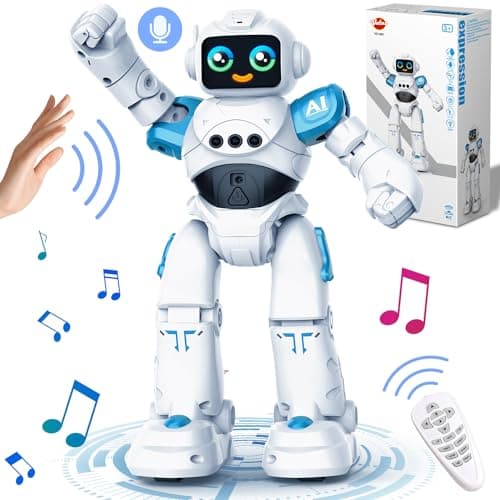
Around £30. Check the price of the VATOS Smart Talking Robot on Amazon UK →
In the same budget-companion bracket, the EUNEWR Interactive Robot Dog walks, sings, dances and responds to touch and voice commands, giving younger children a pet-style companion without a subscription or a listening app running in the background. It is a toy dog, not an AI pet, but for pretend play and early responsibility it does the job well.
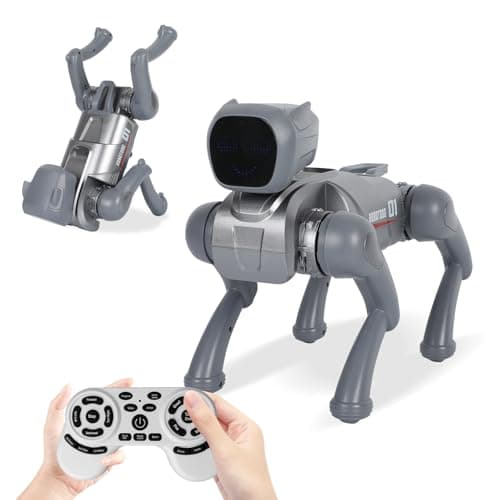
Around £30. Check the price of the EUNEWR Robot Dog on Amazon UK →
What AI is doing to the toy box
The big development this week is regulatory, and it is unusually blunt. In the United States, Congressman Blake Moore has introduced the AI Children's Toy Safety Act, a federal bill that would ban the manufacture, import, sale or distribution of any children's toy or childcare article containing an AI chatbot. Whether or not it passes, it is a striking marker of how quickly official patience with open-ended AI in toys is running out.
It does not stand alone. Maryland's Artificial Intelligence Toy Safety Act would require pre-market child-safety assessments, strict data-privacy rules and content restrictions, with civil penalties of up to $50,000 per violation; makers of toys already on sale as of 1 July 2026 have until January 2027 to complete their first assessments. According to the Toy Association, more than 100 AI-related bills have been introduced across 30-plus US states since December. In Europe, the EU Toy Safety Regulation 2025/2509 has been in force since January and now requires safety assessments that cover mental-health risks for digitally connected toys, while the UK's own Call for Evidence on toy safety (which explicitly invites parents' views) runs until 6 October.
For families, the takeaway is not panic but attention. The commercial momentum has not paused: the Mattel and OpenAI partnership is still expected to bring conversational AI to household toy names, and we unpack what that means in our Mattel x OpenAI explainer. If you are weighing up a talking or connected toy this summer, our guides on whether AI toys are safe for children and smart-toy privacy in the UK walk through the questions worth asking before you buy. Chiefly what data a toy collects, where it is stored, and whether you can delete it.
What AI means for how children learn
The research keeps pointing the same way. A growing body of 2026 randomised trials finds that AI helps children learn only when it is set up to act as a structured tutor with adult support, and that simply telling pupils to "use AI to study" can actually hurt learning. The pattern educators now call the "crutch effect" is the crux: children using a general-purpose AI often produce better work in the moment, but that advantage fades, and can reverse, once the tool is taken away. A widely cited Harvard trial reported large gains from well-designed AI tutoring, yet the same literature is clear that the design and the human role are what make the difference, not the technology on its own. McKinsey estimates 20 to 40 percent of educator tasks could be automated, which is only good news if the time freed up goes back into direct teaching.
That is exactly why we keep steering families towards toys that put the child in the driving seat rather than a chat window. The MatataStudio VinciBot is one of the few in this price range with genuine on-board AI (camera-based vision and voice recognition) but crucially the child programs what it does, using block or Python-style coding, so the robot only acts on logic they have worked out themselves. For ages eight and up it is a rare example of "real AI" that still demands the productive struggle learning depends on.
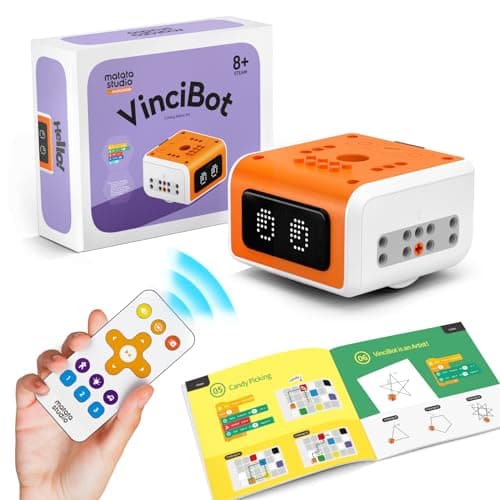
Around £85. Check the price of the MatataStudio VinciBot on Amazon UK →
The Makeblock mBot takes the hands-on principle a step further: the child physically builds the robot from a metal kit before programming it with drag-and-drop blocks, so both the engineering and the logic are theirs. There is no AI chatbot in sight, and that is a feature, not a gap. It is exactly the kind of "do the thinking yourself" play the research rewards.
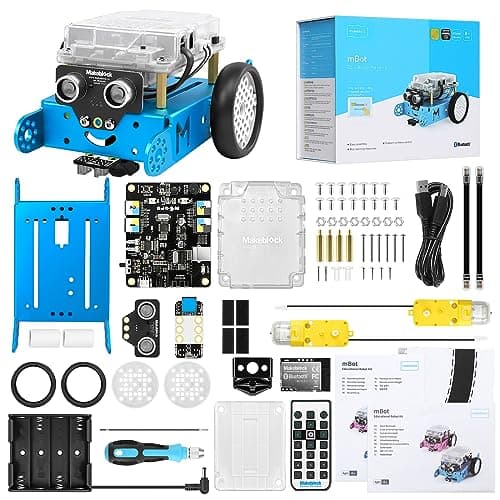
Around £90. Check the price of the Makeblock mBot on Amazon UK →
Read more in our guide to how AI toys are changing education.
This week's smart buys (in stock now)
| Toy | Best for | Age | Around |
|---|---|---|---|
| VATOS Smart Talking Robot | A screen-free first companion | 3-8 | £30 |
| EUNEWR Robot Dog | Pet-style play without an app | 3+ | £30 |
| MatataStudio VinciBot | Genuine AI a child programs themselves | 8+ | £85 |
| Makeblock mBot | Build-it and code-it STEM | 8+ | £90 |
Prices are correct at the time of writing (20 July 2026) and change often, so always check the live figure on Amazon before buying. As an Amazon Associate, AIToys.co.uk earns from qualifying purchases at no extra cost to you.
Frequently asked questions
Could AI chatbots really be banned from children's toys?
It is now a live proposal. A US federal bill, the AI Children's Toy Safety Act, would ban toys containing AI chatbots outright, and several states are advancing their own pre-market safety and privacy rules. Nothing is law yet, but the direction of travel is clearly towards tighter limits and more disclosure.
Are screen-free AI toys safer than app-based ones?
Removing the screen helps with screen-time and some data concerns, but a toy can still have a microphone and send audio to the cloud. Look for toys that are transparent about what they record, offer a parent view, and let you delete data: our smart-toy privacy guide explains what to check.
Does using AI actually help children learn?
Only when it is used well. The 2026 research is consistent that AI helps most when it acts as a structured tutor with a parent or teacher involved, and that unsupervised "use AI to study" can leave children worse off once the tool is removed, which is why we favour toys where the child does the thinking.
That is your lot for this week. We will be back next Monday with the latest launches, debates and deals. In the meantime, browse our Christmas 2026 AI toy gift guide for more in-depth picks.
Related reading
More From AIToys
AI Toys Weekly: A UK Safety Review, the AI 'Crutch Effect' & New Hands-On Toys
This week in AI toys: the UK government's new toy safety consultation, OECD findings on AI's 'crutch effect' in learning, and the best in-stock picks for parents.
AI Toys Weekly: The Clip-On Companion Boom, Maryland's Safety Bill & the AI Homework Gap
This week in AI toys: the screen-free clip-on companion boom, Maryland's proposed AI toy safety bill, fresh research on AI and learning, and the best in-stock buys.
AI Toys Weekly: New AI Companions, a Regulation Milestone & UNICEF's Wake-Up Call
This week in AI toys: a fresh wave of AI companions, a July regulation milestone, UNICEF's new data on children and AI, and the top in-stock buys for parents now.