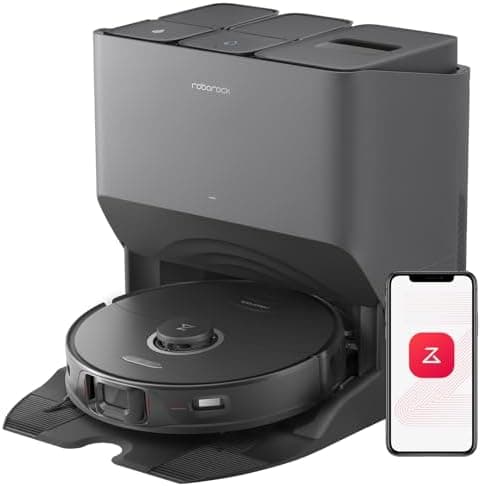
How to Choose a Robot Vacuum UK 2026: The Complete Buyer's Guide
Everything UK buyers need to know before purchasing a robot vacuum in 2026. Floor types, suction power, mopping, mapping, and our top picks from £200-£1,500.
Disclosure: AIToys.co.uk is reader-supported. We may earn a commission if you purchase through links on this page, at no extra cost to you.
Robot vacuums have gone from novelty gadget to genuine household staple in the space of just a few years. In 2026, the technology has matured to the point where a good robot vacuum can genuinely replace your daily vacuum sessions, but with so many models at wildly different price points, choosing the right one is anything but straightforward.
This guide cuts through the noise. Whether you're spending £200 or £1,500, here's exactly what to look for before you buy.
Why Buy a Robot Vacuum in 2026?
The case for robot vacuums has never been stronger. Modern models use AI-powered obstacle avoidance, multi-floor mapping, and room-specific scheduling that make them genuinely autonomous. Not just a toy that bumps around the skirting boards.
A robot vacuum works best as a daily maintenance tool. Run it every day or every other day, and you'll rarely need to get out the upright vacuum. For homes with pets, kids, or anyone who hates vacuuming (i.e., most of us), the return on investment is real.
The average UK household spends around 3-5 hours per week on cleaning tasks. A good robot vacuum can reclaim a significant chunk of that time.
The 8 Key Things to Check Before You Buy
1. Floor Type: Carpets vs Hard Floors
This is the single most important factor. Not all robot vacuums handle all floor types equally well.
Hard floors (wood, tile, laminate): Nearly every robot vacuum handles these well. Even budget models can manage a smooth hard floor without trouble.
Low-pile carpet: Most mid-range and premium models cope fine. Look for a minimum of 2,000 Pa suction and a rubber multi-surface roller brush rather than a bristle brush (which can get tangled).
Medium to thick carpet: This is where budget models start to struggle. You'll want at minimum 4,000 Pa suction, and ideally a model with automatic carpet boost: it detects carpet and ramps up power automatically.
Mixed homes (both carpets and hard floors): The vast majority of UK homes. Good news: most premium models handle both seamlessly. Avoid robot vacuums that advertise themselves as "hard floor specialists": they'll likely struggle on carpets.
Key spec to check: Suction power in Pa (Pascal). Budget: 1,500-2,500 Pa. Mid-range: 3,000-6,000 Pa. Premium: 8,000-15,000 Pa.
2. Mopping: Do You Actually Need It?
Many 2026 robot vacuums include a mopping function, but the quality varies enormously.
Basic drag-mop (avoid): Early-generation combo units simply dragged a damp cloth across the floor. This leaves streak marks and is often worse than no mopping at all. Several budget models still use this approach.
Vibrating sonic mop (good): The mop pad vibrates rapidly, loosening dirt before wiping. Significantly better than drag mopping. Brands like Ecovacs and Roborock offer this on mid-range models.
Pressurised hot water mopping (premium): The best 2026 systems: like those found in the Roborock S8 Pro Ultra and Dreame X50 Ultra: automatically lift the mop pad when crossing carpet and use pressurised mopping for stubborn marks. These are genuinely impressive.
Tip: If you have mostly carpets, skip the mopping feature entirely and put your budget towards better suction. Mopping only makes sense if you have significant hard floor area.
3. Self-Emptying Base: Worth the Premium?
A self-emptying base station collects dust from the robot's small onboard bin into a larger bag or bagless container. This is one of the most genuinely life-changing upgrades in the robot vacuum world.
Without self-emptying: You'll need to manually empty the robot's dustbin every 2-4 cleans. For a small flat, this might be fine. For a larger home, it becomes annoying quickly. Especially if the machine runs while you're out.
With self-emptying (recommended): The base sucks the contents of the robot's bin into a large container that only needs emptying every 4-8 weeks. Some premium systems like the Dreame X50 Ultra also automatically refill the water tank and wash the mop pads.
Cost: Self-emptying bases typically add £100-£300 to the price. For most households, it's worth it.
4. Mapping & Navigation: How Smart Is It?
This is where robot vacuums have improved most dramatically in recent years.
LiDAR (Laser Navigation): Uses a spinning laser to build a precise 3D map of your home. Highly accurate, works in the dark, and handles furniture rearrangement well. Standard on all mid-range and premium models in 2026.
Camera + AI Vision: Some models (like the iRobot Roomba j7+) use cameras and machine learning to identify and avoid specific obstacles: phone charger cables, pet waste, socks, shoes. This is genuinely useful if you have a messy household.
Gyroscope/Optical Navigation (budget): Random or semi-random navigation patterns. These will eventually cover your whole floor, but inefficiently. Not recommended for multi-room homes.
Multi-floor mapping: Essential if you have multiple storeys. The robot saves separate maps for each floor, making it easy to send it to specific rooms or floors on demand. Most LiDAR models support 3-5 floor maps.
App control and scheduling: All reputable brands offer smartphone apps with room-specific cleaning, no-go zones, scheduled runs, and real-time tracking. Test the app reviews before you buy: some are significantly better than others.
5. Obstacle Avoidance: Does It Handle Clutter?
This is the 2026 battleground. Budget robots bump into chair legs, get tangled on cables, and get stuck on pet toys. Premium models use a combination of:
- Structured light sensors: detect objects 3D in real time
- AI cameras: recognise specific object types
- Soft bumpers: touch-detect without marking furniture
The iRobot Roomba j7 has "PrecisionVision Navigation" that specifically recognises and avoids pet waste and dark cables: genuinely useful for families with pets.
The Ecovacs Deebot T30 Pro Omni has an AI obstacle avoidance system that handles cables, toys, and low furniture legs extremely well.
If you have a tidy, uncluttered home: Basic obstacle avoidance is fine. If you have kids or pets: spend more on better avoidance.
6. Battery Life & Coverage Area
Coverage area: Measured in square metres. Most mid-range models handle 150-250m² per charge. Most UK homes are comfortably within this range: the average UK home is approximately 95m².
Battery life: 90-180 minutes is typical. LiDAR navigation is more efficient than random bounce, so a LiDAR robot will cover more ground in the same battery life.
Auto-recharge and resume: Essential for larger homes. The robot docks itself, recharges, then resumes exactly where it left off. All mid-range and premium models include this.
7. Noise Level
Robot vacuums are not silent, but the range is significant. Budget models can reach 65-72 dB: noisy enough to interrupt a phone call. Premium models on standard power typically run at 55-62 dB, comparable to a quiet conversation.
If you plan to run the vacuum during the day while working from home, or have young children napping, noise levels matter. Check the decibel rating in reviews (manufacturers often quote the minimum level, not maximum).
Tip: Almost all models offer a "quiet mode" at reduced suction: useful for nighttime runs on hard floors.
8. UK-Specific Considerations
A few things matter more in the UK than elsewhere:
Pet hair: UK households have high rates of pet ownership. If you have a cat or dog, prioritise models with tangle-free rubber rollers and strong suction. The Roborock Q Revo MaxV handles pet hair exceptionally well at its price point.
Older homes with uneven floors: Victorian and Edwardian properties often have slight level changes between rooms, uneven wooden floors, and thick rugs. Check the robot's maximum threshold height: typically 15-20mm. Step-climbing technology in the Dreame X50 Ultra (up to 60mm steps) is remarkable but comes at a premium.
Warranties and support: Stick to brands with UK-based support or established UK distributors. Roborock, Ecovacs, Dreame, and iRobot all have proper UK presence. Some lesser-known brands offer no practical UK warranty support.
Robot Vacuum Price Brackets: What to Expect
Under £300: Entry Level
At this price, you'll get a basic robot vacuum with LiDAR navigation and decent suction for hard floors. Expect to empty the bin manually every 2-3 cleans, and don't expect sophisticated obstacle avoidance. Suitable for small flats with mostly hard floors.
Best for: Single person, small flat, hard floors only.
£300-£600: Mid-Range
This is the sweet spot for most UK households. You get LiDAR mapping, 4,000-8,000 Pa suction, basic mopping, and often an entry-level self-emptying base. Obstacle avoidance is competent but not perfect.
The Roborock Q Revo MaxV sits firmly in this bracket and punches above its weight.
Best for: Average UK home (2-4 beds), mixed floors, one pet.
£600-£1,000: Premium
Full-featured self-emptying and self-washing base stations, 10,000+ Pa suction, excellent AI obstacle avoidance, pressurised mopping. The Roborock S8 Pro Ultra and Ecovacs Deebot T30 Pro Omni both live here.
Best for: Families, homes with pets, carpets and hard floors mixed, anyone who wants to genuinely forget about vacuuming.
Over £1,000: Ultra Premium
Expect game-changing features at this price: step-climbing capability, detachable side brushes, extended mop coverage, automatic cleaning solution dispensing. The Dreame X50 Ultra at around £1,000-£1,200 is the standout in this tier.
Best for: Large homes (4+ beds), multiple floor types, demanding cleaning needs, or anyone who simply wants the best available.
Our Top Robot Vacuum Recommendations UK 2026
| Model | Price | Best For | Rating |
|---|---|---|---|
| Dreame X50 Ultra | ~£1,100 | Large homes, step-climbing | 4.7/5 |
| Roborock S8 Pro Ultra | ~£750 | Premium all-rounder | 4.6/5 |
| Ecovacs Deebot T30 Pro Omni | ~£700 | Best obstacle avoidance | 4.4/5 |
| Roborock Q Revo MaxV | ~£450 | Best mid-range value | 4.4/5 |
| iRobot Roomba j7+ | ~£500 | Pet owners, cable-heavy homes | 4.3/5 |
What to Avoid
Cheap no-brand imports: Dozens of sub-£150 robots on Amazon UK have no LiDAR, random navigation, and essentially zero customer support. They'll frustrate you within a week.
Mopping-first models on mostly carpet: Several brands push their mopping feature heavily. If you have carpets throughout most of your home, mopping is largely irrelevant: prioritise suction instead.
Old inventory at discounted prices: Previous-generation models sometimes appear at steep discounts. The AI and mapping improvements from 2024 to 2026 are significant enough that we'd recommend buying current-gen unless the saving is very substantial.
Related reading
- Levoit Core 600S Review UK 2026: Smart Air Purifier for Large Rooms
- Ninja Foodi MAX 15-in-1 SmartLid Multi-Cooker Review UK 2026: The Smartest Kitchen Workhorse?
Frequently Asked Questions
Do robot vacuums work on thick carpet?
Most mid-range and premium models (4,000+ Pa suction) handle medium-pile carpet well. Thick shag-pile or very deep pile carpet remains challenging for any robot vacuum: manual vacuuming will still be needed occasionally. Check the maximum carpet height specification before buying.
Can robot vacuums replace a traditional vacuum entirely?
For most households: mostly, yes, but not entirely. A robot vacuum is excellent for daily maintenance, keeping floors consistently clean. For deep cleaning, moving heavy furniture, or vacuuming stairs (no robot vacuum handles stairs yet), you'll still want a traditional vacuum every few weeks.
Are robot vacuums safe around pets?
Generally yes. Modern obstacle avoidance specifically detects pet bowls, toys, and pet waste. Most robots will avoid sleeping pets. Some pets are initially scared of the noise. Running it while you're home the first few times helps pets get accustomed.
How long do robot vacuums last?
Premium models from established brands (Roborock, Ecovacs, iRobot, Dreame) typically last 5-8 years with proper maintenance. Brushes and filters need replacing every 6-12 months. Check that replacement parts are readily available in the UK before buying.
Is Wi-Fi required for a robot vacuum to work?
Wi-Fi is required for app control, scheduling, and firmware updates, but most robots will continue to run scheduled cleans even without Wi-Fi connection. A physical home button triggers a clean without the app. For full functionality, a 2.4GHz Wi-Fi network is standard (not 5GHz).
Final Thoughts
Buying a robot vacuum in 2026 is one of the genuinely worthwhile smart home purchases: it pays for itself in time saved within months. The key is matching the right model to your home:
- Small flat, hard floors: A solid mid-range LiDAR model around £300-£400 is plenty
- Average family home, mixed floors: Spend £450-£700 for self-emptying + proper mopping
- Large home, pets, uneven floors: Go premium at £700-£1,200 and you'll genuinely not regret it
For our hands-on assessments of specific models, check out our Best Robot Vacuums UK 2026 roundup, or dive into individual reviews for the Dreame X50 Ultra, Roborock S8 Pro Ultra, Roborock Q Revo MaxV, and Ecovacs Deebot T30 Pro Omni.
Ready to pick yours? Browse the current Amazon UK price:
See our best robot vacuums for 2026
Prices are correct at time of publishing but may vary. Always check current Amazon UK pricing before purchasing.
Read next
Dreame X50 Ultra Complete Review UK 2026: Is the Step-Climbing Robot Vacuum Worth It?
Our in-depth Dreame X50 Ultra Complete review for UK homes. 20,000Pa suction, ProLeap step-climbing, VersaLift sensor: is it worth the premium price? Find out.
Ecovacs Winbot W2 Pro Omni Review UK 2026: Can a Robot Really Clean Your Windows?
Ecovacs Winbot W2 Pro Omni review for UK homes: WIN-SLAM 4.0 navigation, 5,500Pa suction, charge-while-working and 12-stage fall safety. Honest verdict.
Aiper Scuba S1 Review UK 2026: Cordless Robotic Pool Cleaner With Smart Navigation
Aiper Scuba S1 review UK: cordless robotic pool cleaner with WavePath 2.0 smart navigation, 150-min battery, wall and waterline cleaning. Honest 2026 verdict.