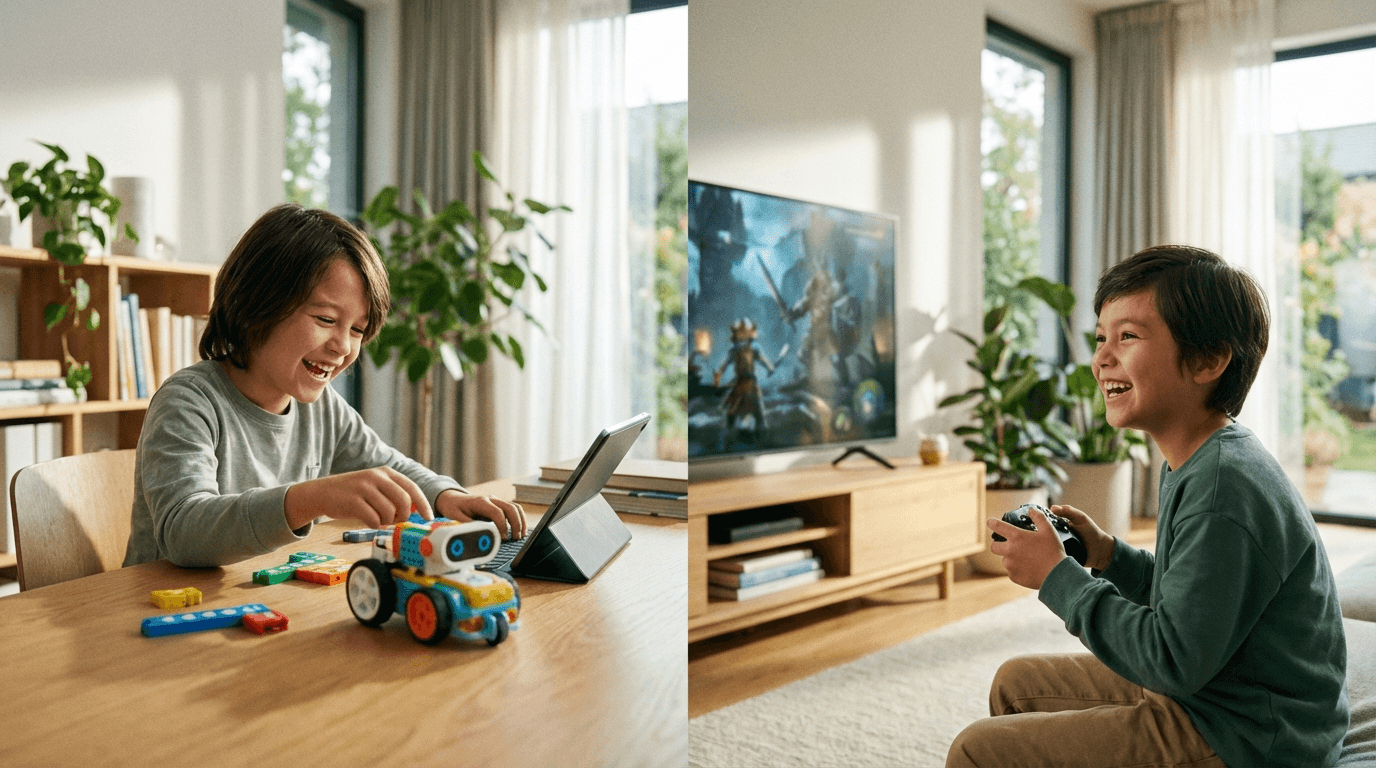
Coding Robots vs Video Games: Which Is Better for Children's Development?
Balanced, research-backed comparison of coding robots vs video games for children's development. Learning outcomes, skills, and which is right for your child.
Coding Robots vs Video Games: Which Is Better for Children's Development?
Every parent who has watched their child spend hours gaming has probably wondered: what if that time and energy were directed at something more educational? And many who've invested in coding toys have wondered whether their child is actually learning anything or just playing in a different way.
The comparison between coding robots and video games is genuinely interesting, and the answer is more nuanced than either camp typically acknowledges.
First, Let's Be Honest About Both
Video games are not the developmental wasteland they're often portrayed as. Decades of research has complicated the simple narrative that video games are bad for children. Depending on the game, children can develop:
- Spatial reasoning and 3D thinking
- Strategic and systems thinking
- Hand-eye coordination and reaction time
- Problem-solving and puzzle-solving skills
- Reading skills (many games are text-heavy)
- Social skills (cooperative multiplayer)
- Persistence and resilience (games are designed around failure and retry)
Games like Minecraft, Portal, Kerbal Space Program, and countless strategy titles have genuine cognitive value. The evidence that moderate video game play causes harm to children's development is, despite years of searching for it, limited.
Coding robots are not automatically educational. A child who mindlessly drives a robot around without engaging with any programming concepts is learning very little, regardless of how "educational" the toy's marketing claims. The learning happens in the challenge, the problem-solving, and the cognitive engagement. Not from the presence of the toy itself.
With that framing in place, let's look at the genuine differences.
What Coding Robots Do Better
Explicit Computational Thinking
Coding toys are specifically designed to build computational thinking skills: algorithms, loops, conditionals, decomposition, debugging. These aren't incidental to the play; they're the entire point. The learning objectives are clear and structured.
Video games can build problem-solving skills implicitly, but they're not designed to transfer those skills to programming or STEM contexts. A child who is excellent at Minecraft redstone circuits is building logical thinking, but has likely learned little that they could apply directly to writing code.
Coding toys provide a more direct on-ramp to programming proper. The gap between "programming my Sphero robot" and "writing Python code" is much smaller than the gap between "winning at Minecraft" and "writing Python code."
Active Creation vs Passive Consumption
This is perhaps the most significant distinction. Coding toys, at their best, position children as creators: they design, build, program, and problem-solve. Video games, even excellent ones, more often position children as consumers: they experience content that others have created.
There are exceptions: Minecraft's creative mode, Roblox's game creation tools, and LittleBigPlanet are genuinely creative video game experiences. But the default mode of most video games is consumption.
The creative mindset ("I can build and make things with technology") is a deeply valuable orientation that coding toys tend to develop more directly than standard video games.
Physical, Tangible Feedback
Coding robots produce physical, tangible results. When you program a Bee-Bot to navigate a path, the consequence is visible, physical, and immediate. This tangible cause-and-effect is particularly powerful for younger children (ages 5-9), supporting learning in a way that on-screen feedback often doesn't.
Educational research consistently finds that physical, manipulative learning experiences support deeper understanding of abstract concepts for younger children. This gives coding robots a developmental advantage in the 5-9 age range that diminishes as children mature.
Curriculum Alignment
For UK parents, this is practical: coding toys align directly with the National Curriculum's computing requirements. Investing in a coding toy can support school learning in a direct and measurable way. Most video games, even educational ones, have more tenuous curriculum connections.
What Video Games Do Better
Sustained, Intrinsic Motivation
This is where video games win decisively: children want to play them. The engagement and motivation video games generate is genuinely remarkable. Children will voluntarily spend hours working on a difficult challenge in a game that they'd refuse to engage with if it were homework.
This intrinsic motivation is pedagogically valuable. Learning that happens through genuine engagement is more effective than learning under external pressure. Game designers spend enormous resources understanding what makes challenges compelling and satisfying. Resources that most educational toy companies don't have.
Many coding toys are engaging initially but plateau in interest. The novelty fades once the child has explored what the toy can do. The best video games are designed to maintain engagement for hundreds of hours.
Social Play at Scale
Online multiplayer games provide social experiences that coding toys, typically single-player, don't match. Cooperative problem-solving, communication under pressure, and managing social dynamics in a competitive or collaborative context are all skills built through multiplayer gaming.
For children who are naturally social, the social dimension of gaming may deliver genuine developmental value that solo coding toy play doesn't.
Complexity and Systems Thinking
The best video games (strategy games, simulation games, RPGs) are extraordinarily complex systems. Children who deeply engage with games like Cities: Skylines, Civilization, or Factorio are developing sophisticated systems thinking: understanding feedback loops, resource management, second-order consequences, and emergent behaviour.
This kind of systems thinking is genuinely valuable, and somewhat different from the more procedural thinking that coding toys primarily develop.
Accessibility
This isn't strictly developmental, but it matters: video games work for virtually every child on virtually every device. Coding toys require physical space, setup, and often adult involvement to get started and to remain challenging. The low friction of video games means more children actually use them.
What the Research Says
What does the evidence actually say?
Coding toys and computational thinking: Research on educational robots (Bee-Bot, floor robots) consistently shows improvements in computational thinking skills, mathematical concepts (particularly spatial reasoning), and problem-solving in primary school children. The evidence base is strongest for ages 5-9.
Video games and cognitive skills: Meta-analyses of action video game research show consistent benefits for spatial reasoning, attention, and processing speed. Strategic games show benefits for planning and executive function. The evidence is substantially positive for moderate play.
Comparative studies: Direct comparisons of coding toys vs video games as learning interventions are limited. Most research compares coding toy use vs no coding toy use, or gaming vs no gaming, rather than directly comparing the two categories.
The time displacement question: The most valid developmental concern about video games is opportunity cost. Time spent gaming is time not spent on other activities. The relevant comparison isn't "games vs coding toys" but "games vs the full range of things children could be doing."
The Practical Answer
For most children and families, this isn't actually an either/or question. The children who benefit most from coding toys are those who already spend time gaming and want to move from being consumers of technology to creators of it.
Choose coding robots/toys when:
- Your child has expressed interest in how things work or in making things
- You want explicit curriculum support for computing
- Your child is in the 6-10 age range and physical manipulation suits their learning style
- You're looking for activities that build specific STEM pathway skills
Lean towards quality video games when:
- Your child learns best through high-engagement, self-directed exploration
- Social gaming is a meaningful part of their peer relationships
- You're specifically looking to build strategic or systems thinking
- Screen-based learning fits better with your family's context
The best answer for most families: Both, with balance. Encourage some coding toy time (particularly if your child is interested in STEM) and don't demonise quality video gaming. The child who programs a robot in the morning and plays Minecraft in the afternoon is getting a genuinely valuable mix of creation and consumption, structured and exploratory learning.
The most important variable isn't which category you choose. It's the quality of engagement. Mindless play with a coding toy is less valuable than focused, challenging video game play. And vice versa. The toy or game is just a context; the thinking is the education.
Related reading
Read next
Screen-Free vs Screen-Based Coding Toys: Which Is Better for Your Child?
Bee-Bot, Botley vs Scratch, Osmo: when should you choose screen-free coding toys over screen-based ones? Our complete guide for UK parents in 2026.
AI and Coding Toys for Autistic Children UK 2026: A Parent's Guide
Find the best AI and coding toys for autistic children in the UK. Covers benefits, recommended products, sensory considerations and expert tips for 2026.
Are AI Toys Safe for Children? A Parent's Complete Guide
Are AI toys safe for your child? Honest guide covering screen time, data privacy, age-appropriateness, and the real benefits and risks of AI toys for kids.