Best Smart Health Monitors UK 2026 (BP, ECG, Weight)
Ten in-stock smart health monitors compared for the UK in 2026: blood pressure, ECG, SpO2 and smart scales from Withings, OMRON, KardiaMobile, Beurer and RENPHO.
Disclosure: As an Amazon Associate, AIToys.co.uk earns from qualifying purchases. When you buy through links on our site, we may earn a commission at no extra cost to you. All opinions are our own. Prices were correct at the time of our latest update on 29 July 2026 and can change.
Best Smart Health Monitors UK 2026
Home health tracking has quietly grown up. The devices in this guide are not fitness gimmicks. They are clinically validated blood pressure monitors, personal ECG recorders and body-composition scales that sync to your phone, spot trends over weeks and months, and let you share a clean report with your GP. Used sensibly, they turn a once-a-year check-up into an ongoing picture of your health.
The hard part in 2026 is not choosing a monitor. It is finding one that is genuinely in stock and still supported. Older models get delisted, apps get retired, and a glowing review is no help if the buy button has gone. So we re-checked every listing in this guide on Amazon UK on the day of our latest update, and every single product below had a working buy button and a live listing. We rebuilt the guide from ten in-stock devices spanning four categories: blood pressure, ECG, blood oxygen (SpO2) and weight/body composition.
A note on health claims: these are consumer wellness devices, not a substitute for professional medical care. A home reading can flag something worth discussing with a clinician, but it cannot diagnose a condition on its own. If a device suggests an irregular heart rhythm, a persistently high blood pressure or a low oxygen reading, treat it as a prompt to speak to your GP or NHS 111. Not as a verdict. Always follow the instructions that come with each device, and look for the CE/UKCA mark and, where relevant, clinical validation.
If you also track activity and sleep, our guides to the best AI smartwatches and fitness trackers and the best smart rings in the UK pair naturally with this one, and a smart air purifier is worth a look if you're building out a healthier home.
Quick Comparison Table
| Product | Type | Key Measures | Price Bracket | Our Rating |
|---|---|---|---|---|
| Withings BPM Connect | Blood Pressure | BP, heart rate (Wi-Fi sync) | Around £119 | 4.6/5 |
| OMRON X7 Smart AFib | Blood Pressure | BP, AFib screening | Around £100 | 4.7/5 |
| OMRON X4 Connect AFib | Blood Pressure | BP, AFib, Bluetooth app | Around £73 | 4.5/5 |
| OMRON X2+ Connect | Blood Pressure | BP, Bluetooth app | Around £34 | 4.4/5 |
| KardiaMobile 1-Lead | ECG | Single-lead ECG, AFib | Around £89 | 4.5/5 |
| KardiaMobile 6-Lead | ECG | Six-lead ECG, AFib | Around £149 | 4.6/5 |
| Beurer PO60 | Pulse Oximeter | SpO2, pulse rate (Bluetooth) | Around £53 | 4.3/5 |
| Withings Body Comp | Smart Scale | Weight, full body composition | Around £189 | 4.6/5 |
| Withings Body Smart | Smart Scale | Weight, body fat, muscle | Around £78 | 4.5/5 |
| RENPHO Elis 1 | Smart Scale | Weight, 13 body metrics | Around £20 | 4.4/5 |
The Best Smart Health Monitors for 2026
1. Withings BPM Connect: Best Wi-Fi Blood Pressure Monitor
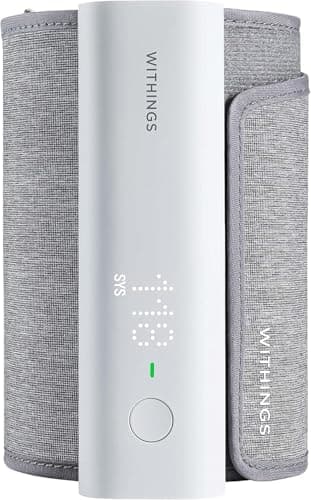
The Withings BPM Connect is the blood pressure monitor to buy if you want measuring to feel effortless. Wrap the cuff, press the single button, and it takes a clinically validated reading, shows it on the device with colour-coded feedback, then syncs it over Wi-Fi to the Health Mate app. No phone needed in the room, no pairing dance every time.
Key features:
- Clinically validated upper-arm measurement (systolic, diastolic and heart rate)
- Wi-Fi and Bluetooth sync straight to the Health Mate app
- On-device colour feedback so a reading makes sense at a glance
- Rechargeable battery that lasts up to six months per charge
Why we recommend it: It removes every bit of friction from taking your blood pressure, which is the single biggest reason people actually stick with home monitoring. The unlimited history in Health Mate makes it easy to show your GP a trend rather than a one-off number.
Best for: Anyone managing blood pressure long term who wants a fuss-free, good-looking device that just works.
Around £119. Check price on Amazon UK →As an Amazon Associate, AIToys.co.uk earns from qualifying purchases.
2. OMRON X7 Smart AFib: Best Blood Pressure Monitor with Heart-Rhythm Screening
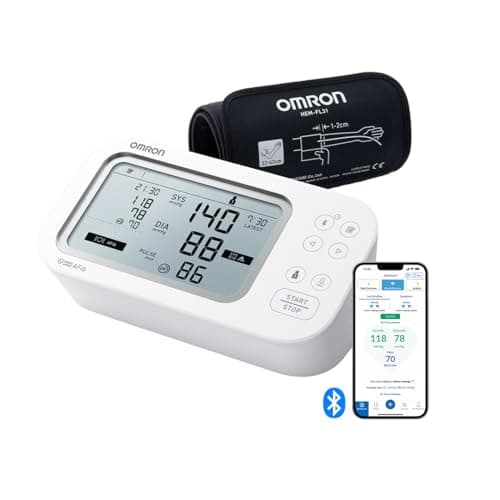
OMRON is the brand most clinicians name first, and the X7 Smart is its standout all-rounder. Alongside a clinically validated blood pressure reading it screens for atrial fibrillation (AFib) with every measurement. A common irregular rhythm that raises stroke risk and often has no symptoms. Its Intelli Wrap cuff also forgives sloppy positioning, so your readings stay consistent.
Key features:
- Clinically validated blood pressure with AFib screening on every reading
- Intelli Wrap cuff for accurate results whatever the cuff angle
- Bluetooth sync to the OMRON connect app for trends and doctor-ready reports
- Detects irregular heartbeats and body movement that can skew a reading
Why we recommend it: You get the two things that matter most from a home monitor (trustworthy BP numbers and an early flag for AFib) in one device from the brand most GPs recognise. It is our top pick for anyone with a family history of heart problems.
Best for: Households that want the most complete cardiovascular screening without stepping up to a wearable.
Around £100. Check price on Amazon UK →
3. OMRON X4 Connect AFib: Best Mid-Range Connected BP Monitor
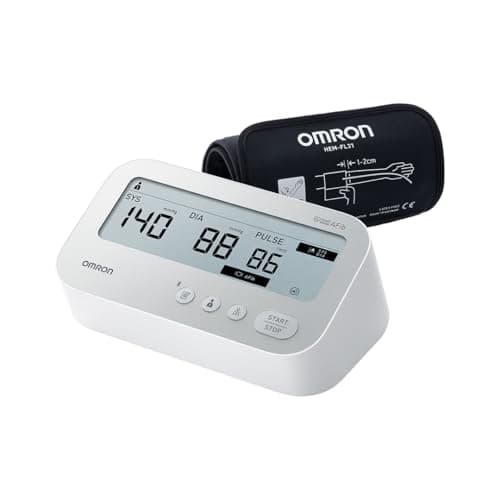
The X4 Connect sits neatly below the X7 and keeps the features that matter: clinically validated readings, AFib screening and Bluetooth sync to the OMRON connect app. You lose a little of the X7's cuff refinement and top-end polish, but for most people it delivers the same reassurance for meaningfully less money.
Key features:
- Clinically validated upper-arm blood pressure with AFib indicator
- Bluetooth sync to OMRON connect for history and shareable reports
- Irregular-heartbeat and body-movement detection for cleaner readings
- Simple one-button operation with a clear backlit display
Why we recommend it: It is the sweet spot in OMRON's connected range. AFib screening and app tracking at a mid-range price. If the X7 is more than you need but you still want heart-rhythm screening, this is the one.
Best for: Buyers who want AFib screening and app history without paying flagship money.
Around £73. Check price on Amazon UK →
4. OMRON X2+ Connect: Best Budget Smart Blood Pressure Monitor
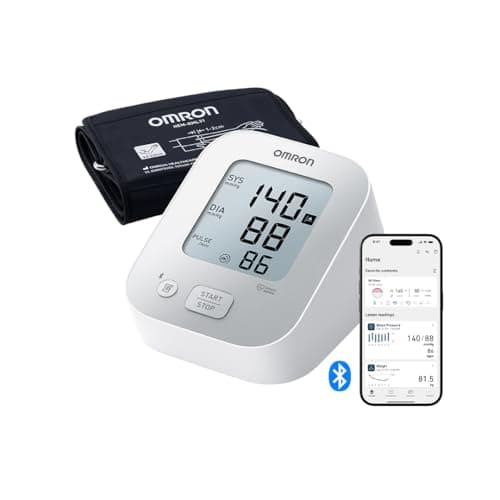
Not everyone needs AFib screening: sometimes you just want a dependable, clinically validated blood pressure reading that lands in an app so you can see the trend. The X2+ Connect does exactly that. It is OMRON's entry-level Bluetooth model, and it inherits the accuracy the brand is known for at a price that makes home monitoring an easy decision.
Key features:
- Clinically validated upper-arm blood pressure measurement
- Bluetooth sync to the OMRON connect app for automatic logging
- Irregular-heartbeat detection to flag readings worth repeating
- Straightforward one-button use with a large, clear display
Why we recommend it: It proves you do not have to spend a lot to monitor blood pressure properly. For a first home monitor, or a spare for a parent, the accuracy-to-price ratio is hard to beat.
Best for: First-time buyers and anyone who wants trustworthy readings and app history on a budget.
Around £34. Check price on Amazon UK →
5. KardiaMobile 1-Lead: Best Affordable Personal ECG
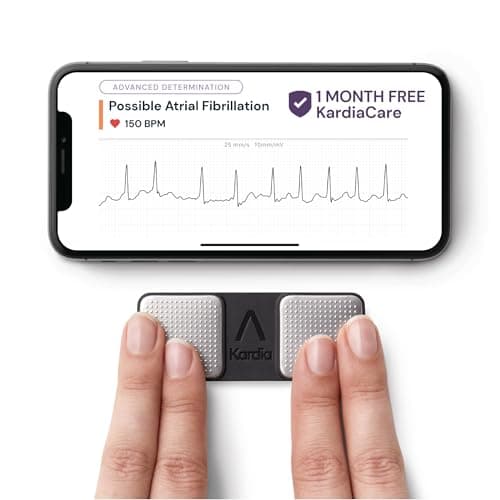
The KardiaMobile is the device that put a personal ECG in your pocket. Rest two fingers from each hand on its pads and, in 30 seconds, it records a single-lead ECG and tells you whether your rhythm looks normal or shows possible atrial fibrillation. It is the most established name in home ECG, CE-marked, and small enough to keep in a wallet or on the fridge.
Key features:
- Medical-grade single-lead ECG in 30 seconds, any time
- Instant analysis for normal rhythm or possible AFib
- Recordings save to the Kardia app as a PDF you can email your doctor
- No cuff, no wires: works with most modern phones
Why we recommend it: For anyone who has been told to "capture it when it happens", an on-demand ECG is invaluable, because palpitations rarely arrive during a GP appointment. It is the affordable, proven entry point to home ECG.
Best for: People who get occasional palpitations or have been asked to record their heart rhythm.
Around £89. Check price on Amazon UK →
6. KardiaMobile 6-Lead: Best Home ECG for Detailed Readings
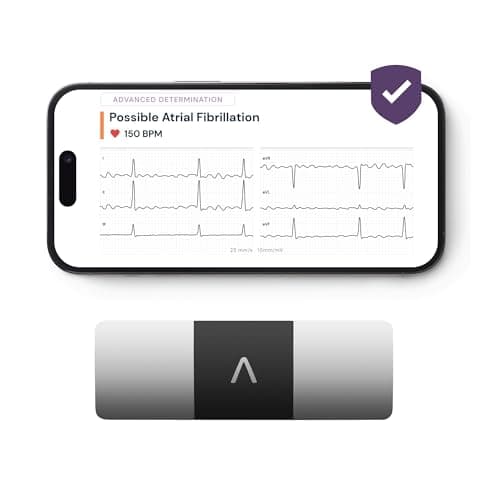
Where the standard KardiaMobile captures one lead, the 6-Lead version records six, giving a fuller view of the heart's electrical activity. You rest two fingers on the top pads and the base against your knee or ankle, and it captures leads I, II, III, aVL, aVR and aVF. That extra detail helps the Kardia app and your clinician distinguish more rhythm types than a single lead can.
Key features:
- Six-lead ECG for a more detailed rhythm recording
- Same 30-second capture and instant AFib analysis as the 1-Lead
- PDF reports through the Kardia app to share with your GP or cardiologist
- Pocket-sized and works without a cuff or wires
Why we recommend it: If your doctor wants richer ECG data, or you simply want the most capable at-home recorder short of a clinical machine, the 6-Lead is the step up. It is the choice for people actively managing a diagnosed rhythm condition.
Best for: Anyone who wants the most detailed personal ECG, or has been advised to capture multi-lead recordings.
Around £149. Check price on Amazon UK →
7. Beurer PO60: Best Smart Pulse Oximeter (Blood Oxygen)
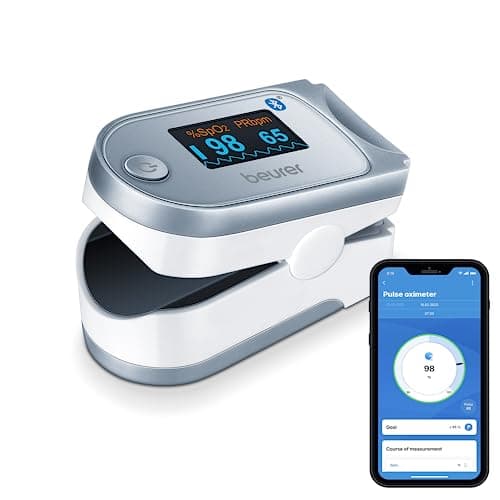
Blood oxygen (SpO2) became a metric everyone learned to care about, and the Beurer PO60 is a proper, well-made way to track it. Clip it on a fingertip and it reads your oxygen saturation and pulse rate in seconds on a clear rotating display, then syncs the results to Beurer's HealthManager app over Bluetooth so you can watch trends rather than chase single numbers.
Key features:
- Fingertip SpO2 and pulse-rate measurement in seconds
- Bluetooth sync to the Beurer HealthManager app for history and graphs
- Clear colour display that rotates to whichever way you are holding it
- Compact, battery-powered and travel-friendly, from a trusted German health brand
Why we recommend it: It adds a genuinely different vital sign to your home kit. For anyone with a respiratory condition, or who simply wants to keep an eye on oxygen levels during recovery or at altitude, a Bluetooth oximeter with app history beats the cheap display-only clips.
Best for: People monitoring a respiratory condition or recovery who want SpO2 trends, not just a one-off number.
Around £53. Check price on Amazon UK →
8. Withings Body Comp: Best Premium Body-Composition Scale
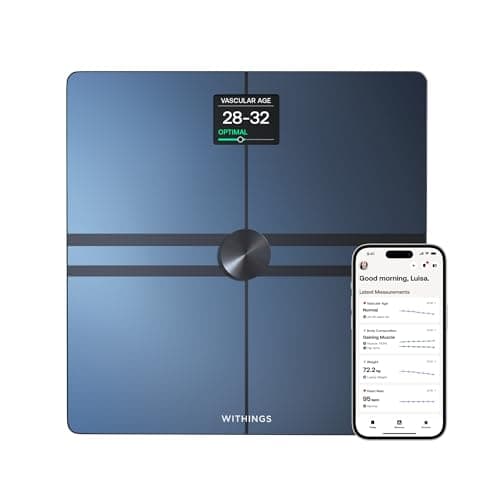
The Withings Body Comp is less a bathroom scale than a full-body analyser. Beyond weight and BMI it estimates body fat, muscle mass, water percentage, bone mass, visceral fat and even standing heart rate, then plots all of it in Health Mate. If you want the most complete picture of what is changing when your weight does, this is the scale.
Key features:
- Weight plus detailed body composition: fat, muscle, water, bone and visceral fat
- Standing heart-rate reading and clear colour on-scale display
- Wi-Fi and Bluetooth sync to Health Mate with automatic user recognition for up to eight people
- Trend graphs that make weekly changes easy to read at a glance
Why we recommend it: Weight alone rarely tells the whole story. This scale shows whether a change is fat, muscle or water. It is the premium pick for anyone serious about body composition, not just the number on the display.
Best for: Fitness-focused users and families who want granular body-composition data and multi-user tracking.
Around £189. Check price on Amazon UK →
9. Withings Body Smart: Best Mid-Range Smart Scale
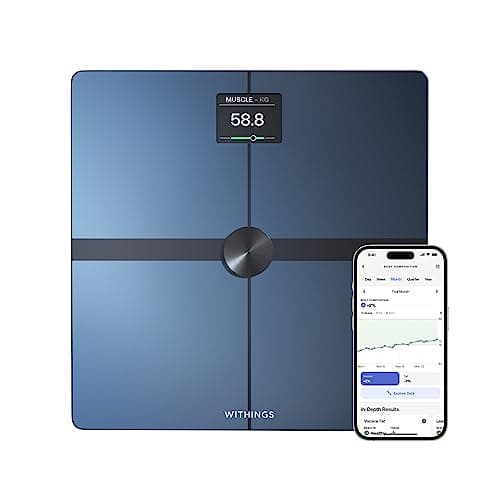
The Body Smart keeps most of what makes the Body Comp great (accurate weight, body fat, muscle and water percentage, and the excellent Health Mate app) for a lot less money. There is no visceral-fat or ECG-grade heart feature, but for the vast majority of people wanting to track weight and composition, it hits the sweet spot between capability and price.
Key features:
- Weight plus body fat, muscle mass and water percentage
- Wi-Fi and Bluetooth sync to Health Mate with automatic multi-user recognition
- Bright display with an "eyes closed" mode that hides your weight if you prefer to track by trend
- Compact, sturdy build with the same tidy app experience as the flagship
Why we recommend it: It gives you the polished Withings ecosystem and reliable body-composition tracking at a mid-range price. For most households this is the smart scale to buy.
Best for: Anyone who wants trustworthy body-composition tracking and a great app without paying flagship money.
Around £78. Check price on Amazon UK →
10. RENPHO Elis 1: Best Budget Smart Scale
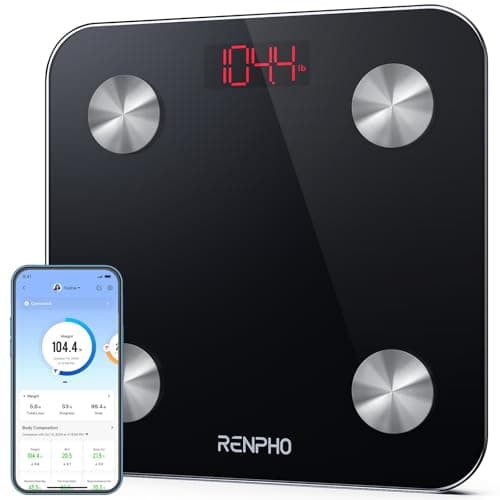
If you just want to dip a toe into smart tracking, the RENPHO Elis 1 is the one that has sold by the million for good reason. It pairs with the RENPHO app over Bluetooth and reports 13 body metrics: weight, BMI, body fat, muscle and more. The composition figures are estimates rather than clinical measurements, but for tracking your own trend over time at this price, it is remarkable value.
Key features:
- 13 body metrics including weight, BMI, body fat and muscle mass
- Bluetooth sync to the free RENPHO app, which plays nicely with Apple Health, Google Fit and Fitbit
- Unlimited users and a slim, tempered-glass design
- Auto-calibration and high-precision sensors for consistent day-to-day readings
Why we recommend it: It removes every excuse not to start tracking. Treat the composition numbers as trend indicators rather than gospel and it is genuinely useful, and at this price it is the easiest recommendation in the guide.
Best for: First-time buyers and anyone wanting app-connected weight tracking for the price of a takeaway.
Around £20. Check price on Amazon UK →
Buying Guide: How to Choose a Smart Health Monitor
Start with the metric that matters to you. If a clinician has asked you to watch your blood pressure, a validated BP monitor is the priority. If it is palpitations or a rhythm concern, a personal ECG earns its keep. If you are managing weight or training, a body-composition scale is the right first buy. Few people need all of them at once: pick the device that answers your actual question.
Insist on clinical validation for blood pressure. For BP specifically, accuracy is not a nice-to-have. Look for monitors that are clinically validated (OMRON and Withings both are across the models here) and use an upper-arm cuff rather than a wrist device, which is more sensitive to position. Take readings sitting, rested and at the same time of day for numbers you can compare.
Check the app and the ecosystem. A smart monitor is only as good as the app behind it. Withings Health Mate, OMRON connect, Kardia and RENPHO are all mature and export data you can share with a clinician. If you already live in Apple Health, Google Fit or Fitbit, confirm the device feeds into it so everything sits in one place.
Wi-Fi versus Bluetooth. Wi-Fi models (like the Withings scales and BPM Connect) sync on their own with no phone nearby: the most reliable way to build an unbroken history. Bluetooth models are cheaper and sync when your phone is in range, which is fine for most people who measure at home.
Mind the consumables and the caveats. ECG pads and oximeters need no strips, but some ECG apps offer optional paid tiers for extra analysis: the core reading is free. And remember body-fat percentages from any consumer scale are estimates affected by hydration; track the trend, not a single figure.
Buy for the household. Multi-user recognition (up to eight on the Withings scales, unlimited on RENPHO) matters if more than one person will use the device, so each person's data stays separate and private.
How we picked these
Every product here was checked against its live Amazon UK listing before publication: in stock, the listing matching the model we describe, and the price recorded at the time of writing. We read the manufacturer's own specifications for the figures quoted, and work through recent verified-purchase reviews looking for the same fault reported repeatedly rather than one-off complaints.
Picks are ordered by who each product actually suits: age, budget, and whether an app or subscription is involved. Not by commission. AIToys.co.uk earns from qualifying purchases through the links on this page; that does not affect the order. The full process, including what we don't do, is on our how we choose page.
Frequently Asked Questions
Are home blood pressure monitors accurate enough to trust? The clinically validated ones are. Every BP monitor in this guide (from OMRON and Withings) uses an upper-arm cuff and meets recognised validation standards, so readings are reliable when you follow the technique: sit rested with your back supported, arm at heart height, and take two or three readings a minute apart. Home monitoring is now actively encouraged by the NHS for many people, precisely because it avoids "white-coat" spikes at the surgery.
Can a personal ECG like KardiaMobile diagnose a heart condition? No, and neither device claims to. A KardiaMobile can record your heart rhythm and flag a possible atrial fibrillation, which is genuinely useful for capturing an event that would never show up in a short GP visit. But a diagnosis needs a clinician to interpret the recording (which is exactly why the app exports a shareable PDF). Think of it as evidence to bring to your doctor, not a replacement for one.
What is AFib screening and do I need it? Atrial fibrillation is an irregular heart rhythm that increases stroke risk and often causes no symptoms. Monitors like the OMRON X7 and X4 screen for it with every reading, and the KardiaMobile devices can record it directly. It is most worth having if you are over 65, have a family history of heart problems, or have been told your pulse is sometimes irregular. If you are young and healthy, a standard BP monitor is fine.
Are these smart scales' body-fat readings reliable? They use bioelectrical impedance, which sends a tiny, harmless current through your body to estimate composition. The absolute number can be a few points out and shifts with hydration, time of day and recent exercise. The trend, though, is genuinely informative: weigh yourself under the same conditions (first thing in the morning works well) and watch the direction of travel rather than obsessing over a single figure.
Do I need Wi-Fi at home for these to work? Only the Wi-Fi models need it for their headline feature. The Withings scales and BPM Connect sync over Wi-Fi with no phone present, which is the most seamless option. The Bluetooth devices (the OMRON X-series, KardiaMobile, Beurer oximeter and RENPHO scale) sync to your phone when it is nearby, so no home Wi-Fi is required.
Which one should I buy first? For most people, match the device to your main concern: the OMRON X7 Smart AFib is our overall pick for blood pressure and heart-rhythm peace of mind; the KardiaMobile 1-Lead is the best-value way to capture palpitations; and the Withings Body Smart is the smart scale to buy if weight and body composition are your focus. On the tightest budget, the OMRON X2+ Connect and RENPHO Elis 1 cover BP and weight for well under £60 combined.
The Verdict
Smart health monitors have earned their place on the bathroom shelf. The OMRON X7 Smart AFib is our top overall pick (clinically validated blood pressure plus AFib screening from the brand clinicians trust) while the Withings BPM Connect wins for sheer ease of use. For the heart, the KardiaMobile 1-Lead puts a proven personal ECG in your pocket for well under £100, and the 6-Lead goes further when you need it. On the scales, the Withings Body Comp is the most complete body analyser, the Body Smart is the value sweet spot, and the RENPHO Elis 1 makes smart tracking almost free. Add the Beurer PO60 if blood oxygen matters to you.
Whatever you choose, the point of these devices is not the gadget. It is the habit. A monitor that is easy enough to use every day, feeding a clean history you can share with your GP, is worth far more than a feature-packed one that ends up in a drawer. Every product here was confirmed in stock on Amazon UK at our latest update, but do double-check the live price and availability before you buy, as both can change. And remember: these tools inform conversations with your doctor: they never replace them.
Read next
Best Smart Rings UK 2026: 8 Top Picks Compared
Expert guide to the best smart rings in the UK for 2026. Compare Oura Ring 4, Samsung Galaxy Ring, RingConn Gen 2, Ultrahuman Ring AIR and budget options.
Best AI Smartwatches and Fitness Trackers UK 2026: 12 Top Picks Compared
Expert guide to the best AI smartwatches and fitness trackers in the UK for 2026. Compare 12 in-stock top picks from Apple, Garmin, Samsung, Fitbit
Samsung Galaxy Fit 3 Review UK 2026: Budget Brilliance or Missed Opportunity?
Samsung Galaxy Fit 3 review UK: A close look at Samsung's ultra-affordable fitness band. Large AMOLED display, long battery life, but where's the GPS?